
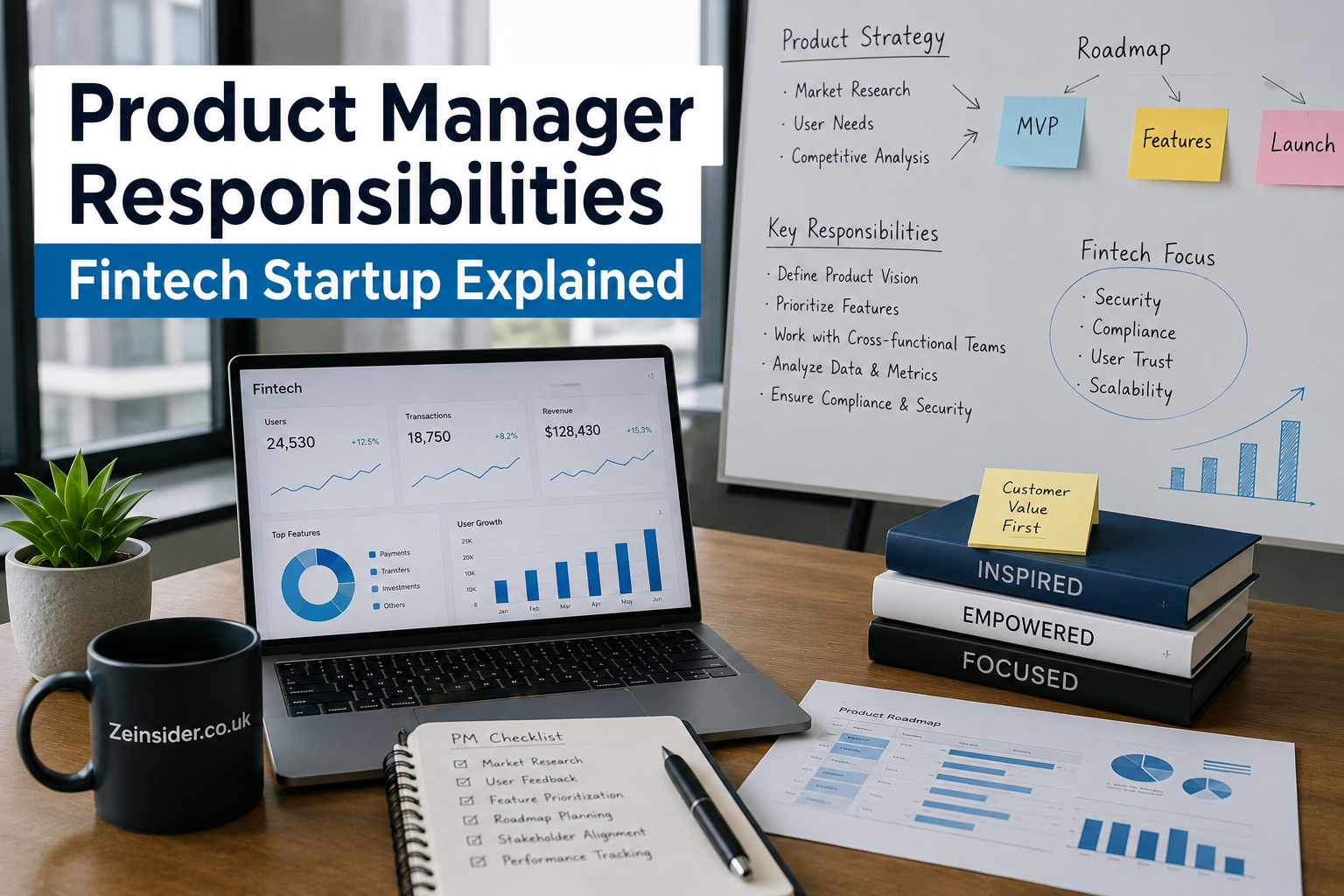
Understanding product manager responsibilities fintech startup is essential for anyone entering the rapidly growing financial technology industry. Unlike traditional software companies, fintech startups operate in highly regulated environments while competing against established financial institutions and innovative digital-first businesses. Product managers become the bridge between customer expectations, engineering teams, compliance experts, designers, executives, and business stakeholders. Every decision they make directly impacts user trust, regulatory compliance, customer satisfaction, and business growth. Because fintech products often handle sensitive financial information and real money, product managers must balance innovation with security and legal requirements. They also need to prioritize features that solve genuine customer problems instead of simply following industry trends. Modern fintech organizations rely on data-driven decision-making, continuous experimentation, and agile product development to remain competitive. This guide explains the most important product manager responsibilities fintech startup professionals handle during the early stages of product development while following Google’s Helpful Content and EEAT best practices.
Quick Answer
A product manager in a fintech startup is responsible for identifying customer problems, defining product strategy, prioritizing features, creating product roadmaps, coordinating engineering and design teams, ensuring regulatory compliance, monitoring product performance, and delivering secure financial products that meet both customer and business goals. Successful fintech product managers combine technical knowledge, business strategy, customer empathy, risk management, and agile leadership to build products that scale in competitive financial markets.
Understanding Product Manager Responsibilities Fintech Startup
The role of product manager responsibilities fintech startup goes far beyond writing feature requests or organizing sprint meetings. Product managers own the vision of the financial product from discovery through launch and continuous improvement. They spend significant time understanding customer pain points, studying competitors, analyzing market trends, and validating ideas before development begins. Since fintech startups usually operate with limited budgets and small teams, product managers must carefully prioritize every feature based on customer value and business impact. They communicate daily with developers, designers, compliance specialists, marketing professionals, executives, and customer support teams to ensure everyone shares the same product vision. Risk assessment also becomes an important responsibility because financial applications must maintain security, privacy, and regulatory compliance. Product managers regularly evaluate performance metrics such as customer acquisition, retention, transaction success rates, and feature adoption to guide future improvements. Their ability to align customer needs with business objectives often determines whether a fintech startup succeeds or struggles in a competitive market.
Fintech product management also requires understanding the unique characteristics of financial services. Customers expect fast, secure, transparent, and reliable experiences when managing their money. Product managers must consider fraud prevention, payment processing, digital identity verification, banking integrations, lending workflows, investment platforms, insurance technology, or cryptocurrency services depending on the startup’s niche. This makes product manager responsibilities fintech startup significantly broader than product management in many other industries. Strong communication skills, strategic thinking, analytical abilities, and customer-focused decision-making become essential for long-term success.
Why Product Managers Are Critical in Fintech Startups
Product managers play one of the most influential roles inside fintech startups because they connect technology with customer needs while supporting business growth. They continuously evaluate changing financial regulations, market competition, customer expectations, and emerging technologies. Their decisions influence product direction, development priorities, revenue opportunities, and customer satisfaction. Unlike enterprise organizations with multiple management layers, startup product managers frequently make rapid decisions while adapting to changing business conditions. They help founders validate product-market fit and ensure resources are invested in the highest-value initiatives. Every roadmap decision can affect funding opportunities, customer retention, and competitive positioning. As fintech continues expanding into digital banking, embedded finance, buy-now-pay-later services, wealth management, and payment technology, experienced product managers become even more valuable. Their leadership ensures innovation remains practical, scalable, and customer-focused.
Another important reason product managers are essential involves cross-functional coordination. Engineers focus on building reliable systems, designers prioritize usability, legal teams ensure compliance, while executives concentrate on business growth. The product manager unifies these perspectives into a single product vision. They eliminate confusion, clarify priorities, and maintain transparency across departments. This coordination reduces costly mistakes and helps startups deliver products faster without sacrificing quality or security.
Core Product Manager Responsibilities Fintech Startup
Building Product Vision and Strategy
One of the primary product manager responsibilities fintech startup professionals perform is defining a long-term product vision. Instead of building random features, they establish a strategic roadmap aligned with customer problems and business objectives. This vision provides direction for engineering teams, investors, marketing departments, and company leadership. Product managers study market opportunities, customer behavior, industry reports, and competitor products before defining strategic priorities. They evaluate which financial services offer the highest value while remaining technically feasible and commercially viable. Their roadmap balances immediate customer requests with long-term innovation initiatives. Strategy also includes identifying growth opportunities, improving user engagement, increasing revenue, and reducing customer churn. Without a clear product strategy, fintech startups often waste valuable resources developing features customers never use.
Strategic planning also requires flexibility because fintech markets evolve rapidly. Product managers continuously revise priorities based on customer feedback, regulatory updates, market competition, and business performance metrics. They use evidence instead of assumptions to guide product decisions while ensuring every roadmap item supports measurable business outcomes.
Understanding Customer Problems
Customer discovery remains one of the most valuable product manager responsibilities fintech startup teams depend on. Before launching any feature, product managers conduct customer interviews, surveys, usability testing, behavioral analysis, and market research. Their objective is understanding the real financial challenges users experience instead of assuming customer needs. This research helps eliminate unnecessary product features while identifying opportunities for meaningful innovation. Customer feedback also reveals usability issues, onboarding friction, payment failures, trust concerns, and support challenges. Product managers transform qualitative insights into actionable development priorities that improve customer experiences. They collaborate closely with customer support teams to identify recurring issues affecting satisfaction. Every successful fintech product begins with a deep understanding of user needs rather than technical capabilities alone.
Continuous customer research doesn’t stop after product launch. Product managers regularly monitor feature adoption, retention metrics, customer reviews, and behavioral analytics to identify improvement opportunities. This iterative approach supports continuous product optimization while maintaining alignment with changing customer expectations.
Creating and Managing the Product Roadmap
A product roadmap serves as the strategic blueprint for product development. One of the most visible product manager responsibilities fintech startup professionals perform involves prioritizing initiatives based on customer value, technical complexity, business impact, and available resources. Rather than scheduling every requested feature, they evaluate opportunities using structured prioritization frameworks. Roadmaps communicate upcoming priorities to engineering teams, executives, investors, designers, marketing departments, and customer support representatives. Product managers continuously revise roadmaps based on customer feedback, competitive analysis, regulatory changes, and performance data. This flexibility allows startups to respond quickly to market changes without losing strategic focus. Effective roadmaps also improve transparency and reduce misunderstandings across cross-functional teams. Successful product managers understand that a roadmap represents strategic direction rather than a rigid development schedule.
Roadmap planning requires balancing short-term wins with long-term product innovation. Quick improvements increase customer satisfaction, while larger initiatives create sustainable competitive advantages. Product managers carefully manage these competing priorities to maximize both immediate value and future growth.
Working with Cross-Functional Teams
Collaborating with Engineering Teams
Engineering collaboration represents one of the most important product manager responsibilities fintech startup organizations expect. Product managers translate customer requirements into detailed product specifications that developers can implement efficiently. They clarify business objectives, prioritize backlog items, answer technical questions, and remove blockers throughout development. Rather than dictating technical solutions, experienced product managers encourage engineering teams to recommend the best implementation approaches. This collaborative relationship improves innovation while maintaining realistic delivery expectations. Product managers also participate in sprint planning, backlog refinement, release planning, and product reviews. They ensure engineering efforts remain aligned with customer value instead of focusing solely on technical complexity. Strong communication between engineering and product teams significantly improves delivery speed and software quality.
Healthy engineering relationships also promote continuous improvement. Product managers encourage feedback, discuss technical constraints openly, and adapt priorities when unexpected challenges arise. This collaborative environment increases trust while supporting long-term product success.
Partnering with UX and Product Designers
Design collaboration is another essential aspect of product manager responsibilities fintech startup teams rely upon. Financial products must simplify complex banking, investment, lending, insurance, or payment processes without overwhelming users. Product managers work closely with UX researchers and designers to create intuitive customer experiences supported by usability testing and behavioral analytics. They review prototypes, gather customer feedback, validate workflows, and prioritize accessibility improvements before development begins. Good design reduces customer confusion, decreases support requests, and increases user confidence when handling financial transactions. Product managers ensure every design decision aligns with customer goals, regulatory requirements, and business objectives. They also encourage iterative design improvements based on measurable user behavior instead of subjective opinions. This partnership creates financial products that customers trust and enjoy using.
Design thinking encourages experimentation and continuous learning throughout product development. Product managers help transform customer insights into practical design solutions that improve both usability and business performance.
Compliance and Risk Awareness in Fintech Product Management

Unlike many software industries, fintech requires product managers to understand regulatory environments from the beginning of product development. Financial products frequently involve identity verification, anti-money laundering procedures, fraud detection, payment security, privacy protection, and financial reporting requirements. Product managers collaborate closely with compliance specialists and legal teams to ensure product features satisfy applicable regulations before launch. Ignoring compliance can result in financial penalties, customer distrust, operational disruptions, and reputational damage. Product managers therefore include compliance considerations during planning instead of treating them as final review activities. They also monitor changing regulations that may require future product updates. This proactive approach reduces business risk while protecting customers and maintaining operational stability. Regulatory awareness has become one of the defining characteristics of successful product manager responsibilities fintech startup professionals.
Risk management extends beyond regulatory compliance. Product managers also evaluate operational risks, cybersecurity concerns, fraud prevention strategies, vendor dependencies, infrastructure reliability, and customer trust factors. By addressing these issues early, fintech startups build stronger foundations for sustainable growth.
Using Data Analytics to Drive Product Decisions
Data plays a central role in modern product manager responsibilities fintech startup environments because every feature, workflow, and customer interaction generates valuable insights. Product managers rely on quantitative and qualitative data to understand customer behavior instead of making decisions based on assumptions. They monitor key performance indicators (KPIs) such as customer acquisition cost, monthly active users, retention rate, churn rate, transaction success rate, feature adoption, lifetime value, and conversion rates. By analyzing these metrics, product managers identify which features create value and which require optimization or removal. Data also helps prioritize roadmap items by highlighting customer pain points and business opportunities. In fintech, analytics become even more important because small improvements in payment success rates or onboarding completion can significantly increase revenue and customer satisfaction. Product managers work closely with data analysts and business intelligence teams to interpret trends and transform findings into actionable product improvements. A culture of continuous measurement ensures that every product decision contributes to sustainable business growth.
Analytics also support experimentation. Product managers frequently conduct A/B testing to compare different user experiences, pricing models, onboarding flows, or feature designs before rolling them out to all customers. They establish success criteria in advance and evaluate results objectively using statistically meaningful data. This disciplined approach minimizes risk while encouraging innovation. Instead of relying solely on intuition, successful fintech product managers combine customer empathy with measurable evidence. As startups scale, data-driven product management becomes a significant competitive advantage that supports faster decision-making and better resource allocation.
Managing Product Backlogs and Agile Development
Prioritizing Features Effectively
Backlog management is among the daily product manager responsibilities fintech startup professionals perform to keep development teams focused on delivering maximum value. Product managers continuously review customer requests, bug reports, compliance requirements, technical debt, and new feature ideas before assigning priorities. They often use prioritization frameworks such as RICE, MoSCoW, Kano, or Value vs. Effort analysis to make objective decisions. Every backlog item should align with business objectives, customer needs, and measurable outcomes. Fintech startups cannot build everything at once, making disciplined prioritization essential for efficient resource utilization. Product managers communicate the reasoning behind each priority so stakeholders understand why certain features move forward while others wait. They also revisit backlog priorities regularly because customer expectations and market conditions change rapidly. A well-maintained backlog enables engineering teams to work efficiently while supporting continuous product delivery.
Effective prioritization also requires balancing innovation with maintenance. New features attract customers, but fixing usability issues, improving security, and enhancing performance often generate greater long-term value. Product managers evaluate both short-term customer demands and long-term strategic goals when refining the backlog. This balanced approach helps fintech startups deliver consistent improvements without sacrificing product quality or operational stability.
Leading Agile Product Development
Agile methodologies have become the preferred approach for fintech startups because they support rapid iteration and continuous learning. Product managers participate in sprint planning, backlog refinement, daily stand-ups, sprint reviews, and retrospectives to ensure product development remains aligned with business priorities. They define user stories with clear acceptance criteria, helping developers understand expected outcomes while maintaining flexibility in implementation. Throughout each sprint, product managers answer questions, clarify requirements, and adjust priorities when new information becomes available. Agile practices also encourage frequent product releases, allowing startups to collect customer feedback earlier and improve products more quickly. Rather than waiting months for large software releases, fintech teams deliver incremental improvements that reduce risk and accelerate innovation. Product managers monitor sprint outcomes to ensure each release contributes meaningful customer value. Agile leadership enables startups to remain responsive in competitive financial markets where customer expectations evolve rapidly.
Continuous collaboration is another benefit of agile development. Designers, developers, testers, compliance specialists, and product managers work together throughout the product lifecycle rather than operating in isolated departments. This collaborative environment improves communication, reduces misunderstandings, and increases product quality. Product managers facilitate these interactions while maintaining focus on customer outcomes and strategic objectives.
Essential Skills Every Fintech Product Manager Needs
Business and Strategic Thinking
Business strategy forms the foundation of effective product manager responsibilities fintech startup roles. Product managers must understand revenue models, market positioning, competitive differentiation, customer acquisition strategies, and long-term business objectives. Every product decision should contribute to measurable business growth while improving customer experiences. Strategic thinking allows product managers to identify emerging opportunities before competitors and adapt quickly to industry changes. They regularly evaluate market trends such as embedded finance, digital wallets, open banking, artificial intelligence, blockchain technology, and financial automation. Strong business knowledge also helps product managers communicate effectively with executives and investors by connecting product initiatives to financial outcomes. This strategic perspective ensures product development supports both customer satisfaction and organizational success. Fintech startups especially benefit from leaders who can balance innovation with commercial viability.
Technical Understanding
Although product managers are not expected to write production code, technical knowledge greatly enhances collaboration with engineering teams. Understanding APIs, cloud infrastructure, cybersecurity principles, databases, payment gateways, authentication methods, and software architecture enables product managers to make informed decisions. Technical literacy improves communication, reduces misunderstandings, and supports realistic project planning. Product managers who understand development constraints can prioritize features more effectively and identify potential implementation risks earlier. In fintech, technical awareness also includes understanding encryption, transaction processing, fraud detection systems, and third-party integrations. This knowledge helps product managers bridge the gap between business objectives and engineering execution. Continuous learning remains essential because financial technology evolves rapidly. Technical confidence strengthens credibility while supporting more effective cross-functional leadership.
Leadership and Communication
Leadership extends beyond managing tasks or timelines. Successful product managers inspire collaboration, resolve conflicts, communicate product vision, and build trust across departments. Since fintech startups often operate with lean teams, product managers influence without formal authority by aligning stakeholders around shared objectives. Clear communication ensures engineering teams understand customer problems while executives remain informed about product progress and strategic priorities. Product managers also facilitate difficult conversations involving trade-offs, resource limitations, and changing priorities. Strong presentation skills help secure stakeholder support for roadmap initiatives and investment decisions. Empathy plays an equally important role by encouraging productive collaboration among diverse teams. Effective communication remains one of the defining characteristics of exceptional fintech product managers.
Product Manager Responsibilities Fintech Startup Compared with Traditional Companies
| Responsibility | Fintech Startup | Traditional Enterprise |
|---|---|---|
| Decision Making | Fast, iterative, data-driven | Structured, multi-layer approval |
| Customer Feedback | Continuous and immediate | Periodic research cycles |
| Compliance | Integrated into every phase | Often handled by dedicated departments |
| Product Roadmap | Frequently updated | Longer planning cycles |
| Team Structure | Small cross-functional teams | Larger specialized departments |
| Innovation Speed | High | Moderate |
| Risk Management | Daily operational focus | Formal governance processes |
| Customer Research | Ongoing interviews and analytics | Scheduled research initiatives |
| Product Releases | Frequent agile deployments | Larger scheduled releases |
| Ownership | Broad end-to-end responsibility | More specialized responsibilities |
Common Challenges Fintech Product Managers Face
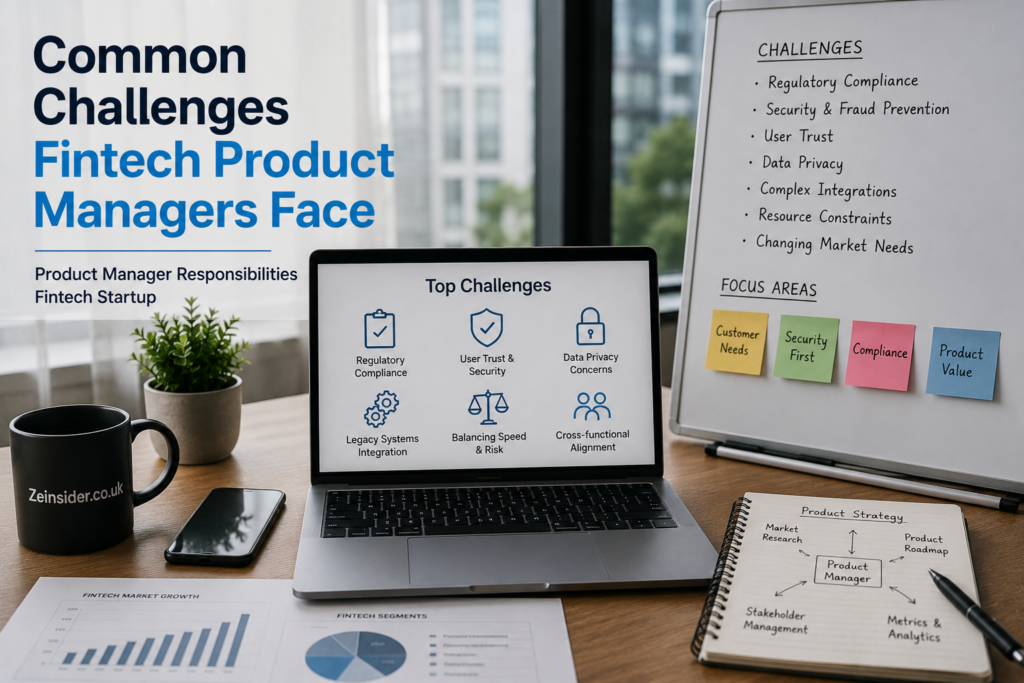
Product managers in fintech startups encounter challenges that extend beyond standard software development. Regulatory requirements change frequently, requiring continuous collaboration with compliance and legal teams. Customer expectations continue rising as users compare fintech applications with leading consumer technology platforms. Product managers must balance rapid innovation with the security and reliability expected from financial services. Resource limitations often require difficult prioritization decisions because startups cannot pursue every promising opportunity simultaneously. Technical debt can accumulate quickly if development focuses exclusively on speed without maintaining architecture quality. Competition from established banks and emerging fintech companies increases pressure to deliver differentiated customer experiences. Product managers also manage stakeholder expectations while ensuring product decisions remain customer-centric and evidence-based. Successfully navigating these challenges requires resilience, adaptability, and continuous learning.
Market uncertainty introduces additional complexity. Economic conditions, regulatory updates, cybersecurity threats, and changing consumer behavior can significantly influence product strategy. Product managers remain flexible by monitoring industry developments and adjusting roadmaps based on reliable data. This adaptability allows fintech startups to remain competitive while maintaining customer trust.
Best Practices for Product Manager Responsibilities Fintech Startup
- Develop a customer-first mindset before prioritizing new features.
- Base roadmap decisions on measurable data rather than assumptions.
- Collaborate closely with engineering, design, compliance, and customer support teams.
- Validate product ideas through customer interviews before development.
- Continuously monitor KPIs and customer behavior after every release.
- Prioritize security and regulatory compliance from the earliest planning stages.
- Keep product documentation accurate and accessible for cross-functional teams.
- Encourage experimentation through controlled A/B testing and iterative improvements.
- Maintain transparent communication with executives and stakeholders.
- Invest in continuous learning about financial technology trends and regulations.
Common Mistakes to Avoid
- Building features without validating customer demand.
- Ignoring compliance requirements until the end of development.
- Prioritizing stakeholder opinions over customer evidence.
- Creating overly complex product roadmaps.
- Measuring success using vanity metrics instead of meaningful KPIs.
- Failing to communicate changing priorities across teams.
- Neglecting technical debt while pursuing rapid feature delivery.
- Overlooking user experience during financial transaction design.
- Avoiding customer interviews after product launch.
- Treating product management as project management instead of strategic leadership.
Pro Tips for Success
- Spend time with customer support teams to understand recurring issues firsthand.
- Review product analytics weekly to identify emerging opportunities.
- Learn the fundamentals of financial regulations relevant to your product.
- Build strong relationships with engineering leaders through open communication.
- Use prioritization frameworks consistently to reduce subjective decision-making.
- Keep roadmap objectives outcome-focused rather than feature-focused.
- Study competitors regularly but avoid copying their products without validation.
- Balance innovation with operational reliability to maintain customer trust.
- Continuously improve onboarding experiences because first impressions strongly influence retention.
- Develop excellent storytelling skills to communicate product vision effectively.
Conclusion
Understanding product manager responsibilities fintech startup is essential for building financial products that deliver meaningful value to customers while supporting sustainable business growth. Product managers serve as the strategic connection between customer needs, engineering execution, business objectives, compliance requirements, and market opportunities. Their responsibilities extend from product discovery and roadmap planning to agile development, analytics, customer research, cross-functional leadership, and continuous optimization. In the highly competitive fintech industry, success depends on balancing innovation with security, regulatory compliance, and exceptional user experiences. Organizations that empower skilled product managers are better positioned to adapt quickly, respond to customer feedback, and maintain long-term competitiveness. As financial technology continues evolving through artificial intelligence, embedded finance, automation, and digital banking innovations, product managers will play an even more influential role in shaping the future of financial services. By combining strategic thinking, technical understanding, customer empathy, and data-driven decision-making, fintech product managers create products that customers trust and businesses rely on. Mastering these responsibilities prepares professionals to lead successful products in one of the world’s fastest-growing technology sectors.
Frequently Asked Questions
1. What does a product manager do in a fintech startup?
A fintech product manager defines product strategy, prioritizes features, conducts customer research, collaborates with engineering teams, ensures regulatory compliance, and drives product improvements using customer feedback and analytics.
2. Why are product managers important in fintech?
They align customer needs with business goals while ensuring financial products remain secure, compliant, user-friendly, and commercially successful.
3. Do fintech product managers need technical skills?
Yes. Although coding is not mandatory, understanding software architecture, APIs, payment systems, cloud technologies, and cybersecurity greatly improves collaboration and decision-making.
4. Which KPIs should fintech product managers monitor?
Important metrics include customer retention, churn rate, feature adoption, transaction success rate, monthly active users, customer acquisition cost, lifetime value, and conversion rates.
5. What industries hire fintech product managers?
Digital banking, payment processing, insurance technology, wealth management, lending platforms, cryptocurrency companies, embedded finance providers, and financial SaaS organizations.
6. What is the biggest challenge for fintech product managers?
Balancing rapid innovation with regulatory compliance, cybersecurity, customer trust, and limited startup resources.
7. Which agile methodologies are commonly used in fintech startups?
Most fintech startups use Scrum, Kanban, or hybrid agile frameworks combined with continuous integration and continuous deployment practices.
8. How do fintech product managers prioritize features?
They analyze customer feedback, business value, implementation effort, compliance requirements, strategic alignment, and measurable outcomes using prioritization frameworks.
9. What soft skills are essential for fintech product managers?
Leadership, communication, negotiation, problem-solving, stakeholder management, adaptability, empathy, and strategic thinking are all critical.
10. Can someone transition into fintech product management from another industry?
Yes. Professionals with experience in product management, software development, finance, business analysis, or UX research can transition successfully by learning fintech regulations and financial technologies.
Author Bio
About the Author
The author is an experienced SEO content writer and technology researcher specializing in fintech, SaaS, software development, digital transformation, and product management. With extensive experience creating EEAT-focused, search-optimized content, the author produces practical, research-backed articles that simplify complex technical concepts for business leaders, startups, and technology professionals while following Google’s Helpful Content best practices.