
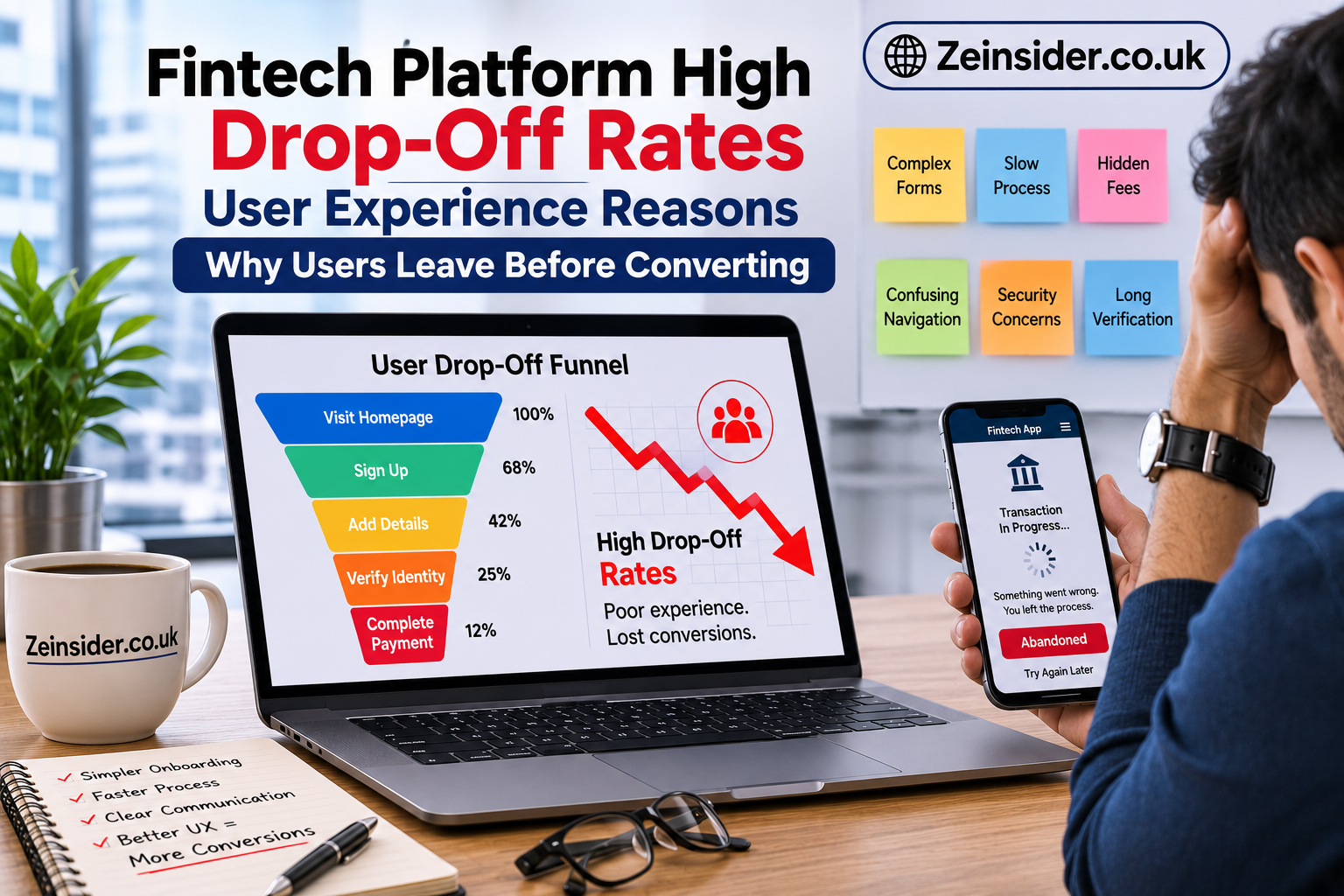
The fintech platform high drop-off rates user experience reasons have become one of the biggest concerns for financial technology companies competing in today’s digital economy. Every abandoned signup, incomplete verification, or failed payment journey represents a lost opportunity and increased customer acquisition costs. While many fintech businesses invest heavily in marketing campaigns, they often overlook the importance of delivering a seamless digital experience after users arrive. Customers expect banking, investing, lending, and payment applications to work quickly, securely, and without confusion. Even minor usability issues can create frustration that causes users to abandon the platform before completing their intended action. Understanding the fintech platform high drop-off rates user experience reasons allows organizations to identify friction points, improve customer satisfaction, and increase long-term retention. This guide explores the first half of the most important user experience challenges affecting modern fintech platforms and explains why solving them should be a strategic priority.
Quick Answer
The most common fintech platform high drop-off rates user experience reasons include complicated onboarding, lengthy identity verification, confusing navigation, slow application performance, lack of trust signals, poor mobile optimization, inconsistent interfaces, unclear calls-to-action, security concerns, and excessive form requirements. Improving user experience through simplified workflows, transparent communication, intuitive design, and faster performance significantly reduces abandonment rates while increasing customer engagement, satisfaction, and conversion rates.
Understanding Fintech Platform High Drop-Off Rates User Experience Reasons
The fintech platform high drop-off rates user experience reasons extend far beyond attractive interface design. User experience represents every interaction customers have with a financial application, from the first website visit to completing transactions and managing accounts over time. When users encounter friction during these interactions, they often lose confidence in the platform and leave before completing important actions. Unlike entertainment or retail applications, fintech platforms deal with sensitive financial information, making trust and usability equally important. Customers expect every page to load quickly, every process to be understandable, and every security feature to inspire confidence without creating unnecessary complexity. A poor experience creates uncertainty, and uncertainty is especially damaging in financial services where people are sharing personal information and money. Companies that recognize these fintech platform high drop-off rates user experience reasons can prioritize improvements that directly influence customer retention and business growth. Understanding user behavior through analytics, customer feedback, and usability testing helps identify the most problematic areas before they become expensive conversion obstacles.
Modern fintech users also compare every platform against leading digital experiences from technology giants. Expectations continue to rise as consumers become accustomed to fast applications, personalized recommendations, and intuitive navigation. If a fintech application feels outdated or difficult to use, customers quickly explore alternative providers. This makes user experience one of the strongest competitive advantages available to financial technology companies. Organizations that consistently monitor the fintech platform high drop-off rates user experience reasons are more likely to improve customer lifetime value while reducing acquisition costs. Better usability encourages repeat visits, stronger customer loyalty, and increased trust in financial products. Instead of viewing user experience as a design project, successful fintech companies treat it as an ongoing business strategy supported by continuous optimization.
Why User Experience Matters More in Financial Technology
Financial decisions involve higher emotional and financial risk than many other online activities. Whether users are opening digital bank accounts, applying for loans, investing money, or making international transfers, they expect complete confidence throughout the process. A confusing interface immediately raises concerns about security, reliability, and professionalism. This explains why fintech platform high drop-off rates user experience reasons frequently relate to trust rather than aesthetics alone. Every unnecessary click or unclear instruction creates additional cognitive effort, making users question whether they should continue.
Strong user experience also influences customer perceptions of brand credibility. Financial institutions traditionally earned trust through physical branches and personal interactions, but digital fintech companies must establish that trust entirely through online experiences. Professional layouts, consistent branding, clear messaging, transparent pricing, and responsive customer support all contribute to user confidence. When customers understand every step of a financial process, they are far more likely to complete onboarding and continue using the platform. Addressing the fintech platform high drop-off rates user experience reasons therefore improves both customer satisfaction and business performance simultaneously.
Complicated Onboarding Processes Drive Early Abandonment
Too Many Steps Create Immediate Frustration
One of the most common fintech platform high drop-off rates user experience reasons is an unnecessarily complicated onboarding journey. Many fintech companies request extensive information before users experience any value from the platform. Customers may be required to complete multiple forms, upload documents, verify identities, create security settings, and review lengthy disclosures before reaching their dashboard. While many of these requirements are necessary for regulatory compliance, poor workflow design makes the experience feel overwhelming. Users often begin the registration process with enthusiasm but gradually lose motivation as additional requirements appear. Every extra screen increases the likelihood of abandonment. Simplifying information requests and organizing them into logical stages helps maintain momentum throughout onboarding. Progressive disclosure techniques also reduce cognitive overload by presenting only the information needed at each step.
Companies should continuously analyze user behavior throughout onboarding to identify where abandonment occurs most frequently. Heatmaps, session recordings, funnel analytics, and customer interviews provide valuable insights into the fintech platform high drop-off rates user experience reasons affecting registration completion. Improvements should focus on reducing unnecessary friction while maintaining regulatory compliance. Clear progress indicators, estimated completion times, and helpful explanations encourage users to continue. Organizations that optimize onboarding often see significant improvements in activation rates without changing their marketing strategies.
Common Onboarding Pain Points
| User Experience Issue | Customer Impact | Business Result |
|---|---|---|
| Long registration forms | Increased frustration | Higher abandonment |
| Too many verification steps | Reduced motivation | Lower conversion |
| Confusing instructions | User uncertainty | More support requests |
| Missing progress indicators | Anxiety | Session abandonment |
| Technical validation errors | Loss of confidence | Failed registrations |
Identity Verification Delays Reduce User Confidence
Identity verification remains essential for fraud prevention and regulatory compliance, yet it also contributes significantly to the fintech platform high drop-off rates user experience reasons. Customers understand the need for Know Your Customer (KYC) requirements, but they expect the process to be efficient and clearly explained. Delayed document reviews, repeated photo uploads, unclear rejection messages, and technical verification failures create unnecessary frustration. Many users abandon applications because they believe something has gone wrong rather than understanding the verification timeline. Transparent communication greatly improves customer patience during these mandatory security procedures.
Fintech platforms should clearly explain why each verification step exists and provide estimated processing times whenever possible. Automatic document scanning, AI-assisted identity verification, and real-time progress updates help reduce uncertainty. If additional information is required, the platform should communicate specific reasons instead of generic error messages. Addressing these fintech platform high drop-off rates user experience reasons requires balancing compliance with convenience. Customers appreciate security measures when they understand their purpose and experience minimal disruption during completion.
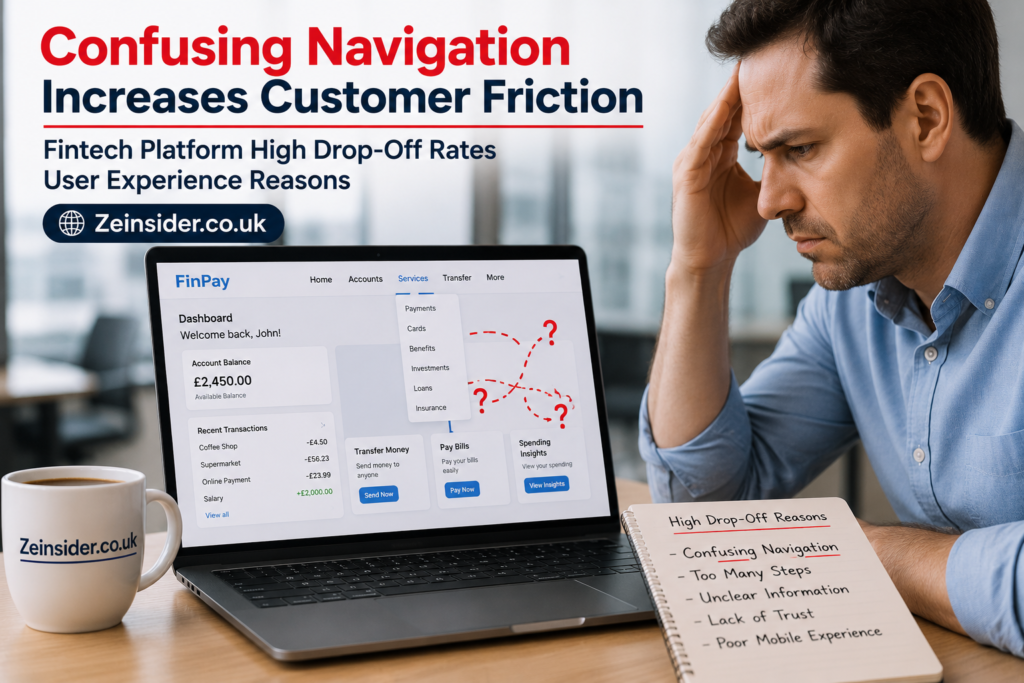
Confusing Navigation Increases Customer Friction
Users Should Never Wonder Where to Click Next
Navigation problems consistently appear among the leading fintech platform high drop-off rates user experience reasons because customers expect intuitive digital experiences. Financial applications often contain numerous products, dashboards, reports, payment options, and account settings. Without logical organization, users become overwhelmed and struggle to locate important features. Confusing menu structures, inconsistent labels, hidden navigation elements, and cluttered interfaces increase mental effort while reducing confidence. Users who cannot easily find information frequently abandon their sessions rather than contacting support.
Clear information architecture allows customers to complete tasks efficiently without unnecessary searching. Consistent navigation patterns reduce learning time while improving customer satisfaction. Search functionality, contextual guidance, and simplified dashboards further enhance usability. Organizations should regularly conduct usability testing with real users to identify confusing workflows contributing to the fintech platform high drop-off rates user experience reasons. Small navigation improvements often generate measurable increases in engagement because customers complete desired actions more efficiently.
Slow Performance and Loading Times Hurt Conversion Rates
Application speed directly influences user satisfaction across every digital industry, but it carries even greater importance in financial technology. Customers expect transactions, account balances, and payment confirmations to appear almost instantly. Slow-loading dashboards, delayed authentication, frozen interfaces, and lengthy processing screens increase anxiety because users worry about financial errors. These technical issues rank among the most damaging fintech platform high drop-off rates user experience reasons because customers interpret poor performance as unreliable service.
Performance optimization requires collaboration between designers, developers, infrastructure engineers, and quality assurance teams. Efficient databases, optimized APIs, content delivery networks, image compression, caching strategies, and scalable cloud infrastructure all contribute to faster user experiences. Regular performance monitoring ensures problems are detected before affecting large customer segments. When fintech applications consistently deliver fast and reliable interactions, users develop greater trust in the platform and are less likely to abandon important financial processes.
Poor Mobile Optimization Increases Fintech Platform High Drop-Off Rates User Experience Reasons
Mobile devices have become the primary way many consumers interact with financial services, making mobile usability one of the most significant fintech platform high drop-off rates user experience reasons. Users expect to open accounts, transfer money, apply for loans, and monitor investments with the same ease they experience in leading consumer apps. When buttons are difficult to tap, forms are not optimized for smaller screens, or important information requires excessive scrolling, customers quickly become frustrated. Mobile users are also more likely to be multitasking, which means they have less patience for unnecessary complexity. Slow responsiveness, poor touch interactions, and inconsistent layouts increase abandonment throughout the customer journey. Fintech companies should design for mobile-first experiences rather than adapting desktop interfaces after development. Responsive layouts, optimized typography, and simplified workflows create smoother interactions across all devices. Continuous testing on different operating systems and screen sizes helps identify usability issues before they affect customers. Addressing these fintech platform high drop-off rates user experience reasons significantly improves engagement, conversion rates, and long-term customer loyalty.
Customers also judge a fintech company’s credibility by the quality of its mobile experience. A polished application communicates professionalism, while glitches and layout problems reduce confidence in the platform’s ability to protect financial information. Mobile accessibility should include readable text, high-contrast elements, intuitive gestures, and support for assistive technologies. Push notifications should provide value without overwhelming users, and biometric authentication should simplify secure access whenever possible. Offline handling, graceful error recovery, and efficient battery usage further contribute to a positive customer experience. Organizations that prioritize mobile optimization often see improvements in both customer satisfaction and retention. As smartphone usage continues to grow, reducing these fintech platform high drop-off rates user experience reasons becomes increasingly important for sustainable business growth.
Lack of Trust Signals Discourages Customer Engagement
Trust is the foundation of every successful financial relationship, making weak credibility indicators one of the leading fintech platform high drop-off rates user experience reasons. Users share sensitive personal and financial information, so they naturally evaluate whether a platform appears secure before proceeding. Missing security badges, unclear privacy policies, inconsistent branding, outdated visual design, and vague company information all contribute to hesitation. Even if the underlying security is excellent, customers may leave if the interface fails to communicate professionalism. Transparent communication regarding encryption, regulatory compliance, and data protection helps reduce uncertainty throughout the customer journey. Testimonials, verified reviews, and recognizable partnerships also strengthen credibility. Every interaction should reinforce the perception that the company values both security and customer success. These improvements reduce anxiety and encourage users to continue their financial activities with confidence.
Building Confidence Throughout the Customer Journey
Trust should not be established only during account creation; it must be reinforced continuously. Clear transaction confirmations, transparent pricing, accessible customer support, and consistent messaging all strengthen long-term confidence. Users appreciate knowing exactly what happens after submitting information or initiating payments. Regular updates, proactive communication, and helpful educational content demonstrate that the organization values transparency. Trust grows when expectations consistently match actual experiences. By addressing these fintech platform high drop-off rates user experience reasons, fintech companies create stronger customer relationships and reduce abandonment across multiple stages of the user lifecycle. Continuous investment in credibility ultimately improves retention, referrals, and brand reputation.
Trust Elements That Improve User Retention
| Trust Signal | Customer Benefit | Impact on Drop-Off |
|---|---|---|
| Security certifications | Greater confidence | Lower abandonment |
| Transparent pricing | Better expectations | Higher conversions |
| Verified customer reviews | Social proof | Increased trust |
| Live customer support | Faster issue resolution | Improved retention |
| Clear privacy policies | Data confidence | Reduced hesitation |
Unclear Calls-to-Action Create Decision Fatigue
Another major contributor to fintech platform high drop-off rates user experience reasons is the absence of clear and consistent calls-to-action throughout the platform. Users should immediately understand what action to take next without searching through crowded interfaces. When multiple buttons compete for attention or important actions are hidden, customers become uncertain and postpone decisions. Financial applications often contain complex products, making clarity even more important than visual creativity. Action buttons should use concise language, consistent placement, and contrasting colors that naturally guide user attention. Supporting text should explain outcomes before customers commit to important financial decisions. Reducing ambiguity minimizes hesitation and creates smoother user journeys.
Clear calls-to-action also support accessibility by making navigation predictable for all users. Consistency across registration, verification, payments, investments, and account management improves familiarity over time. A well-designed interface anticipates user needs and removes unnecessary decision points. Organizations should test different layouts, wording, and button placements through controlled experiments to identify the highest-performing experiences. Small improvements frequently generate measurable increases in completion rates. Eliminating these fintech platform high drop-off rates user experience reasons enables customers to achieve their goals with greater confidence and less effort.
Poor Error Handling and Limited Feedback Frustrate Users
Customers expect digital platforms to communicate clearly whenever something goes wrong. Generic error messages, unexplained failures, or missing confirmation screens are common fintech platform high drop-off rates user experience reasons because they leave users uncertain about what happened. Financial transactions involve high levels of trust, so ambiguity increases anxiety. Instead of displaying technical codes or vague notifications, applications should explain the issue in simple language while offering practical next steps. Helpful guidance reduces frustration and prevents unnecessary customer support requests. Immediate validation of form inputs also minimizes repeated mistakes during registration and payment processes.
Effective feedback extends beyond error handling. Success confirmations, progress indicators, loading animations, and transaction receipts reassure customers that their actions have been completed correctly. Timely notifications create transparency while reducing uncertainty during longer processes such as identity verification or loan approval. Customers are more forgiving of unavoidable delays when the platform communicates proactively. Continuous refinement of messaging helps organizations eliminate many fintech platform high drop-off rates user experience reasons before they significantly impact conversion performance.
Personalization Improves Engagement and Reduces Drop-Off
Modern customers expect fintech platforms to recognize their preferences and provide relevant experiences. Personalized dashboards, product recommendations, educational resources, and financial insights increase perceived value while reducing unnecessary complexity. Generic interfaces force every customer through identical experiences regardless of their goals. Personalization helps prioritize the most relevant actions, making navigation simpler and more meaningful. Machine learning and behavioral analytics allow platforms to tailor recommendations responsibly without overwhelming users. Effective personalization should always remain transparent and respect customer privacy. These improvements directly address several fintech platform high drop-off rates user experience reasons by making interactions feel more intuitive and valuable.
However, personalization should never become intrusive. Customers should maintain control over preferences, communication settings, and recommended products. Relevant suggestions improve satisfaction only when they genuinely support user objectives. Excessive notifications or aggressive cross-selling can have the opposite effect by creating additional friction. Organizations should balance automation with customer choice to maximize long-term engagement. Continuous testing ensures personalization strategies remain helpful rather than distracting. Solving these fintech platform high drop-off rates user experience reasons strengthens both customer trust and platform adoption.
Comparison of Strong vs Weak User Experience
| User Experience Area | Strong UX | Weak UX |
|---|---|---|
| Onboarding | Simple and guided | Long and confusing |
| Navigation | Intuitive and organized | Complex and cluttered |
| Mobile Experience | Fully responsive | Difficult to use |
| Security Communication | Transparent and reassuring | Unclear and inconsistent |
| Performance | Fast and reliable | Slow and unstable |
| Error Messages | Helpful and actionable | Generic and confusing |
| Personalization | Relevant and useful | Generic experience |
| Customer Support | Easy to access | Difficult to find |
Best Practices for Reducing Fintech Platform High Drop-Off Rates User Experience Reasons
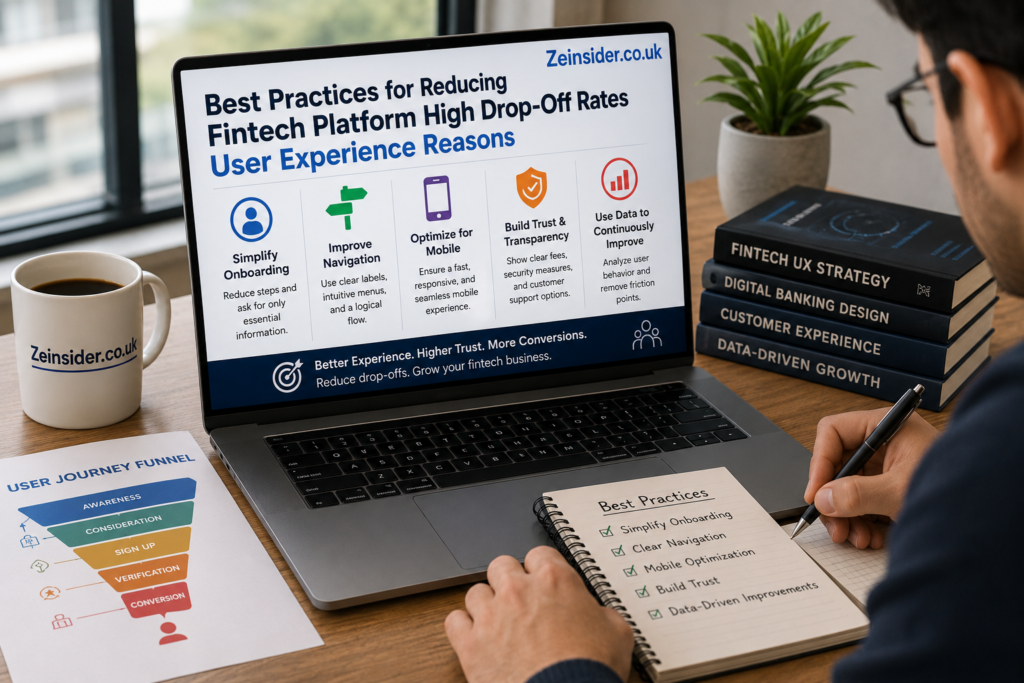
- Design every workflow with the customer journey in mind.
- Keep onboarding as short and intuitive as compliance allows.
- Optimize every screen for mobile-first usability.
- Continuously monitor analytics to identify abandonment points.
- Use plain language instead of technical financial terminology whenever possible.
- Build trust through transparency, security messaging, and responsive support.
- Test interfaces regularly with real users instead of relying on assumptions.
- Improve platform speed through ongoing performance optimization.
- Personalize experiences without compromising user privacy.
- Continuously refine the product using customer feedback and usability testing.
Common Mistakes That Increase User Drop-Off
- Asking for unnecessary information during registration.
- Overloading dashboards with excessive features.
- Ignoring mobile usability testing.
- Displaying unclear validation or error messages.
- Using inconsistent navigation across different sections.
- Failing to communicate processing times.
- Neglecting accessibility requirements.
- Prioritizing visual design over usability.
- Offering too many choices at critical decision points.
- Ignoring customer feedback after product launches.
Pro Tips for Improving Fintech User Experience
- Map the complete customer journey before redesigning interfaces.
- Review funnel analytics weekly to detect emerging friction points.
- Conduct usability sessions with first-time users regularly.
- Reduce clicks required to complete high-value actions.
- Explain security measures in simple, reassuring language.
- Introduce progressive onboarding instead of lengthy initial registration.
- Use A/B testing to validate every major design change.
- Combine quantitative analytics with qualitative customer interviews.
- Keep interface consistency across web and mobile platforms.
- Treat user experience as an ongoing optimization process rather than a one-time project.
Conclusion
The fintech platform high drop-off rates user experience reasons are rarely caused by a single problem. Instead, they result from multiple friction points that gradually reduce customer confidence throughout the digital journey. From complicated onboarding and slow performance to confusing navigation, weak trust signals, poor mobile optimization, and ineffective communication, every interaction shapes how users perceive a fintech brand. Organizations that prioritize customer-centered design consistently outperform competitors because they make financial tasks simpler, faster, and more trustworthy. Continuous usability testing, behavioral analytics, customer feedback, and iterative improvements allow businesses to identify emerging challenges before they significantly impact conversions. Investing in intuitive experiences not only reduces abandonment but also strengthens customer loyalty, increases lifetime value, and enhances brand reputation. As digital financial services continue to evolve, companies that proactively address the fintech platform high drop-off rates user experience reasons will be better positioned to attract, retain, and satisfy modern consumers in an increasingly competitive marketplace.
Frequently Asked Questions
1. What are the primary fintech platform high drop-off rates user experience reasons?
The most common reasons include complicated onboarding, poor navigation, slow loading times, weak trust signals, confusing interfaces, and difficult identity verification processes.
2. Why is user experience important in fintech?
User experience directly affects customer trust, conversion rates, retention, satisfaction, and long-term business growth because financial services require high levels of confidence.
3. How does mobile optimization reduce user abandonment?
A responsive, fast, and intuitive mobile experience allows users to complete financial tasks easily, reducing frustration and increasing engagement.
4. Can better onboarding improve conversion rates?
Yes. Simplified onboarding minimizes friction, helping more users complete registration and begin using financial services successfully.
5. How do trust signals influence customer behavior?
Visible security measures, transparent policies, verified reviews, and professional design reassure customers that their financial information is protected.
6. What role does personalization play in fintech user experience?
Relevant recommendations and customized dashboards make the platform more valuable while simplifying navigation and improving engagement.
7. How can fintech companies identify drop-off points?
Analytics tools, funnel reports, heatmaps, usability testing, customer interviews, and session recordings help identify areas where users abandon the platform.
8. Why are clear error messages important?
Helpful error messages explain problems, reduce confusion, and guide users toward successful completion instead of causing abandonment.
9. How often should fintech platforms review their user experience?
User experience should be reviewed continuously through regular testing, analytics monitoring, customer feedback, and iterative product improvements.
10. Does improving user experience increase customer retention?
Yes. Better usability creates smoother interactions, builds trust, encourages repeat usage, and significantly reduces customer churn.
Author Bio
fintech content strategist and digital experience researcher specializing in financial technology, customer behavior, UX optimization, and digital transformation. She writes evidence-based content focused on helping organizations improve customer engagement, strengthen trust, optimize conversion funnels, and deliver user-centered financial experiences while following Google’s EEAT and Helpful Content best practices.