

The financial technology industry across Europe has entered a new era where collaboration is becoming more valuable than competition. Instead of working independently, banks, fintech startups, regulators, investors, and innovation hubs are creating stronger partnerships that encourage faster product development and wider financial inclusion. One phrase attracting increasing attention in this evolving landscape is european innovation bridge leads fintech banks introductions. It represents more than a networking opportunity—it reflects an organized approach to connecting innovative financial technology companies with established banking institutions across European markets. These introductions help reduce barriers that previously slowed innovation while creating trusted relationships that support long-term business growth. As digital banking continues to expand, financial institutions are actively searching for reliable fintech partners capable of improving customer experiences, payment systems, lending technologies, fraud prevention, and compliance solutions. Understanding how european innovation bridge leads fintech banks introductions work has become increasingly important for startups, investors, banking executives, regulators, and technology providers seeking success within Europe’s rapidly changing financial ecosystem.
Quick Answer
European innovation bridge leads fintech banks introductions refers to structured initiatives that connect fintech companies with traditional banks across Europe. These innovation bridges encourage collaboration, simplify market entry, improve regulatory understanding, promote cross-border innovation, attract investment opportunities, and accelerate the adoption of digital financial technologies. By creating trusted introductions between banks and fintech firms, innovation bridges help both sectors develop secure, customer-focused financial products while strengthening Europe’s digital economy.
Understanding European Innovation Bridge Leads Fintech Banks Introductions
The phrase european innovation bridge leads fintech banks introductions describes collaborative frameworks that encourage communication between financial institutions and technology innovators throughout Europe. Rather than relying on random networking events or cold outreach, innovation bridges create organized opportunities where banks meet carefully selected fintech companies with complementary solutions. These programs often involve innovation centers, government-backed organizations, financial regulators, banking associations, accelerator programs, venture capital firms, and technology ecosystems. Their shared objective is reducing the distance between established financial organizations and emerging technology companies capable of transforming banking services. The process usually includes introductions, mentoring, pilot projects, regulatory guidance, investor meetings, and strategic partnerships that allow both parties to evaluate long-term collaboration. Banks gain access to cutting-edge financial technologies, while fintech startups receive credibility, market access, operational expertise, and potential enterprise customers. Because trust remains essential within financial services, these structured introductions provide a safer environment than informal networking. As more countries prioritize financial innovation, european innovation bridge leads fintech banks introductions continues becoming a recognized model for sustainable fintech growth.
Innovation bridges also support Europe’s broader digital transformation strategy by encouraging responsible innovation within highly regulated financial environments. Financial institutions must balance technological advancement with cybersecurity, customer protection, privacy regulations, and operational resilience. Fintech startups often possess innovative solutions but lack the regulatory knowledge required for large-scale implementation. Through european innovation bridge leads fintec’h banks introductions, experienced banking professionals guide startups while regulators clarify compliance expectations before commercial deployment. These relationships reduce development risks, shorten partnership timelines, and improve confidence among investors. Many innovation bridge initiatives also encourage knowledge sharing through workshops, demonstration events, proof-of-concept programs, and collaborative research. The result is an ecosystem where innovation becomes practical instead of theoretical. Businesses entering European financial markets increasingly recognize european innovation bridge leads fintech banks introductions as an effective pathway toward meaningful partnerships and scalable commercial success.
Why Innovation Bridges Matter in Europe’s Financial Ecosystem
Europe’s financial services landscape consists of diverse banking systems, regulatory environments, languages, and customer expectations. While this diversity encourages innovation, it can also make expansion difficult for fintech companies. European innovation bridge leads fintech banks introductions addresses these challenges by creating structured collaboration opportunities that reduce complexity and accelerate market access. Innovation bridges encourage communication between organizations that might otherwise never establish productive relationships. Instead of spending years building credibility independently, fintech firms gain opportunities to demonstrate technology directly to banking decision-makers. Financial institutions benefit by discovering emerging technologies capable of improving customer experiences, reducing operational costs, strengthening compliance procedures, and expanding digital services. These introductions create mutual value because each participant contributes unique expertise. Innovation bridges therefore become strategic infrastructure supporting Europe’s long-term financial competitiveness.
Another important reason european innovation bridge leads fintech banks introductions matters involves improving innovation efficiency across borders. European banks increasingly compete not only with local institutions but also with global digital banks and financial technology platforms. Maintaining competitiveness requires continuous innovation supported by trusted technology partners. Innovation bridges simplify this process by identifying qualified fintech companies with proven solutions before formal partnership discussions begin. They also encourage transparency regarding regulatory expectations, cybersecurity requirements, technical integration, and customer protection standards. This collaborative approach reduces misunderstandings during early negotiations while improving project success rates. As digital payments, embedded finance, artificial intelligence, blockchain, open banking, and financial automation continue expanding, european innovation bridge leads fintech banks introductions serves as an essential foundation supporting responsible financial innovation throughout Europe.
The Key Participants Behind European Innovation Bridges
Traditional Banks
Banks remain central participants in european innovation bridg’e leads fintech banks introductions because they provide financial infrastructure, regulatory expertise, customer trust, and operational scale. Although many financial institutions maintain internal innovation teams, external fintech partnerships often deliver specialized technologies more efficiently. Banks seek startups capable of improving payment systems, fraud detection, customer onboarding, digital identity verification, wealth management, lending automation, and data analytics. Through structured innovation bridge programs, banking executives evaluate emerging technologies before making significant investments or integration decisions. These introductions help banks remain competitive without independently developing every technological solution. As customer expectations continue evolving toward personalized digital experiences, banks increasingly recognize fintech collaboration as a strategic necessity rather than an optional initiative.
Banks also contribute valuable mentoring during european innovation bridge leads fintech banks introductions by sharing industry knowledge that startups may lack. Regulatory compliance, operational resilience, enterprise procurement, cybersecurity frameworks, and risk management represent complex challenges within financial services. Experienced banking professionals help fintech founders understand enterprise expectations before commercial deployment begins. These collaborative relationships improve partnership quality while reducing implementation delays. Banks further benefit from startup agility, allowing them to experiment with innovative technologies through pilot programs before full-scale adoption. This balanced exchange creates long-term value for both organizations while strengthening Europe’s financial innovation ecosystem.
Fintech Startups
Fintech companies represent the innovation engine behind european innovation bridge leads fintech banks introductions. These organizations develop technologies designed to simplify financial services, improve operational efficiency, enhance security, and create better customer experiences. Many specialize in artificial intelligence, digital payments, open banking, blockchain infrastructure, lending platforms, financial analytics, cybersecurity, embedded finance, or regulatory technology. Innovation bridges provide these startups with opportunities to demonstrate solutions directly to banking executives actively seeking technological improvements. Instead of competing solely for investor attention, startups gain access to enterprise customers capable of accelerating commercial growth. This structured approach significantly increases partnership potential compared to traditional business development strategies.
Early-stage fintech companies also benefit from credibility established through recognized innovation bridge initiatives. Large financial institutions typically prefer working with organizations that demonstrate regulatory awareness, technical maturity, and long-term sustainability. European innovation bridge leads fintech banks introductions helps startups showcase these qualities while receiving expert feedback before commercial deployment. Participation often results in pilot projects, investment opportunities, accelerator placements, strategic partnerships, and expanded industry recognition. These advantages support sustainable growth while strengthening Europe’s position as a global fintech innovation leader.
Regulators and Government Organizations
Regulatory authorities play an essential role in european innovation bridge leads fintech banks introductions because financial innovation must remain safe, transparent, and compliant with existing legal frameworks. Rather than slowing innovation, many European regulators actively encourage responsible experimentation through innovation hubs, regulatory sandboxes, and collaborative engagement programs. Their involvement helps fintech companies understand licensing requirements, consumer protection obligations, anti-money laundering standards, cybersecurity expectations, and operational resilience requirements before launching new services. Early regulatory guidance reduces uncertainty while encouraging responsible innovation across financial markets.
Government-supported innovation initiatives also encourage cross-border cooperation among European financial ecosystems. Through european innovation bridge lead’s fintech banks introductions, policymakers aim to strengthen digital competitiveness, encourage investment, attract international talent, and improve financial inclusion across member states. Collaborative regulatory engagement reduces friction between innovation and compliance, allowing promising financial technologies to reach customers more efficiently. As Europe’s digital finance strategy continues evolving, regulators increasingly view innovation bridges as valuable mechanisms supporting sustainable economic growth.
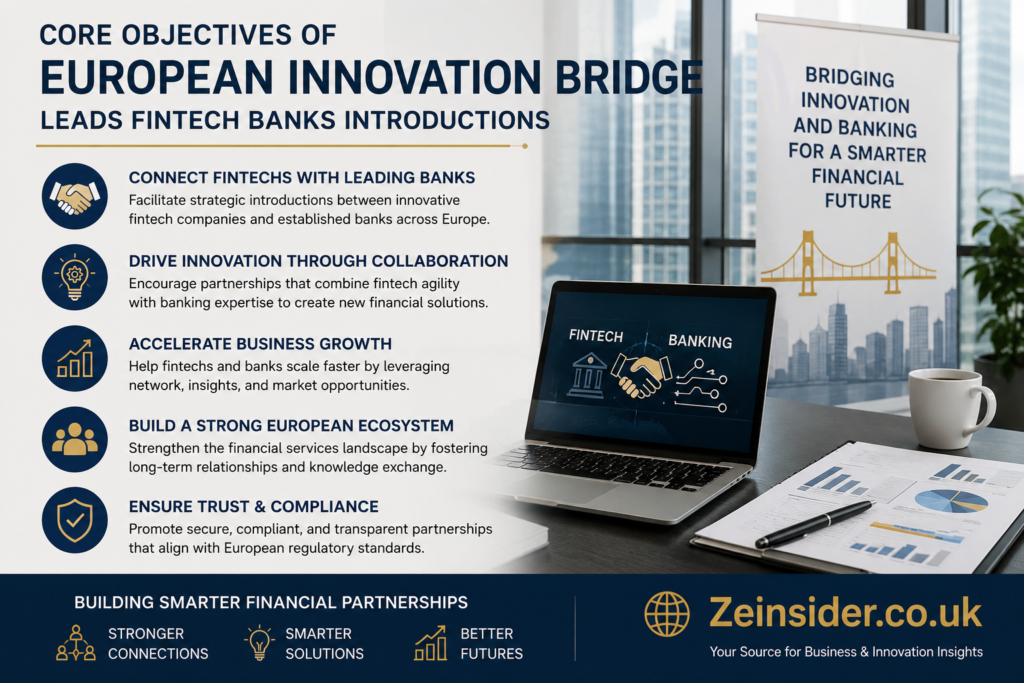
Core Objectives of European Innovation Bridge Leads Fintech Banks Introductions
Accelerating Digital Banking Innovation
One primary objective of european innovation bridge leads fintech banks introductions is accelerating digital transformation throughout the banking industry. Customer expectations continue shifting toward mobile-first financial experiences, instant payments, personalized financial insights, automated lending decisions, and secure digital identity verification. Meeting these expectations requires banks to adopt innovative technologies faster than traditional development cycles typically allow. Innovation bridges connect financial institutions with specialized fintech providers already developing advanced solutions capable of addressing these challenges. This collaborative model shortens innovation timelines while improving implementation quality.
Banks participating in european innovation bridge leads fintech banks introductions often identify technologies that improve operational efficiency without requiring complete infrastructure replacement. Instead of rebuilding entire banking platforms, institutions integrate targeted fintech solutions that complement existing systems. This modular approach reduces project risks while accelerating customer value delivery. Innovation bridges therefore become practical mechanisms supporting continuous banking modernization across European financial markets.
Encouraging Cross-Border Collaboration
Europe consists of numerous financial markets with unique regulatory environments and customer preferences. European innovation bridge lead’s fintech banks introductions encourages collaboration beyond national borders by connecting organizations capable of sharing expertise, technologies, and market insights. Fintech startups gain opportunities to expand internationally through banking partnerships, while financial institutions discover innovations developed in neighboring European countries. These introductions reduce duplication of effort while encouraging knowledge exchange across diverse financial ecosystems.
Cross-border collaboration also strengthens Europe’s competitive position within the global fintech industry. Rather than limiting innovation to individual countries, european innovation bridge leads fintech banks introductions encourages scalable partnerships capable of serving multiple markets simultaneously. Shared innovation creates stronger technology ecosystems, attracts international investment, and encourages continuous improvement throughout Europe’s digital financial sector.
How European Innovation Bridge Leads Fintech Banks Introductions Create Successful Partnerships
The success of european innovation bridge leads fintech banks introductions depends on a structured collaboration process rather than informal networking alone. Innovation bridge organizations typically evaluate fintech companies before introducing them to financial institutions, ensuring that startups possess mature technology, clear business models, regulatory awareness, and scalable infrastructure. This screening process saves banks valuable time because they meet businesses that have already demonstrated a certain level of readiness. Initial introductions are usually followed by workshops, technical demonstrations, and strategic discussions where both parties identify opportunities for collaboration. Banks assess whether a fintech solution aligns with their digital transformation goals, while startups evaluate whether the institution provides suitable market access and long-term partnership potential. Transparent communication during these early stages reduces misunderstandings regarding compliance, security expectations, and technical integration. The structured nature of european innovation bridge leads fintech banks introductions encourages confidence between both organizations before commercial agreements are signed. Ultimately, these carefully managed relationships lead to higher-quality partnerships and better outcomes for customers across Europe’s financial ecosystem.
Strong partnerships also rely on shared objectives rather than one-sided expectations. Banks seek innovation that improves operational efficiency, customer satisfaction, regulatory compliance, and competitive positioning, while fintech companies aim for commercial growth, credibility, and enterprise-scale adoption. Innovation bridge facilitators help both sides establish realistic expectations before pilot projects begin. They encourage measurable performance indicators, governance frameworks, regular communication, and clearly defined project milestones. This collaborative planning reduces project delays and strengthens long-term trust. As more institutions adopt open banking principles and digital-first strategies, european innovation bridge leads fintech banks introductions becomes increasingly valuable for building sustainable innovation partnerships. Instead of treating fintech companies as vendors, many banks now view them as strategic innovation partners. This evolution reflects the growing maturity of Europe’s collaborative financial ecosystem.
Typical Partnership Journey
Discovery and Qualification
The first stage of european innovation bridge leads fintech banks introductions focuses on identifying organizations with complementary objectives. Innovation hubs evaluate fintech capabilities, regulatory readiness, cybersecurity practices, customer demand, and scalability before recommending them to financial institutions. This qualification process ensures that both parties enter discussions with realistic expectations and compatible business goals. Banks appreciate receiving carefully vetted opportunities rather than reviewing hundreds of unsolicited proposals. Startups likewise benefit from meeting institutions genuinely interested in their technology. Early compatibility significantly improves the probability of successful collaboration. It also reduces unnecessary negotiations that rarely produce meaningful results. By emphasizing quality over quantity, innovation bridges create stronger foundations for future partnerships.
Pilot Programs and Commercial Deployment
Following successful introductions, many organizations begin with limited pilot programs instead of immediate enterprise-wide implementation. Pilot initiatives allow banks to test fintech solutions under controlled conditions while measuring performance, security, compliance, customer feedback, and operational efficiency. These small-scale deployments minimize financial risk and provide valuable insights before broader adoption. Fintech companies receive practical feedback that helps refine products according to enterprise requirements. Innovation bridge facilitators often continue supporting communication throughout the pilot phase, ensuring both organizations remain aligned. Successful pilots frequently evolve into long-term strategic partnerships, commercial licensing agreements, or even investment opportunities. This measured approach explains why european innovation bridge leads fintech banks introductions consistently delivers sustainable collaboration rather than short-lived business relationships.
Benefits of European Innovation Bridge Leads Fintech Banks Introductions
The advantages of european innovation bridge leads fintech banks introductions extend well beyond simple networking. For financial institutions, these initiatives provide access to emerging technologies that improve customer experience, automate operations, strengthen fraud prevention, and accelerate digital transformation. Banks can identify innovative solutions much earlier than through conventional procurement processes, giving them a competitive advantage within increasingly digital financial markets. Fintech startups gain direct exposure to enterprise customers, industry experts, investors, and regulatory guidance that would otherwise require years to develop independently. Investors benefit because innovation bridges create greater transparency regarding startup quality and commercial readiness. Customers ultimately experience more secure, efficient, and personalized financial services resulting from successful collaboration. Governments also benefit through increased economic growth, job creation, and international investment. The broad impact of european innovation bridge leads fintech bank’s introductions demonstrates why collaborative innovation has become central to Europe’s financial strategy.
Another major advantage involves reducing uncertainty throughout the innovation process. Financial services remain heavily regulated, making compliance an essential component of product development. Innovation bridges encourage early engagement with regulators, reducing the likelihood of costly redesigns later. Banks also gain confidence that recommended fintech companies understand enterprise governance, operational resilience, and customer protection standards. Structured collaboration reduces duplication of effort while improving resource allocation for all participants. Cross-border introductions further expand commercial opportunities across multiple European markets, enabling startups to scale more efficiently. These collective benefits strengthen Europe’s reputation as one of the world’s leading fintech innovation regions. As digital finance continues evolving, european innovation bridge leads fintech banks introductions will likely remain a cornerstone of responsible financial innovation.
Challenges Facing European Innovation Bridge Leads Fintech Banks Introductions
Despite numerous advantages, european innovation bridge leads fintech banks introductions is not without challenges. Banks often operate with legacy infrastructure that can complicate integration with modern fintech platforms. Enterprise procurement procedures may also require lengthy approval processes, slowing partnership development despite strong initial interest. Startups, meanwhile, frequently underestimate the complexity of enterprise security standards, regulatory documentation, and operational resilience requirements. Cultural differences between agile startup environments and established financial institutions can create communication challenges if expectations are not carefully managed. Innovation bridges help address these issues, but successful collaboration still requires patience, flexibility, and mutual commitment. Regulatory differences between European jurisdictions may further complicate cross-border expansion. Nevertheless, organizations that proactively prepare for these challenges significantly improve their partnership outcomes. The continued success of european innovation bridge leads fintech banks introductions depends on balancing innovation with practical implementation.
Cybersecurity also remains an ongoing concern. Financial institutions must protect sensitive customer information while complying with increasingly sophisticated regulatory requirements. Any fintech solution introduced through innovation bridges must demonstrate strong security controls before enterprise deployment. Continuous monitoring, penetration testing, secure software development, and governance reviews become essential throughout collaboration. Innovation bridge programs increasingly include cybersecurity specialists who evaluate technical readiness before introductions occur. This additional oversight strengthens trust among participating organizations while protecting customer interests. By proactively addressing technological and operational risks, european innovation bridge leads fintech bank’s introductions continues evolving into an increasingly mature and reliable collaboration model.
Future Trends Shaping European Innovation Bridge Leads Fintech Banks Introductions
Emerging technologies will significantly influence how european innovation bridge leads fintech bank’s introductions evolves over the coming years. Artificial intelligence will continue improving fraud detection, customer service automation, personalized financial advice, and operational efficiency. Open banking initiatives will encourage greater data sharing between authorized financial providers, creating new partnership opportunities for fintech innovators. Embedded finance will allow non-financial businesses to integrate banking services directly into customer experiences, increasing demand for collaborative technology providers. Blockchain infrastructure may further improve payment transparency, digital identity management, and cross-border settlement efficiency. Sustainability initiatives will also encourage financial products supporting environmental, social, and governance objectives. These technological developments will require closer collaboration between banks and fintech companies than ever before. Innovation bridges will remain essential facilitators connecting organizations capable of delivering these next-generation financial services.
Cross-border regulatory cooperation is expected to strengthen alongside technological advancement. European policymakers increasingly recognize that innovation thrives when regulatory clarity supports responsible experimentation. Innovation bridge initiatives will likely expand their educational programs, investor engagement, accelerator partnerships, and international collaboration opportunities. Financial institutions will continue shifting from isolated innovation toward ecosystem-based collaboration involving startups, universities, technology providers, and government organizations. Customers will benefit through faster product innovation, improved financial accessibility, stronger cybersecurity, and more personalized digital banking experiences. As financial ecosystems become increasingly interconnected, european innovation bridge leads fintech banks introduction’s will continue serving as an important catalyst for sustainable growth throughout Europe’s digital economy.
Comparison Table: Traditional Banking Partnerships vs Innovation Bridge Introductions
| Feature | Traditional Partnership Approach | European Innovation Bridge Leads Fintech Banks Introductions |
|---|---|---|
| Initial Contact | Cold outreach | Structured introductions |
| Startup Screening | Limited | Comprehensive evaluation |
| Regulatory Support | Usually independent | Often included |
| Collaboration Speed | Slower | Faster |
| Trust Building | Takes longer | Facilitated early |
| Pilot Opportunities | Less common | Frequently encouraged |
| Cross-Border Access | Limited | Strong support |
| Investor Exposure | Separate process | Often integrated |
| Mentorship | Minimal | Extensive |
| Long-Term Success Rate | Variable | Generally stronger |
Best Practices for European Innovation Bridge Leads Fintech Banks Introductions
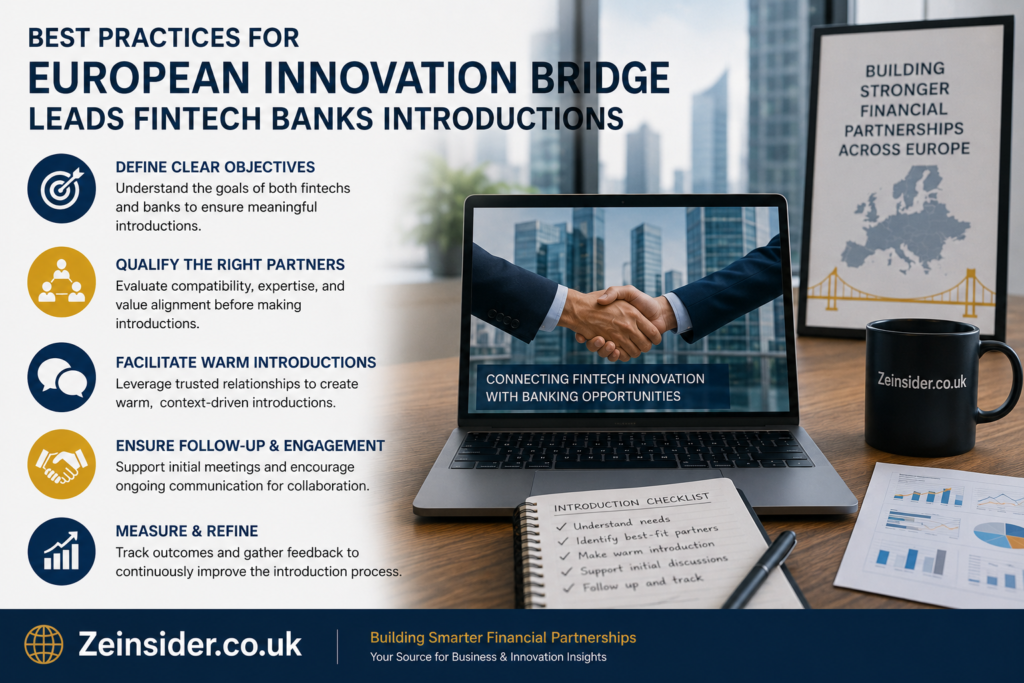
- Prepare regulatory documentation before approaching banking partners.
- Build scalable technology capable of enterprise deployment.
- Prioritize cybersecurity from the earliest development stages.
- Clearly communicate business value instead of focusing only on technical features.
- Participate actively in innovation hubs, accelerators, and fintech events.
- Develop measurable pilot objectives before implementation.
- Maintain transparent communication throughout partnership discussions.
- Understand banking procurement timelines and approval processes.
- Invest in long-term relationship building instead of seeking immediate commercial success.
- Continuously improve products based on enterprise feedback.
Common Mistakes to Avoid
- Assuming innovative technology alone guarantees banking partnerships.
- Ignoring regulatory compliance until late development stages.
- Underestimating cybersecurity requirements.
- Failing to understand enterprise procurement processes.
- Presenting unrealistic implementation timelines.
- Neglecting customer experience while emphasizing technical complexity.
- Poor communication between banking and fintech teams.
- Scaling too quickly before validating pilot results.
- Treating collaboration as a one-time project instead of a long-term relationship.
- Overlooking cultural differences between startups and established financial institutions.
Pro Tips for Long-Term Success
- Focus on solving measurable banking challenges rather than showcasing technology alone.
- Build relationships with regulators early to improve compliance readiness.
- Create flexible APIs that simplify enterprise integration.
- Document measurable business outcomes from every pilot project.
- Stay informed about evolving European financial regulations.
- Collaborate with multiple innovation ecosystems to expand market opportunities.
- Continuously improve customer security and data privacy practices.
- Develop multilingual capabilities for cross-border European expansion.
- Monitor emerging fintech trends to remain competitive.
- View european innovation bridge leads fintech banks introductio’n as a continuous strategic process rather than a single networking opportunity.
Conclusion
The growing importance of european innovation bridge leads fintech banks introductions reflects a broader transformation occurring throughout Europe’s financial services industry. Rather than viewing innovation as an isolated activity, banks, fintech companies, regulators, investors, and innovation organizations increasingly recognize the value of collaborative ecosystems. Structured introductions reduce barriers that once prevented promising technologies from reaching financial institutions capable of deploying them at scale. They also create trusted environments where compliance, cybersecurity, customer protection, and commercial objectives can be addressed simultaneously. As digital banking continues evolving, innovation bridges will remain instrumental in accelerating responsible technological adoption while strengthening Europe’s competitive position within the global fintech market.
Organizations that actively participate in european innovation bridge leads fintec’h banks introductions position themselves to benefit from stronger partnerships, improved market access, enhanced regulatory understanding, and faster innovation cycles. Whether a company is an established financial institution seeking next-generation technology or a fintech startup pursuing enterprise growth, these collaborative initiatives offer practical pathways toward long-term success. Continued investment in innovation ecosystems will help Europe remain a global leader in secure, customer-focused, and sustainable financial services for years to come.
Frequently Asked Questions
1. What does european innovation bridge leads fintech banks introductions mean?
It refers to structured initiatives that connect fintech companies with banks across Europe to encourage collaboration, innovation, and responsible financial technology adoption.
2. Who benefits from these innovation bridges?
Banks, fintech startups, investors, regulators, governments, and customers all benefit from stronger collaboration and improved financial innovation.
3. Why are innovation bridges important?
They reduce barriers between financial institutions and technology companies while accelerating secure digital transformation.
4. Do innovation bridges help with regulatory compliance?
Yes. Many innovation bridge programs provide regulatory guidance, mentoring, and access to financial authorities.
5. Can startups participate without large funding?
Yes. Many programs focus on technology quality, innovation, scalability, and regulatory readiness rather than company size.
6. Are these introductions limited to one European country?
No. Many innovation bridge initiatives encourage cross-border collaboration across multiple European markets.
7. What technologies are commonly introduced through innovation bridges?
Artificial intelligence, open banking, blockchain, digital identity, cybersecurity, payment technology, lending platforms, RegTech, and embedded finance solutions.
8. How do banks evaluate fintech companies?
Banks typically review technology maturity, cybersecurity, compliance readiness, scalability, customer value, and integration capability.
9. What is the biggest challenge in these partnerships?
Balancing innovation speed with regulatory compliance, cybersecurity, enterprise integration, and long-term operational stability.
10. What is the future of european innovation bridge leads fintech banks introductions?
The future includes greater AI adoption, stronger cross-border collaboration, expanded open banking ecosystems, increased regulatory cooperation, and broader digital financial innovation.
Author Bio
Author: An experienced fintech and digital banking content specialist focused on European financial innovation, emerging technology ecosystems, regulatory developments, and enterprise digital transformation. With extensive experience creating research-driven SEO content aligned with Google’s EEAT and Helpful Content principles, the author helps readers understand complex financial technology topics through practical, trustworthy, and engaging insights.