
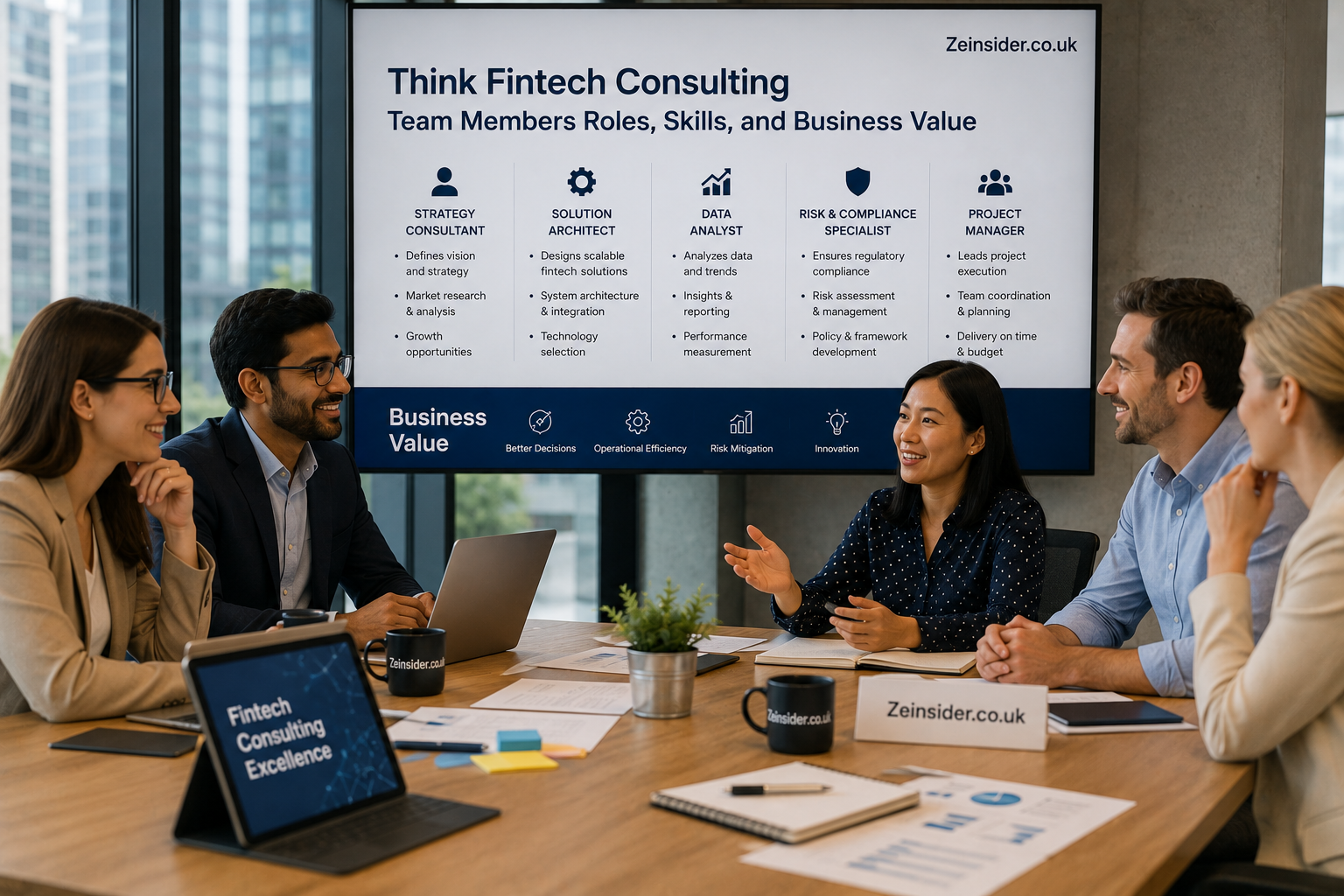
The success of every financial technology company depends on much more than innovative software. Behind every successful fintech platform is a highly skilled team of professionals working together to solve complex financial, technical, and regulatory challenges. Understanding think fintech consulting team members can help startups, enterprises, investors, and business leaders make smarter decisions when choosing consulting partners. These professionals combine financial expertise, technology knowledge, compliance experience, and strategic planning to deliver secure and scalable fintech solutions. Whether a company is developing digital banking applications, payment systems, lending platforms, or blockchain products, every specialist contributes unique expertise throughout the project lifecycle. Modern fintech consulting focuses on improving customer experience while maintaining security, compliance, and operational efficiency. Businesses that understand the structure of think fintech consulting team members are better positioned to launch successful products, reduce project risks, and accelerate innovation. This guide explores the essential roles, responsibilities, collaboration processes, and expertise that make fintech consulting teams valuable assets for organizations operating in today’s competitive financial landscape.
Quick Answer
Think fintech consulting team members are multidisciplinary professionals who help financial organizations design, build, optimize, and scale fintech solutions. These teams typically include fintech consultants, business analysts, solution architects, compliance specialists, cybersecurity experts, software engineers, UI/UX designers, project managers, DevOps engineers, quality assurance professionals, cloud specialists, and data analysts. Together, think fintech consulting team members ensure financial products meet business objectives, customer expectations, industry regulations, and modern security standards while supporting long-term growth and innovation.
Understanding Think Fintech Consulting Team Members
Modern fintech projects require far more than software developers. Think fintech consulting team members work across business strategy, financial services, technology implementation, security planning, regulatory compliance, cloud infrastructure, customer experience, and data analytics. Their collaborative approach helps organizations transform traditional financial operations into digital-first services that are secure, efficient, and scalable. Instead of working independently, every specialist contributes throughout planning, development, testing, deployment, and optimization phases. This integrated workflow reduces communication gaps while improving product quality and delivery speed. Businesses benefit from access to specialized knowledge that would otherwise require hiring multiple full-time experts. Financial regulations continue evolving worldwide, making experienced consultants increasingly valuable during product development. The effectiveness of think fintech consulting team members comes from combining technical excellence with a deep understanding of financial markets, banking operations, payment ecosystems, and customer expectations.
Why Businesses Depend on Think Fintech Consulting Team Members
Organizations increasingly rely on think fintech consulting team members because financial technology projects involve unique technical and regulatory complexities. Building payment gateways, digital wallets, investment platforms, lending applications, or banking software requires expertise that extends beyond conventional software engineering. Consultants evaluate business objectives before recommending scalable technology stacks, cloud architecture, API integrations, security controls, and compliance frameworks. They also help organizations avoid costly development mistakes by identifying technical and operational risks early in the project. Financial institutions benefit from proven methodologies developed through years of industry experience. The consulting team also improves collaboration between stakeholders, executives, developers, and compliance officers, ensuring project objectives remain aligned. As competition intensifies within the fintech industry, organizations increasingly depend on think fintech consulting team members to accelerate innovation while maintaining security, reliability, and regulatory compliance.
Business Challenges They Solve
Financial organizations face numerous operational and technical challenges that require specialized expertise. Think fintech consulting team members evaluate outdated legacy systems, identify performance bottlenecks, recommend modernization strategies, and design digital transformation roadmaps. They help businesses reduce operational costs while improving customer satisfaction through automation and intelligent workflows. Consultants also guide API integration with banking systems, payment providers, identity verification platforms, and financial data services. Their experience minimizes implementation risks while supporting long-term scalability. Organizations benefit from strategic recommendations backed by practical industry knowledge. The ability of think fintech consulting team members to bridge business strategy with technical execution significantly improves project success rates.
Strategic Business Benefits
Some of the biggest advantages include:
| Business Need | How Think Fintech Consulting Team Members Help |
|---|---|
| Digital Transformation | Modernize financial systems |
| Compliance | Meet financial regulations |
| Cybersecurity | Protect financial data |
| Cloud Migration | Improve scalability |
| Product Innovation | Accelerate development |
| Risk Management | Reduce project failures |
| Customer Experience | Improve digital engagement |
Core Roles Within Think Fintech Consulting Team Members
A successful consulting engagement depends on assembling professionals with complementary expertise. Think fintech consulting team members rarely consist of only developers because fintech projects require balanced knowledge across finance, technology, security, governance, and user experience. Each specialist contributes specific insights that improve decision-making throughout the project lifecycle. Their collaboration enables businesses to launch secure digital products while maintaining operational efficiency. Experienced consulting firms assign team members based on project complexity, regulatory requirements, customer expectations, and technology architecture. Cross-functional collaboration reduces communication barriers and increases project transparency. Organizations working with think fintech consulting team members gain access to specialists capable of solving both technical and strategic challenges simultaneously.
Fintech Strategy Consultant
The fintech strategy consultant defines business objectives and identifies opportunities for innovation. They analyze market conditions, customer expectations, competitor positioning, emerging financial technologies, and digital transformation priorities. Strategic consultants recommend product roadmaps aligned with business goals while ensuring investments generate measurable value. They also coordinate with executives to establish project priorities and long-term growth strategies. Through market analysis and financial expertise, they help organizations remain competitive in rapidly evolving financial ecosystems. Their recommendations influence technology decisions, operational improvements, and investment planning. Effective think fintech consulting team members always begin projects with strong strategic leadership.
Business Analyst
Business analysts serve as the communication bridge between stakeholders and technical teams. They document functional requirements, analyze workflows, identify business challenges, and prioritize software features. Detailed requirement gathering reduces misunderstandings during development while improving project outcomes. Business analysts also evaluate user needs and recommend workflow improvements that increase efficiency. Their documentation supports developers, testers, project managers, and executives throughout implementation. By translating business objectives into technical specifications, they ensure every project remains aligned with organizational goals. Every successful group of think fintech consulting team members relies heavily on experienced business analysts.
Solution Architect
Solution architects design scalable technical frameworks that support fintech applications. They select cloud infrastructure, integration methods, databases, APIs, microservices, and security models based on business requirements. Their decisions influence software performance, scalability, resilience, and operational costs. Architects also evaluate technology risks before development begins, reducing expensive redesign efforts later. Collaboration with developers ensures architectural consistency across multiple systems. Their technical leadership supports long-term maintainability while simplifying future product expansion. Within think fintech consulting team members, solution architects provide the technical foundation for successful implementation.
Technical Specialists Inside Think Fintech Consulting Team Members
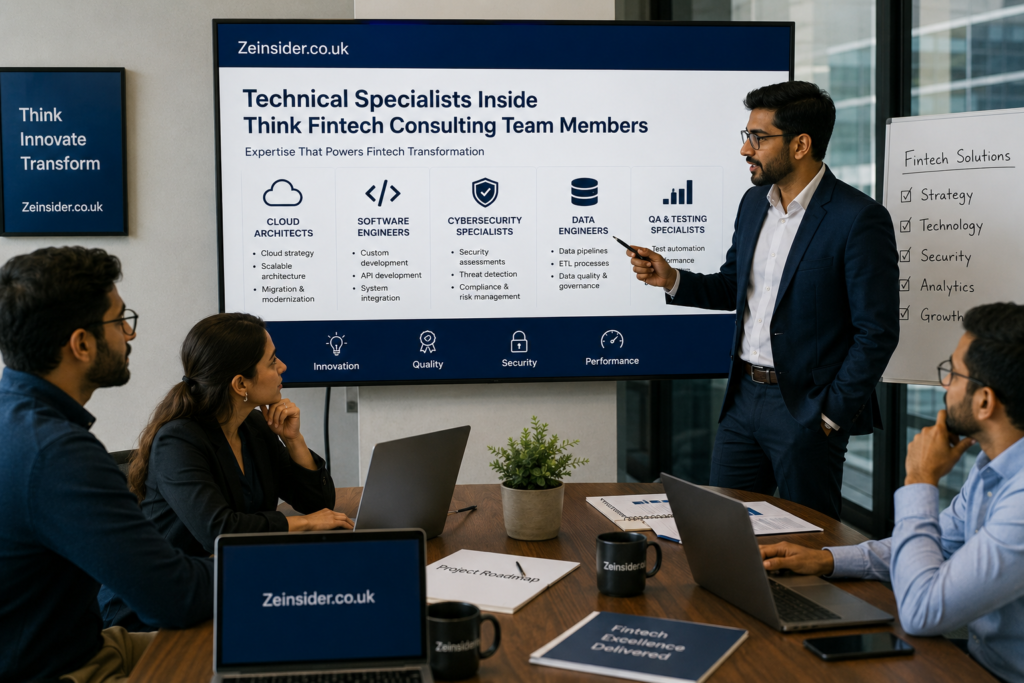
Technology specialists transform strategic plans into fully functional financial products. Think fintech consulting team members include software engineers, DevOps professionals, cloud architects, cybersecurity experts, QA engineers, and integration specialists who work together throughout development. Their combined expertise ensures fintech platforms remain reliable, secure, scalable, and compliant with financial standards. Continuous collaboration reduces development delays while maintaining software quality. Technical specialists also adopt Agile methodologies that support rapid iteration and continuous improvement. Businesses benefit from faster releases without compromising reliability. As financial applications process sensitive customer information, technical excellence remains one of the defining strengths of think fintech consulting team members.
Software Engineers
Software engineers build the applications that power digital banking, payment systems, lending platforms, wealth management solutions, and financial marketplaces. They develop secure APIs, backend services, customer portals, mobile applications, and administrative dashboards. Their responsibilities include writing maintainable code, implementing business logic, integrating third-party services, and optimizing application performance. Experienced developers follow secure coding practices that protect financial information against cyber threats. Collaboration with architects and QA engineers ensures software quality throughout development. They continuously improve applications through testing, optimization, and feature enhancements. Skilled engineers remain one of the most valuable members of think fintech consulting team members.
Cybersecurity Specialists
Cybersecurity professionals protect fintech products from increasingly sophisticated digital threats. They perform security assessments, penetration testing, vulnerability management, identity protection, encryption implementation, and security monitoring. Regulatory compliance requires strong security controls across every component of financial applications. Security specialists also educate development teams about secure coding standards and emerging cyber risks. Continuous monitoring enables organizations to identify suspicious activities before major incidents occur. Businesses handling financial transactions depend heavily on cybersecurity expertise throughout software development and production operations. Within think fintech consulting team members, cybersecurity specialists safeguard customer trust while protecting organizational assets.
DevOps Engineers
DevOps engineers automate software deployment, infrastructure management, monitoring, and system reliability. Their automation pipelines accelerate software releases while reducing operational errors. Infrastructure as Code, containerization, cloud deployment, and continuous integration allow fintech organizations to scale efficiently as customer demand grows. DevOps professionals collaborate closely with developers and security teams to maintain system availability. Automated monitoring improves issue detection and system recovery times. Their expertise enables continuous delivery without sacrificing stability or security. Every mature group of think fintech consulting team members depends on DevOps practices to deliver reliable financial platforms.
Compliance and Regulatory Experts Among Think Fintech Consulting Team Members
Financial technology companies operate in one of the most heavily regulated industries in the world. That is why think fintech consulting team members often include compliance officers and regulatory specialists who understand both domestic and international financial regulations. These professionals ensure products comply with banking standards, anti-money laundering (AML) requirements, Know Your Customer (KYC) procedures, payment regulations, and data privacy laws. They work closely with developers, architects, and project managers to incorporate compliance requirements during the design phase rather than treating them as an afterthought. This proactive approach reduces project delays, legal risks, and expensive redesigns. Compliance specialists also monitor changing regulations and recommend updates that keep fintech platforms legally compliant over time. Their involvement builds trust among customers, investors, financial institutions, and regulatory authorities. Every successful group of think fintech consulting team members understands that compliance is not simply a legal requirement—it is a competitive advantage that strengthens business credibility.
Risk Management Professionals
Risk management specialists identify operational, financial, cybersecurity, and strategic risks before they impact the organization. They conduct comprehensive assessments that evaluate vulnerabilities across technology infrastructure, payment systems, customer authentication processes, and third-party integrations. Their recommendations help companies prioritize security investments while reducing operational disruptions. They also create contingency plans that improve business resilience during unexpected events. By working closely with executives and technical teams, they ensure every major decision considers both opportunity and potential risk. Risk professionals regularly update assessment frameworks as new technologies and regulations emerge. Their expertise makes think fintech consulting team members more capable of delivering secure and reliable financial solutions. Businesses benefit from improved decision-making and greater confidence when expanding into competitive financial markets.
Legal Advisors
Legal advisors contribute specialized knowledge regarding contracts, intellectual property, financial licensing, digital payment regulations, and cross-border financial services. They assist organizations during partnerships, mergers, acquisitions, and vendor negotiations. Their guidance reduces contractual disputes while ensuring business operations comply with applicable laws. Legal experts also review customer agreements, privacy policies, and terms of service to minimize legal exposure. Working alongside compliance professionals, they help organizations prepare documentation required by regulators and financial institutions. Their expertise becomes particularly valuable when launching innovative fintech products into new markets. Strong legal oversight complements the technical expertise of think fintech consulting team members by ensuring every business decision aligns with applicable legal frameworks.
Customer Experience Specialists Within Think Fintech Consulting Team Members
Outstanding customer experience has become one of the strongest competitive advantages in financial technology. Think fintech consulting team members include UX researchers, UI designers, customer journey specialists, and accessibility experts who focus on making financial services intuitive and engaging. These professionals study user behavior, identify pain points, and simplify complex financial processes into user-friendly digital experiences. Clear navigation, fast onboarding, and transparent interfaces improve customer satisfaction while increasing product adoption. Designers also collaborate closely with compliance specialists to ensure regulatory information remains understandable without overwhelming users. Continuous usability testing helps identify areas requiring improvement before public release. Their work supports customer retention while strengthening brand reputation. By prioritizing usability, think fintech consulting team members help organizations differentiate themselves in increasingly competitive financial markets.
UI/UX Designers
User interface and user experience designers transform technical requirements into visually appealing and intuitive digital products. They develop wireframes, interactive prototypes, design systems, and responsive layouts that improve accessibility across desktop and mobile devices. Their design decisions reduce customer frustration while increasing engagement with financial services. Designers also conduct user testing sessions to validate interface improvements before implementation. Collaboration with developers ensures design consistency throughout the application lifecycle. Accessibility standards remain an important consideration so financial products remain usable by diverse audiences. Well-designed interfaces strengthen the overall value delivered by think fintech consulting team members. Exceptional design ultimately improves customer loyalty and long-term business performance.
Key Customer Experience Priorities
| Priority Area | Business Impact |
|---|---|
| Easy Navigation | Faster task completion |
| Mobile Optimization | Higher customer engagement |
| Accessibility | Inclusive financial services |
| Personalization | Better customer retention |
| Secure Authentication | Increased customer trust |
| Performance Speed | Improved user satisfaction |
| Clear Financial Data | Better decision-making |
Data and Analytics Professionals in Think Fintech Consulting Team Members
Modern financial organizations generate enormous volumes of transactional and customer data every day. Think fintech consulting team members rely on data analysts, business intelligence experts, and data scientists to convert that information into meaningful business insights. These professionals develop dashboards, predictive models, customer segmentation strategies, fraud detection systems, and performance reports. Their analysis helps executives make evidence-based decisions rather than relying on assumptions. Advanced analytics also improve marketing effectiveness, operational efficiency, and customer personalization. Data professionals continuously monitor key performance indicators that reveal opportunities for product improvements. Their work supports strategic planning while identifying emerging market trends before competitors recognize them. Businesses leveraging data-driven insights through think fintech consulting team members often achieve stronger long-term growth and operational efficiency.
AI and Machine Learning Specialists
Artificial intelligence has become increasingly important across digital banking, lending, fraud prevention, investment management, and customer support. AI specialists within think fintech consulting team members develop intelligent models that automate repetitive processes, identify fraudulent transactions, personalize financial recommendations, and improve customer interactions. Machine learning algorithms continuously improve as additional data becomes available, increasing prediction accuracy over time. These specialists also collaborate with cybersecurity professionals to detect suspicious activities more efficiently than traditional methods. Responsible AI governance remains an important consideration throughout model development. Organizations implementing AI strategically improve operational efficiency while delivering enhanced customer experiences. As fintech innovation accelerates, AI expertise continues becoming an essential capability within consulting teams.
How Think Fintech Consulting Team Members Collaborate Throughout a Project
Successful fintech consulting depends on structured collaboration rather than isolated expertise. Think fintech consulting team members follow well-defined project methodologies that encourage continuous communication between business stakeholders, developers, designers, security professionals, and compliance specialists. Project managers coordinate timelines while ensuring every department remains aligned with business objectives. Agile development practices enable frequent feedback cycles that reduce misunderstandings and improve product quality. Cross-functional meetings encourage faster decision-making while identifying potential risks before they become significant problems. Documentation remains continuously updated so every contributor understands evolving project requirements. This collaborative culture improves productivity, transparency, and accountability across the organization. Companies working with experienced think fintech consulting team members benefit from smoother implementation and higher project success rates.
Typical Collaboration Workflow
| Project Phase | Primary Team Members |
|---|---|
| Business Discovery | Strategy Consultant, Business Analyst |
| Planning | Project Manager, Solution Architect |
| System Design | Architects, UI/UX Designers |
| Development | Software Engineers, DevOps |
| Security Review | Cybersecurity Specialists |
| Compliance Validation | Compliance Experts, Legal Advisors |
| Testing | QA Engineers, Business Analysts |
| Deployment | DevOps Engineers, Cloud Specialists |
| Continuous Improvement | Entire Consulting Team |
Choosing the Right Think Fintech Consulting Team Members

Selecting experienced think fintech consulting team members requires evaluating both technical expertise and industry experience. Organizations should review previous fintech projects, customer testimonials, certifications, and technical capabilities before making a decision. Industry knowledge is equally important because financial technology requires understanding complex regulatory environments and evolving customer expectations. Companies should also assess communication practices, project management methodologies, and long-term support capabilities. A consulting team with diverse expertise provides greater flexibility when project requirements evolve over time. Transparency regarding timelines, pricing, deliverables, and responsibilities also contributes to successful partnerships. Businesses should prioritize consulting partners that demonstrate measurable results across multiple fintech domains. Investing time in selecting the right think fintech consulting team members often leads to higher project quality and stronger long-term returns.
Best Practices
- Clearly define business goals before engaging think fintech consulting team members.
- Involve compliance experts from the earliest planning stages.
- Maintain transparent communication between technical and business stakeholders.
- Adopt Agile methodologies for continuous improvement.
- Prioritize cybersecurity throughout the software development lifecycle.
- Conduct regular performance and security audits.
- Document every business requirement thoroughly.
- Invest in cloud scalability for future business growth.
- Continuously train internal teams on emerging fintech technologies.
- Measure project success using clearly defined KPIs.
Common Mistakes
- Hiring consultants based solely on cost.
- Ignoring regulatory requirements until late development stages.
- Underestimating cybersecurity risks.
- Poor documentation of business requirements.
- Lack of collaboration between departments.
- Choosing outdated technology stacks.
- Failing to perform adequate testing before deployment.
- Ignoring customer experience during product design.
- Neglecting ongoing maintenance after launch.
- Not defining measurable project objectives.
Pro Tips
- Choose consultants with proven fintech case studies.
- Verify certifications related to cloud, cybersecurity, and compliance.
- Schedule regular stakeholder review meetings.
- Build scalable architecture from the beginning.
- Integrate automated testing into development workflows.
- Use analytics dashboards to monitor product performance.
- Keep regulatory documentation continuously updated.
- Encourage knowledge transfer between consultants and internal teams.
- Invest in customer feedback programs after product launches.
- Treat think fintech consulting team members as strategic partners rather than temporary vendors.
Conclusion
Understanding think fintech consulting team members helps organizations appreciate the wide range of expertise required to build successful financial technology solutions. These multidisciplinary teams combine business strategy, financial knowledge, software engineering, cybersecurity, compliance, cloud infrastructure, data analytics, and customer experience into one coordinated effort. Their collaboration allows businesses to innovate while maintaining security, regulatory compliance, and operational efficiency. Instead of focusing only on technology, experienced consultants align every project with measurable business objectives and long-term growth strategies. As financial services continue evolving through digital transformation, the value of skilled consulting professionals will only increase. Organizations that invest in experienced think fintech consulting team members position themselves to launch secure, scalable, and customer-focused fintech products with greater confidence. Choosing the right consulting team ultimately reduces project risk, accelerates innovation, and creates a stronger competitive advantage in today’s dynamic financial marketplace.
Frequently Asked Questions (FAQs)
1. Who are think fintech consulting team members?
They are professionals with expertise in finance, technology, compliance, cybersecurity, project management, design, and analytics who help businesses develop and improve fintech solutions.
2. Why are think fintech consulting team members important?
They provide specialized knowledge that helps organizations build secure, scalable, compliant, and customer-friendly financial technology products.
3. What skills do fintech consultants need?
They typically require expertise in financial systems, software development, cloud computing, cybersecurity, regulatory compliance, data analytics, and business strategy.
4. How do think fintech consulting team members improve project success?
They collaborate across departments, reduce technical risks, improve compliance, strengthen security, and ensure business goals remain aligned throughout development.
5. Do fintech consulting teams include cybersecurity experts?
Yes. Cybersecurity specialists are essential members responsible for protecting sensitive financial information and preventing cyber threats.
6. What industries benefit from fintech consulting?
Banks, insurance companies, investment firms, payment providers, lending platforms, wealth management companies, credit unions, and financial startups all benefit from fintech consulting expertise.
7. How do compliance specialists contribute?
They ensure products meet financial regulations, support licensing requirements, implement AML and KYC processes, and reduce legal risks.
8. Can think fintech consulting team members support cloud migration?
Yes. Cloud architects and DevOps engineers help organizations migrate financial systems securely while improving scalability and operational efficiency.
9. What should businesses consider before hiring a fintech consulting team?
Evaluate industry experience, technical expertise, regulatory knowledge, communication processes, certifications, customer references, and previous project success.
10. Are fintech consulting services suitable for startups?
Absolutely. Startups often benefit from experienced think fintech consulting team members because they provide strategic guidance, technical expertise, and regulatory support without requiring large in-house teams.
Author Bio
Author: Digital Finance & Technology Researcher
The author specializes in fintech innovation, digital transformation, financial software, cloud technologies, cybersecurity, and enterprise consulting. With extensive experience researching financial technology trends and emerging digital solutions, the author creates practical, EEAT-focused content that helps businesses and professionals make informed decisions about modern fintech strategies and consulting services.