
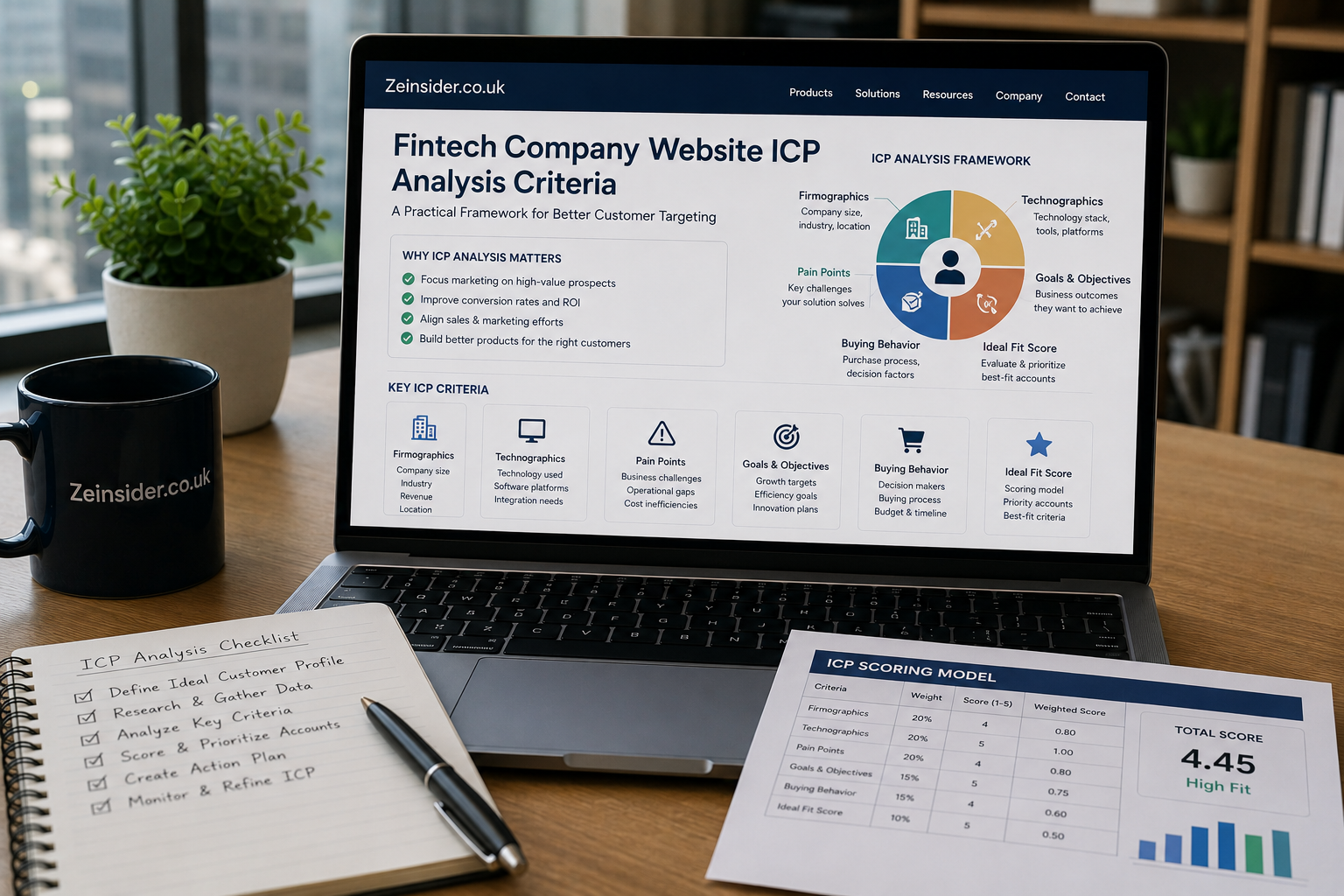
Every successful fintech business understands that attracting more website visitors means little if those visitors are not the right audience. Companies that grow consistently focus on identifying their Ideal Customer Profile (ICP) before investing heavily in marketing, sales, or product development. This is where fintech company website ICP analysis criteria become essential. Instead of relying on assumptions, businesses evaluate websites using measurable indicators that reveal who the company serves, how it communicates value, and whether its messaging attracts qualified prospects. A structured ICP analysis also helps marketing teams reduce acquisition costs while increasing lead quality. Investors, consultants, SaaS providers, and enterprise buyers often perform these evaluations before making strategic decisions. Understanding these criteria allows fintech companies to improve positioning, personalize experiences, and compete in an increasingly crowded financial technology market.
Quick Answer
Fintech company website ICP analysis criteria refers to the process of evaluating a fintech company’s website to determine whether it clearly targets its Ideal Customer Profile. The analysis typically examines audience segmentation, value proposition, product messaging, compliance indicators, trust signals, pricing transparency, industry focus, customer success stories, integrations, technology positioning, and conversion pathways. A well-optimized fintech website communicates who it serves, what problems it solves, why customers should trust it, and how prospects can move through the buying journey efficiently.
Understanding Fintech Company Website ICP Analysis Criteria
A fintech company website ICP analysis criteria framework helps organizations evaluate whether a fintech website effectively communicates with its intended audience. Rather than focusing only on attractive design or technical performance, the analysis examines how well the website supports business objectives and customer acquisition. Every section of the website should reinforce the company’s understanding of its target market, including financial institutions, lenders, payment providers, insurers, investment firms, or enterprise clients. The messaging should immediately explain the problem being solved and why the solution is different from competitors. Strong ICP alignment also ensures that marketing campaigns attract qualified leads instead of generating low-quality traffic. Businesses that regularly review their ICP criteria often achieve higher conversion rates because their messaging becomes more relevant to customer needs. This evaluation process also reveals gaps in positioning that competitors may exploit. Ultimately, fintech website ICP analysis provides actionable insights for improving both customer experience and revenue generation.
A comprehensive evaluation includes qualitative observations and quantitative measurements. Analysts assess navigation, website architecture, user intent alignment, educational resources, trust indicators, and product positioning. They also review whether the content addresses industry pain points using terminology familiar to the intended audience. Decision-makers often compare these findings against competitor websites to understand market positioning. Because fintech solutions frequently involve complex financial processes, clear communication becomes even more valuable. A website that simplifies technical information while maintaining credibility generally performs better with enterprise buyers. The analysis also examines consistency across landing pages, product pages, case studies, and resource libraries. When every element supports the same Ideal Customer Profile, the overall marketing strategy becomes significantly stronger.
Why ICP Analysis Matters for Fintech Companies
Understanding fintech company website ICP analysis criteria allows organizations to allocate marketing resources more effectively. Rather than attempting to appeal to every possible customer, companies focus on audiences most likely to benefit from their solutions. This targeted approach improves campaign efficiency, lowers acquisition costs, and increases long-term customer value. Enterprise software buyers typically conduct extensive research before contacting vendors, making website messaging one of the most influential factors in purchasing decisions. If visitors immediately recognize that a solution addresses their challenges, they are more likely to continue through the buying journey. ICP-focused websites also produce better-qualified leads for sales teams, reducing time spent on prospects that are unlikely to convert. As competition within financial technology continues to increase, businesses with clearly defined ICP strategies gain a measurable advantage.
Another important benefit involves internal alignment across departments. Marketing, sales, customer success, and product teams all reference the same customer profile when creating campaigns, developing features, and supporting clients. This consistency strengthens brand positioning and improves customer satisfaction throughout the lifecycle. Investors also appreciate companies with a clearly defined ICP because it demonstrates strategic market understanding rather than broad, unfocused growth efforts. Website analysis often uncovers messaging inconsistencies that limit performance despite having a strong product. Addressing these issues creates a more unified customer experience while increasing trust among enterprise buyers. The result is stronger brand recognition and more predictable business growth.
Core Components of Fintech Company Website ICP Analysis Criteria
Audience Identification
One of the first priorities during fintech company website ICP analysis criteria is determining whether the website clearly identifies its intended audience. Visitors should immediately understand whether the solution serves banks, credit unions, payment processors, insurance companies, investment firms, startups, or enterprise organizations. Effective audience segmentation reduces confusion and increases engagement because each visitor quickly recognizes relevant solutions. Industry-specific terminology also signals expertise and builds credibility with experienced buyers. Companies targeting multiple customer segments should organize content into dedicated landing pages instead of presenting generic messaging. This structured approach improves user experience while supporting SEO through keyword relevance. Analysts often evaluate headlines, navigation menus, product descriptions, and customer stories to determine audience clarity. Clear segmentation ultimately improves conversion rates because prospects spend less time determining whether the product fits their needs.
The website should also demonstrate a deep understanding of customer pain points. Enterprise buyers expect vendors to understand regulatory compliance, operational efficiency, fraud prevention, customer onboarding, risk management, and digital transformation challenges. Messaging that directly addresses these concerns creates stronger emotional and professional connections. Instead of discussing product features alone, successful fintech companies explain measurable business outcomes. This customer-first communication style reinforces ICP alignment while improving trust. Audience identification remains one of the strongest indicators of an effective fintech website because every subsequent marketing decision depends on this foundation.
Value Proposition Clarity
A compelling value proposition represents another critical element within fintech company website ICP analysis criteria. Visitors should understand the company’s primary benefit within seconds of arriving on the homepage. Clear messaging explains what the company does, who benefits, and why the solution is different from alternatives. Many fintech businesses struggle because they emphasize technical features instead of business outcomes. Enterprise buyers usually prioritize operational improvements, regulatory confidence, automation, security, scalability, and measurable return on investment. Effective websites communicate these outcomes using concise language supported by visual examples and customer success stories. Analysts evaluate headlines, supporting content, product demonstrations, and homepage hierarchy to determine messaging effectiveness.
Strong value propositions also remain consistent throughout the website. Every landing page should reinforce the same positioning while adapting language for specific customer segments. Product pages should explain benefits before technical specifications, allowing visitors to understand business impact immediately. Supporting graphics, diagrams, and workflow illustrations often improve comprehension for complex financial technology products. Companies with consistent messaging generally experience stronger brand recognition because prospects encounter the same value proposition across multiple touchpoints. This consistency builds familiarity and confidence during lengthy B2B purchasing processes.
Trust and Credibility Indicators
Trust plays a central role in every fintech company website ICP analysis criteria assessment because financial technology solutions manage sensitive information and critical business operations. Buyers expect evidence that a company follows security standards, regulatory requirements, and industry best practices. Websites should prominently display compliance certifications, security frameworks, privacy commitments, and customer testimonials. Case studies demonstrating measurable results further strengthen credibility by providing real-world validation. Analysts also review executive leadership visibility, company background, media mentions, and partner relationships. These elements collectively reduce perceived purchasing risk and encourage prospects to continue exploring solutions.
Customer success stories deserve particular attention because enterprise buyers frequently compare vendor experience before requesting demonstrations. Detailed case studies showing implementation challenges, solutions delivered, and measurable outcomes offer valuable proof of expertise. Analyst reports, awards, and recognized partnerships also contribute to stronger credibility. Educational content such as white papers, webinars, research reports, and knowledge centers demonstrates thought leadership while supporting SEO performance. A trustworthy fintech website balances promotional messaging with educational resources that genuinely help prospective customers make informed decisions.
Essential Website Elements Evaluated During ICP Analysis
Homepage Messaging
The homepage serves as the first impression in every fintech company website ICP analysis criteria review. Visitors should immediately understand the company’s specialization, target market, competitive advantage, and primary solution. Headlines must communicate benefits rather than vague marketing statements. Supporting content should reinforce these messages using customer-focused language instead of technical jargon. Effective homepages also guide visitors toward logical next steps through clear calls to action. Analysts evaluate whether navigation supports different buyer journeys without overwhelming users. Visual hierarchy, typography, spacing, and content organization also influence user engagement.
Homepage messaging should introduce the company’s unique position within the financial technology ecosystem. Whether the solution focuses on lending, payments, embedded finance, banking infrastructure, wealth management, compliance technology, or digital identity, visitors should recognize this immediately. Consistent messaging across hero sections, product summaries, and customer proof increases confidence. Enterprise buyers often decide within minutes whether a vendor deserves further evaluation. Therefore, homepage optimization directly influences pipeline quality and conversion performance.
Product and Solution Pages
Product pages reveal whether the fintech company website ICP analysis criteria successfully communicates practical business value. Rather than presenting lengthy feature lists, successful fintech companies organize information according to customer objectives. Each solution should explain common challenges, implementation processes, expected outcomes, and measurable business improvements. Interactive demonstrations, workflow diagrams, and integration examples often improve understanding for technical decision-makers. Analysts also assess whether pricing information, deployment options, and scalability considerations receive appropriate attention.
These pages should address different stakeholder perspectives, including executives, IT teams, compliance officers, operations managers, and procurement specialists. Enterprise purchasing decisions typically involve multiple departments, making comprehensive product communication essential. Clear explanations reduce uncertainty while improving lead quality before sales conversations begin. Well-structured solution pages also strengthen SEO by targeting specific customer problems through relevant keyword clusters and educational content.
Industry-Specific Positioning
One distinguishing feature of strong fintech company website ICP analysis criteria is industry specialization. Generic financial technology messaging rarely performs as well as targeted communication tailored to specific industries or business models. Websites should explain how solutions address the unique operational, regulatory, and competitive challenges facing their intended market. Dedicated pages for banking, lending, insurance, wealth management, payment processing, or embedded finance demonstrate expertise while improving organic search visibility. Analysts review whether these specialized pages provide meaningful insights instead of superficial marketing copy.
Industry positioning also extends to terminology, customer examples, implementation methodologies, and compliance references. Buyers expect vendors to understand their specific workflows rather than offering generalized financial software solutions. This expertise differentiates established fintech providers from broader software companies entering the financial services market. Strong specialization reinforces ICP alignment while supporting higher-quality lead generation and stronger customer relationships.
Evaluating User Experience Within Fintech Company Website ICP Analysis Criteria
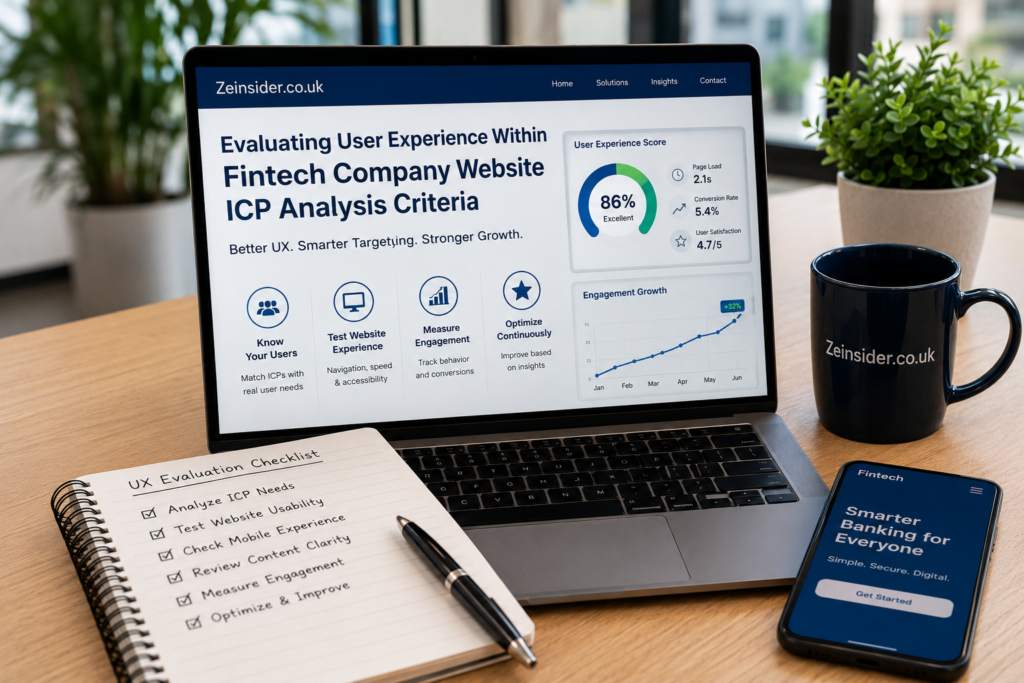
User experience (UX) is one of the most influential factors in fintech company website ICP analysis criteria because it directly affects how prospective customers interact with a company’s digital presence. Even if a fintech business offers an innovative product, a confusing website can reduce engagement and discourage qualified leads from exploring further. During an ICP evaluation, analysts review navigation, page hierarchy, mobile responsiveness, search functionality, and accessibility. Enterprise buyers expect to find information quickly without unnecessary clicks or distractions. A streamlined experience demonstrates professionalism and signals that the company values efficiency, which is especially important in financial technology. Consistent branding, readable typography, intuitive layouts, and logical content organization help visitors move naturally through the buying journey. Analysts also examine whether calls to action appear at appropriate moments instead of interrupting the user experience. A website that combines clarity with functionality supports stronger ICP alignment and encourages higher-quality conversions.
Navigation and Information Architecture
Navigation should guide different audience segments toward relevant information without creating confusion. When performing fintech company website ICP analysis criteria, reviewers determine whether menus reflect customer priorities rather than internal company structures. Banks, payment providers, fintech startups, and enterprise organizations often require different resources, so clearly segmented navigation improves usability. Product categories, solutions, industries, resources, pricing, and contact options should be easy to locate. Breadcrumb navigation and internal linking also contribute to a better user experience while supporting search engine optimization. Information architecture should help visitors answer important questions in a logical order instead of forcing them to search through multiple pages. Strong navigation reduces bounce rates and improves visitor satisfaction. It also provides search engines with a better understanding of website structure, improving organic visibility.
Conversion Path Optimization
Every fintech company website ICP analysis criteria review should evaluate how efficiently visitors can become qualified leads. Conversion paths include demo requests, consultation forms, free trials, newsletter subscriptions, downloadable resources, and contact options. High-performing fintech websites remove unnecessary friction by limiting form fields and providing clear expectations about the next step. Analysts assess button placement, messaging consistency, page speed, and trust indicators surrounding conversion points. Visitors are more likely to engage when forms are simple, secure, and supported by testimonials or customer success stories. Progressive profiling and personalized landing pages can further improve lead quality. Companies should regularly test different call-to-action messages to determine what resonates most with their Ideal Customer Profile. Continuous optimization ensures the website remains aligned with evolving customer expectations.
Measuring Content Quality Against ICP Criteria
Content quality remains a core component of fintech company website ICP analysis criteria because educational resources influence both trust and search engine rankings. Financial technology buyers typically conduct extensive research before contacting vendors, making informative content an essential part of the customer journey. Analysts review blog articles, white papers, guides, webinars, videos, case studies, and product documentation to determine whether the website genuinely helps its audience. High-quality resources answer practical questions instead of focusing exclusively on product promotion. This educational approach supports Google’s Helpful Content principles while demonstrating industry expertise. Companies that consistently publish valuable information establish authority within their niche and improve long-term SEO performance. Educational content also supports different buying stages, from initial awareness to final purchasing decisions. A comprehensive content strategy strengthens both customer relationships and organic visibility.
Educational Resources
Educational resources should address common industry challenges such as fraud prevention, regulatory compliance, payment infrastructure, embedded finance, digital banking, risk management, and customer onboarding. During fintech company website ICP analysis criteria, analysts determine whether these materials provide actionable insights supported by real-world examples. Well-researched articles, downloadable reports, and practical implementation guides demonstrate expertise while building confidence among decision-makers. Content should remain accurate, current, and aligned with industry developments. Including expert commentary, research findings, and original insights further strengthens credibility. Educational resources should also link naturally to relevant product pages without appearing overly promotional. This balanced approach improves user satisfaction while supporting lead generation. Organizations that educate first often build stronger long-term relationships with prospective customers.
Case Studies and Success Stories
Case studies provide concrete evidence that a fintech solution delivers measurable results. As part of fintech company website ICP analysis criteria, reviewers assess whether customer stories include meaningful business outcomes rather than vague testimonials. Effective case studies describe the client’s challenge, implementation process, measurable improvements, and long-term benefits. Quantifiable metrics such as reduced processing time, lower fraud rates, improved compliance, or increased operational efficiency enhance credibility. Including quotes from customers and implementation timelines makes success stories more authentic. Industry-specific examples further strengthen ICP alignment because prospects can relate to organizations facing similar challenges. Well-structured case studies support sales conversations while reinforcing trust throughout the buying process. They also serve as valuable SEO assets targeting industry-specific search queries.
Technical SEO Factors Supporting ICP Success
Technical optimization complements fintech company website ICP analysis criteria by ensuring the website performs efficiently for both users and search engines. Fast loading times, secure connections, structured data, mobile responsiveness, and clean website architecture all contribute to a better user experience. Search engines increasingly prioritize websites that deliver high-quality experiences across devices. Technical performance also affects conversion rates because slow websites often lose visitors before they engage with content. Regular audits help identify indexing issues, broken links, duplicate content, and crawl errors. Strong technical foundations enable educational resources and product pages to reach the intended audience more effectively. Companies investing in technical SEO typically experience more sustainable organic growth. Technical excellence reinforces overall website credibility and ICP effectiveness.
Mobile Performance
Many business decision-makers research vendors using smartphones or tablets before continuing their evaluation on desktop devices. Therefore, fintech company website ICP analysis criteria should include detailed mobile usability assessments. Responsive layouts, readable fonts, touch-friendly navigation, and optimized media contribute to a positive mobile experience. Analysts also examine Core Web Vitals, page responsiveness, and interactive performance. Mobile optimization improves accessibility while supporting search engine rankings. A consistent experience across all devices demonstrates professionalism and customer focus. Companies that neglect mobile optimization risk losing qualified prospects early in the buying process. Mobile-first optimization remains a fundamental aspect of modern fintech marketing.
Comparison Table: Strong vs Weak ICP Website Characteristics
| Evaluation Area | Strong ICP Website | Weak ICP Website |
|---|---|---|
| Audience Focus | Clearly defined customer segments | Generic messaging for everyone |
| Value Proposition | Immediate business benefits | Confusing product descriptions |
| Trust Signals | Certifications, testimonials, case studies | Minimal credibility indicators |
| Navigation | Organized and intuitive | Difficult to locate information |
| Content Strategy | Educational and customer-focused | Sales-heavy promotional content |
| SEO Optimization | Keyword-focused, structured content | Poor optimization and thin pages |
| Calls to Action | Clear and relevant | Inconsistent or hidden |
| Industry Positioning | Specialized financial expertise | Broad software messaging |
| Mobile Experience | Fully responsive | Poor mobile usability |
| Lead Generation | Optimized conversion journey | Complicated forms and weak CTAs |
Best Practices for Fintech Company Website ICP Analysis Criteria
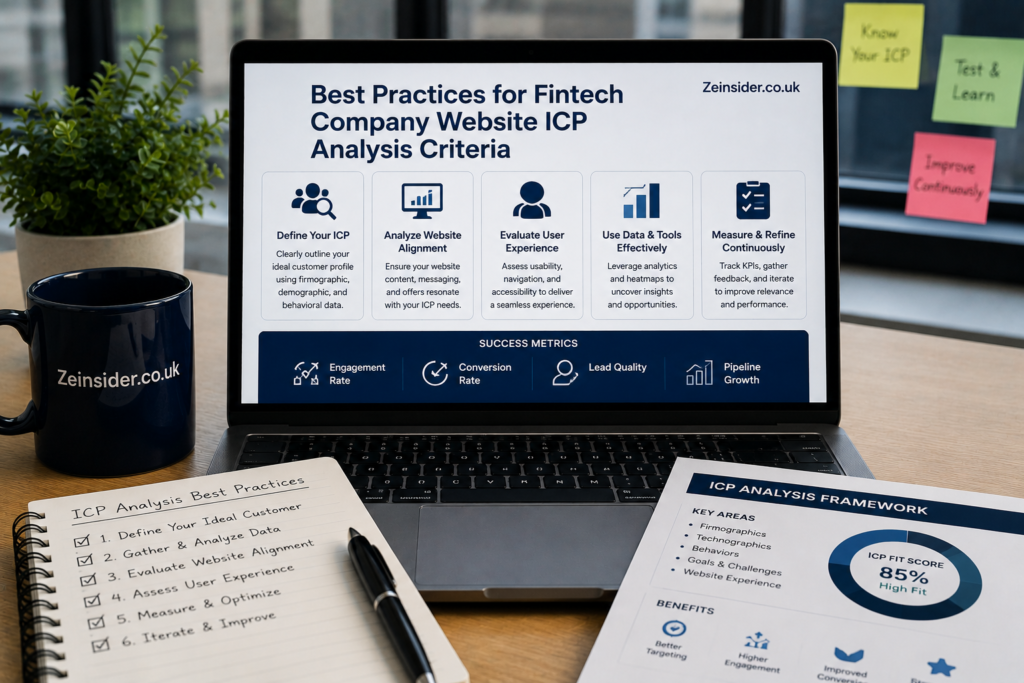
- Clearly define the Ideal Customer Profile before creating website content.
- Align homepage messaging with customer pain points instead of product features.
- Build dedicated landing pages for different industries and buyer personas.
- Publish educational resources that solve real business challenges.
- Regularly update compliance, security, and regulatory information.
- Use measurable customer success stories with verified business outcomes.
- Improve page speed and optimize Core Web Vitals.
- Test calls to action continuously using analytics and user feedback.
- Maintain consistent messaging across every customer touchpoint.
- Conduct regular competitor website analyses to identify positioning opportunities.
Common Mistakes
Many organizations undermine fintech company website ICP analysis criteria by attempting to appeal to every possible audience instead of focusing on qualified buyers. Generic messaging often weakens brand positioning and reduces conversion rates. Another frequent mistake is emphasizing technical specifications without explaining business value. Some companies neglect customer success stories, leaving prospects without evidence of real-world performance. Others fail to organize website navigation according to customer needs, making important information difficult to find. Outdated compliance information, inconsistent branding, slow page performance, and poorly optimized mobile experiences also reduce credibility. Ignoring technical SEO issues further limits organic visibility and lead generation. Avoiding these common mistakes allows fintech businesses to build stronger digital experiences that align closely with their Ideal Customer Profile.
Pro Tips
- Interview existing customers to refine your Ideal Customer Profile.
- Analyze competitors’ messaging to identify positioning gaps.
- Create industry-specific resource hubs targeting niche audiences.
- Use behavioral analytics to improve conversion paths.
- Include implementation timelines within product pages.
- Refresh case studies with recent customer success metrics.
- Monitor keyword performance quarterly to maintain SEO visibility.
- Continuously improve website accessibility for broader usability.
- Combine qualitative customer feedback with quantitative analytics.
- Review ICP alignment whenever launching new products or entering new markets.
Conclusion
A structured approach to fintech company website ICP analysis criteria enables financial technology companies to attract more qualified prospects, improve customer engagement, and strengthen long-term growth strategies. Rather than treating a website as a digital brochure, successful organizations use it as a strategic tool for communicating expertise, solving customer challenges, and demonstrating measurable business value. Every component—from homepage messaging and navigation to educational resources and technical SEO—should reinforce the company’s Ideal Customer Profile. Strong ICP alignment improves marketing efficiency, supports better lead qualification, and enhances customer trust throughout the buying journey. Regular website evaluations also help businesses adapt to changing market conditions and evolving customer expectations. By combining clear positioning, valuable content, robust technical performance, and evidence-based credibility, fintech companies create digital experiences that support sustainable growth. Organizations that continually refine their ICP analysis process are better positioned to outperform competitors and build lasting relationships with enterprise clients.
Frequently Asked Questions (FAQs)
1. What is fintech company website ICP analysis criteria?
It is the process of evaluating whether a fintech website effectively targets and communicates with its Ideal Customer Profile through messaging, content, design, trust signals, and conversion optimization.
2. Why is ICP important for fintech companies?
A well-defined ICP helps attract qualified leads, reduce customer acquisition costs, improve marketing efficiency, and increase conversion rates.
3. Which website sections are most important during ICP analysis?
The homepage, product pages, industry pages, case studies, resource center, navigation, and conversion pages receive the most attention.
4. How often should fintech companies perform ICP analysis?
Most organizations benefit from reviewing their website at least every six to twelve months or whenever significant products or markets change.
5. Does ICP analysis improve SEO?
Yes. Better audience targeting, relevant content, improved user experience, and stronger keyword alignment all contribute to stronger search engine performance.
6. What trust signals matter most?
Security certifications, compliance information, customer testimonials, partner logos, awards, case studies, and transparent company information are highly valuable.
7. Can small fintech startups benefit from ICP analysis?
Absolutely. Even early-stage companies can improve messaging, identify target markets, and increase marketing efficiency through structured ICP evaluations.
8. What metrics should be monitored after implementing improvements?
Track organic traffic, conversion rate, bounce rate, demo requests, qualified leads, engagement time, keyword rankings, and customer acquisition costs.
9. How do case studies strengthen ICP alignment?
They provide real-world evidence that the solution successfully addresses the challenges faced by the target audience, increasing trust and credibility.
10. Is technical SEO part of ICP analysis?
Yes. Website speed, mobile optimization, indexing, security, structured data, and accessibility all contribute to a better experience for ideal customers.
Author Bio
Author
The author is an experienced SEO content strategist and B2B technology writer specializing in fintech, SaaS, enterprise software, digital banking, and financial innovation. With extensive experience creating EEAT-focused, search-optimized content, the author helps businesses produce authoritative resources that improve organic visibility, educate decision-makers, and support sustainable business growth.