

The SMB manager fintech role driving team management has become one of the most influential leadership positions in today’s financial technology industry. As fintech companies continue serving thousands of small and medium-sized businesses, effective leadership is no longer limited to meeting sales targets or overseeing daily operations. Instead, SMB managers are responsible for creating motivated teams, improving customer experiences, streamlining workflows, and ensuring consistent business growth. Their responsibilities bridge communication between executives, sales teams, customer success departments, product specialists, and technical support professionals. Because fintech solutions evolve rapidly, these managers must also encourage continuous learning and adaptability within their teams. Organizations increasingly rely on experienced SMB managers to balance operational efficiency with personalized customer relationships. Their decisions directly impact employee performance, customer retention, revenue growth, and long-term scalability. Understanding this role helps both aspiring leaders and fintech organizations recognize why strong team management has become a competitive advantage.
Quick Answer
The SMB manager fintech role driving team management focuses on leading teams that support small and medium-sized business customers while aligning daily operations with company objectives. These managers coordinate sales, onboarding, customer success, account management, and cross-functional collaboration to improve productivity and customer satisfaction. They establish performance metrics, coach employees, optimize workflows, and encourage innovation to help fintech companies grow efficiently. By combining leadership, communication, strategic planning, and financial technology expertise, SMB managers create stronger teams capable of delivering outstanding business results in a highly competitive market.
Understanding the SMB Manager Fintech Role
The SMB manager fintech role driving team management extends far beyond supervising employees or assigning tasks. Modern fintech companies depend on these professionals to lead customer-focused teams while ensuring operational excellence across multiple departments. They oversee account managers, business development representatives, customer success specialists, onboarding experts, and support personnel working with small and medium-sized business clients. Since SMB customers often require personalized assistance, managers must balance efficiency with relationship building. Strong leadership helps teams respond quickly to customer needs while maintaining regulatory compliance and service quality. Managers also communicate business priorities, monitor performance indicators, resolve operational challenges, and encourage continuous improvement. Their influence affects customer retention, employee engagement, revenue generation, and organizational growth. As fintech continues evolving through automation, artificial intelligence, embedded finance, and digital banking innovations, SMB managers play an increasingly strategic leadership role.
Why SMB Leadership Is Critical in Financial Technology
The fintech industry operates in an environment characterized by rapid innovation, changing customer expectations, and increasing competition. Effective SMB managers provide the stability needed to navigate these challenges while helping their teams remain productive and customer-focused. Small and medium-sized businesses expect fast onboarding, responsive support, secure payment solutions, flexible financing, and seamless digital experiences. Meeting these expectations requires coordinated teamwork rather than isolated departmental efforts. Managers establish clear communication channels, prioritize customer issues, and align daily activities with broader business objectives. Their leadership reduces operational bottlenecks and ensures consistent service delivery across every customer interaction. As organizations expand into new markets, SMB managers become essential in maintaining scalable processes without sacrificing service quality. Their ability to inspire collaboration creates measurable improvements in customer satisfaction and business performance.
Key Objectives of the Role
An SMB manager typically works toward several interconnected objectives that strengthen both organizational performance and customer success.
Primary Goals Include
- Leading high-performing fintech teams
- Improving customer retention
- Supporting SMB client growth
- Increasing employee productivity
- Enhancing cross-functional collaboration
- Developing future team leaders
- Improving operational efficiency
- Meeting revenue and performance goals
- Encouraging continuous learning
- Supporting digital transformation initiatives
Core Responsibilities of an SMB Manager in Fintech
The SMB manager fintech role driving team management requires balancing strategic planning with daily operational leadership. Managers oversee multiple responsibilities that collectively improve organizational performance. They develop team objectives aligned with business strategy while ensuring employees understand expectations and performance standards. Coaching remains a major component of the role, helping team members strengthen communication, problem-solving, negotiation, and customer relationship skills. Managers regularly review business metrics, analyze customer feedback, identify process improvements, and implement new operational strategies. Collaboration with product managers, engineers, marketing teams, compliance officers, and executive leadership helps ensure organizational alignment. Risk management also plays an important role because fintech organizations operate within strict regulatory frameworks. By combining operational oversight with employee development, SMB managers create resilient teams capable of adapting to changing market demands.
Leadership and People Development
People management represents one of the most valuable aspects of the SMB manager fintech role driving team management. Successful managers recognize that business growth depends heavily on employee development. Instead of focusing exclusively on short-term performance, they invest in coaching, mentoring, career planning, and leadership development initiatives. Regular one-on-one meetings provide opportunities for constructive feedback and professional growth discussions. Managers identify individual strengths while helping employees overcome skill gaps through structured learning opportunities. Recognition programs, performance incentives, and transparent communication further improve engagement and morale. Strong leaders encourage innovation by allowing employees to contribute ideas for improving customer experiences and internal processes. This people-first leadership approach creates motivated teams that consistently deliver higher-quality results.
Employee Coaching Strategies
Effective coaching methods commonly include:
| Coaching Method | Primary Purpose | Business Impact |
|---|---|---|
| Weekly one-on-one meetings | Performance guidance | Higher engagement |
| Skills development sessions | Improve expertise | Better productivity |
| Real-time feedback | Correct issues quickly | Faster improvement |
| Leadership mentoring | Build future managers | Strong succession planning |
| Goal-setting workshops | Increase accountability | Improved performance |
| Peer collaboration | Knowledge sharing | Better teamwork |
Essential Skills for SMB Managers in Fintech
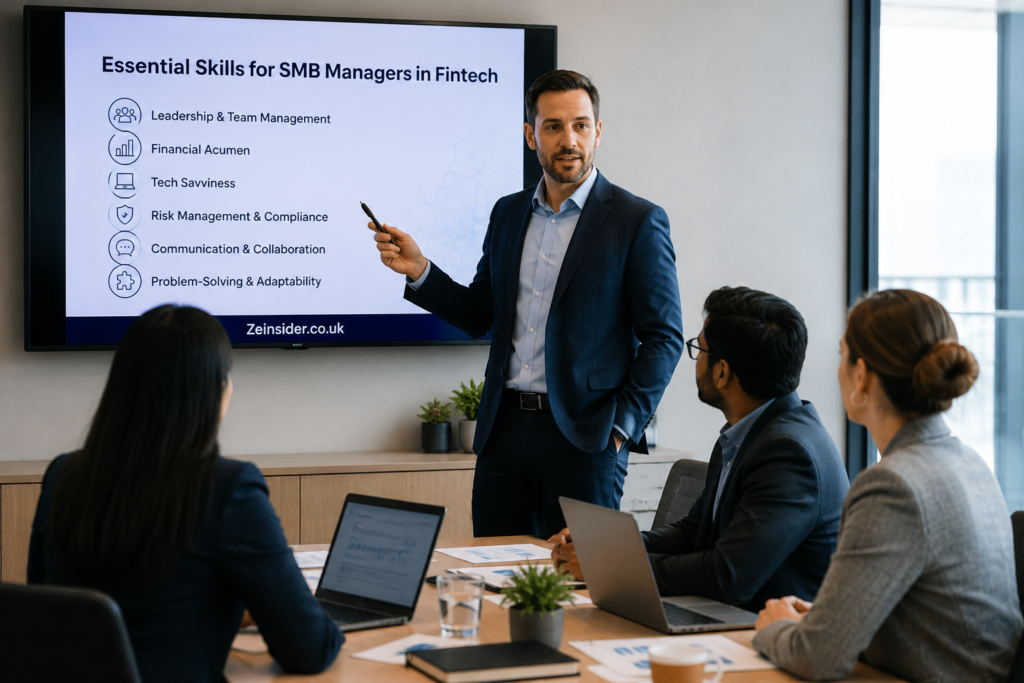
Excelling in the SMB manager fintech role driving team management requires a diverse combination of leadership capabilities, technical understanding, business strategy, and interpersonal communication. Fintech managers frequently navigate complex customer needs while coordinating multiple departments. Strong decision-making helps prioritize initiatives without compromising service quality. Emotional intelligence enables managers to resolve conflicts, motivate employees, and maintain positive workplace relationships. Analytical thinking supports data-driven decisions regarding customer behavior, operational efficiency, and performance optimization. Project management skills ensure deadlines, product launches, and process improvements remain on schedule. Financial literacy helps managers understand fintech products, payment systems, lending platforms, digital banking, and embedded finance solutions. Continuous learning remains essential because technology and financial regulations evolve rapidly.
Technical Knowledge Meets Leadership
Today’s fintech leaders cannot rely solely on management experience. Understanding digital payment platforms, financial software, cloud-based services, cybersecurity principles, compliance requirements, customer relationship management systems, and analytics platforms significantly improves decision-making. Managers who understand the technology behind fintech products communicate more effectively with engineering teams while better supporting customer-facing employees. Technical awareness also allows leaders to identify workflow improvements that increase productivity without adding unnecessary complexity. Combined with strong communication and coaching abilities, technical expertise strengthens leadership credibility across the organization. Employees gain greater confidence when managers understand both business operations and the technology supporting customer solutions. This balanced skill set contributes to stronger collaboration, innovation, and long-term organizational success.
High-Value Leadership Competencies
Core Skills Every SMB Manager Should Master
- Strategic planning
- Team leadership
- Conflict resolution
- Financial technology knowledge
- Customer relationship management
- Business development
- Communication
- Performance management
- Process optimization
- Data analysis
- Time management
- Coaching and mentoring
- Decision-making
- Emotional intelligence
- Cross-functional collaboration
Building High-Performing Fintech Teams
Building exceptional teams remains one of the defining responsibilities within the SMB manager fintech role driving team management. High-performing teams are not created through hiring alone; they require continuous development, trust, accountability, and shared objectives. Managers establish clear expectations while encouraging collaboration instead of unhealthy internal competition. Employees perform more effectively when they understand how their work contributes to company goals and customer success. Team diversity also strengthens innovation by bringing different experiences and perspectives into decision-making processes. Managers encourage open communication, celebrate achievements, and create psychologically safe environments where employees feel comfortable sharing ideas. Regular training ensures teams remain current with evolving fintech products, compliance requirements, and customer expectations. These practices produce stronger engagement, lower turnover, improved customer satisfaction, and better financial performance.
Creating a Collaborative Work Environment
Collaboration sits at the center of successful fintech operations because customer journeys often involve multiple departments working together. SMB managers remove communication barriers by encouraging transparency and shared accountability. Daily stand-up meetings, collaborative planning sessions, digital project management platforms, and knowledge-sharing initiatives help teams remain aligned. Managers also promote mutual respect by recognizing contributions from every department, regardless of role or seniority. Cross-training employees increases organizational flexibility while improving problem-solving capabilities. When teams communicate openly, customer issues are resolved faster and operational efficiency improves significantly. Collaboration ultimately strengthens innovation because employees combine expertise from different disciplines to develop better solutions. This leadership approach creates resilient teams prepared to support long-term fintech growth.
Managing Performance and KPIs in Fintech Teams
The SMB manager fintech role driving team management depends heavily on measuring performance through meaningful key performance indicators (KPIs). Rather than focusing only on revenue, successful managers evaluate customer satisfaction, employee engagement, onboarding efficiency, account retention, response times, and overall operational effectiveness. These metrics provide a complete picture of how well a team is supporting small and medium-sized business clients. Managers regularly review dashboards, analyze trends, and identify opportunities for improvement before small issues become larger business challenges. Data-driven leadership also promotes fairness because performance evaluations are based on measurable outcomes instead of assumptions. Transparent reporting encourages accountability while helping employees understand how their daily contributions affect company goals. Regular KPI reviews create opportunities for coaching, process refinement, and strategic planning. As fintech companies continue expanding, strong performance management enables sustainable growth without sacrificing customer experience.
Key Performance Indicators Every SMB Manager Should Track
Operational and Team Metrics
| KPI | Why It Matters | Business Benefit |
|---|---|---|
| Customer Retention Rate | Measures loyalty | Higher recurring revenue |
| Customer Satisfaction (CSAT) | Tracks service quality | Better client relationships |
| Net Promoter Score (NPS) | Indicates customer advocacy | Stronger brand reputation |
| Employee Engagement Score | Reflects team morale | Lower turnover |
| First Response Time | Measures service efficiency | Faster issue resolution |
| Customer Onboarding Time | Evaluates operational speed | Improved client experience |
| Revenue Growth | Measures financial success | Sustainable business expansion |
| Productivity Rate | Tracks team performance | Higher operational efficiency |
Developing a Strong Team Culture
A positive workplace culture is one of the most valuable assets in the SMB manager fintech role driving team management. Team culture influences employee motivation, collaboration, innovation, and customer service quality. Successful managers intentionally create environments where employees feel respected, heard, and empowered to contribute ideas. Open communication encourages transparency and reduces misunderstandings that can slow business operations. Recognition programs help employees feel appreciated while reinforcing behaviors that support organizational goals. Managers who celebrate achievements—both large and small—strengthen morale and build trust across departments. Inclusive leadership also creates opportunities for diverse perspectives, resulting in better decision-making and more creative problem-solving. A healthy culture ultimately leads to stronger employee retention, improved customer experiences, and long-term business success.
Encouraging Continuous Learning
The fintech industry evolves rapidly with emerging technologies, changing regulations, and shifting customer expectations. Because of this, SMB managers must prioritize continuous learning within their teams. Regular workshops, certification programs, product training, compliance education, and leadership development initiatives keep employees current with industry trends. Managers should also encourage peer learning, knowledge sharing, and cross-functional collaboration to strengthen organizational expertise. Employees who continuously improve their skills become more confident when solving customer problems and adapting to new technologies. Learning initiatives also prepare future leaders, creating a stronger internal talent pipeline. Organizations that invest in professional development often experience higher productivity, greater innovation, and lower employee turnover. Continuous education transforms teams from reactive problem-solvers into proactive business partners.
Managing Change in the Fintech Industry
The SMB manager fintech role driving team management requires leading teams through constant organizational and technological change. Whether implementing new payment platforms, adopting artificial intelligence tools, expanding into new markets, or responding to regulatory updates, change is inevitable in fintech. Managers play a critical role in helping employees understand why change is necessary and how it benefits customers and the organization. Clear communication reduces uncertainty while encouraging employee buy-in during transitions. Effective change management also includes structured training, realistic implementation timelines, and continuous feedback throughout the process. Managers who actively listen to employee concerns can address challenges before they negatively affect productivity. Adaptable teams respond faster to industry changes while maintaining exceptional customer service. Organizations that successfully manage change remain competitive and better positioned for future growth.
Leading Hybrid and Remote Fintech Teams
Hybrid and remote work have become increasingly common across financial technology companies. SMB managers must develop new leadership strategies that maintain productivity regardless of employee location. Regular virtual meetings, collaborative project management tools, and clear communication guidelines help distributed teams remain connected. Managers should establish measurable goals rather than relying on micromanagement to evaluate performance. Frequent recognition and informal check-ins strengthen relationships while reducing employee isolation. Digital collaboration platforms improve knowledge sharing and streamline project coordination across departments. Flexible work arrangements can increase employee satisfaction while expanding access to highly skilled talent worldwide. Strong remote leadership ensures business continuity while maintaining high service standards for SMB customers.
Traditional vs Modern Team Management
| Leadership Area | Traditional Management | Modern Fintech Management |
|---|---|---|
| Communication | Top-down instructions | Two-way collaboration |
| Decision Making | Manager-led | Data-informed and collaborative |
| Performance Reviews | Annual evaluations | Continuous feedback |
| Employee Development | Occasional training | Ongoing learning culture |
| Technology Adoption | Limited digital tools | Cloud-based collaboration |
| Customer Focus | Reactive support | Proactive customer success |
| Innovation | Leadership-driven | Team-wide participation |
| Flexibility | Office-centered | Hybrid and remote models |
Leveraging Technology for Better Team Management
Technology significantly strengthens the SMB manager fintech role driving team management by simplifying workflows, improving communication, and enabling better decision-making. Modern fintech organizations rely on customer relationship management (CRM) systems, workforce management software, project collaboration platforms, analytics dashboards, and automation tools to increase efficiency. These technologies reduce repetitive administrative tasks, allowing managers to focus on coaching employees and strengthening customer relationships. Artificial intelligence can also assist with forecasting workloads, identifying performance trends, and personalizing employee development plans. Automation minimizes operational errors while accelerating customer onboarding and support processes. Managers who effectively integrate technology with human leadership create more productive and agile teams. The result is improved operational performance, stronger customer experiences, and higher employee satisfaction. Technology should always support people rather than replace meaningful leadership.
Digital Tools That Support SMB Managers
Common Categories
- Customer Relationship Management (CRM)
- Workforce Management Software
- Business Intelligence Dashboards
- Team Collaboration Platforms
- Project Management Software
- Customer Support Systems
- Performance Analytics Tools
- Learning Management Systems
- Workflow Automation Platforms
- Internal Communication Tools
Future Trends Shaping SMB Manager Leadership in Fintech
The future of the SMB manager fintech role driving team management will continue evolving as financial technology advances. Artificial intelligence, machine learning, predictive analytics, embedded finance, blockchain solutions, and intelligent automation are transforming how fintech companies operate. Managers will increasingly rely on real-time data to make faster and more informed decisions while improving customer experiences. Employee well-being, workplace flexibility, and continuous learning will become even more important as competition for skilled talent grows. Customer expectations for personalized financial services will encourage greater collaboration between product, engineering, sales, and customer success teams. Sustainability, cybersecurity, and regulatory compliance will also become larger leadership priorities. Future SMB managers will need to balance technological innovation with strong interpersonal leadership skills. Those who embrace continuous improvement will help their organizations remain competitive in a rapidly changing financial landscape.
Best Practices for SMB Manager Fintech Role Driving Team Management

- Establish clear goals aligned with company objectives.
- Hold regular one-on-one coaching sessions.
- Encourage transparent communication across departments.
- Use performance data to guide decisions.
- Invest in employee learning and development.
- Recognize achievements consistently.
- Build a customer-first mindset throughout the team.
- Promote collaboration instead of internal competition.
- Embrace technology that improves productivity.
- Continuously evaluate and optimize business processes.
Common Mistakes to Avoid
- Micromanaging experienced employees.
- Ignoring employee feedback.
- Focusing only on sales numbers.
- Neglecting customer success metrics.
- Delaying difficult conversations.
- Failing to provide ongoing coaching.
- Resisting technological innovation.
- Overlooking cross-functional collaboration.
- Setting unrealistic performance expectations.
- Ignoring employee well-being and work-life balance.
Pro Tips
- Create personalized development plans for every team member.
- Use dashboards to monitor performance in real time.
- Schedule recurring knowledge-sharing sessions.
- Celebrate both individual and team achievements.
- Encourage innovation through regular brainstorming meetings.
- Stay informed about fintech regulations and market trends.
- Develop future leaders through mentorship opportunities.
- Balance automation with personalized customer service.
- Foster trust through honest and consistent communication.
- Continuously refine leadership strategies using employee feedback.
Conclusion
The SMB manager fintech role driving team management has become one of the most important leadership positions within modern financial technology organizations. These professionals combine strategic thinking, operational expertise, people leadership, and customer-focused decision-making to build successful teams that consistently deliver measurable business results. From managing daily performance and coaching employees to guiding organizational change and implementing innovative technologies, SMB managers influence nearly every aspect of a fintech company’s success. Their leadership strengthens collaboration across departments while improving customer satisfaction, operational efficiency, and long-term profitability. As fintech continues evolving through digital transformation, artificial intelligence, and increasing customer expectations, the importance of skilled SMB managers will only continue growing. Organizations that invest in effective team management create stronger cultures, better customer experiences, and sustainable competitive advantages. Professionals who develop leadership, communication, analytical thinking, and fintech expertise will be well-positioned to excel in this rewarding career path. Ultimately, effective team management remains a powerful driver of innovation, resilience, and business growth across the financial technology sector.
Frequently Asked Questions (FAQs)
1. What is the primary responsibility of an SMB manager in fintech?
An SMB manager leads teams serving small and medium-sized business customers while improving performance, customer satisfaction, and operational efficiency.
2. Why is team management important in fintech?
Strong team management improves collaboration, customer experience, productivity, innovation, and long-term business growth.
3. Which skills are most valuable for SMB managers?
Leadership, communication, financial technology knowledge, coaching, strategic planning, problem-solving, emotional intelligence, and data analysis are essential.
4. How do SMB managers measure team success?
They monitor KPIs such as customer retention, employee engagement, onboarding speed, customer satisfaction, revenue growth, and productivity.
5. What technologies support SMB team management?
CRM systems, collaboration platforms, analytics dashboards, automation software, workforce management tools, and learning management systems.
6. How can SMB managers improve employee engagement?
By providing regular coaching, recognizing achievements, encouraging career development, maintaining transparent communication, and creating an inclusive workplace culture.
7. What challenges do fintech SMB managers commonly face?
Rapid technological change, regulatory compliance, talent retention, customer expectations, cross-functional coordination, and performance management.
8. How does continuous learning benefit fintech teams?
It helps employees stay current with industry developments, improve technical expertise, strengthen customer service, and adapt to changing business needs.
9. What makes a high-performing fintech team?
Clear goals, strong leadership, collaboration, accountability, continuous improvement, customer focus, and effective communication.
10. What is the future of the SMB manager fintech role driving team management?
The role will increasingly emphasize AI-assisted decision-making, digital transformation, employee development, cybersecurity awareness, data-driven leadership, and personalized customer experiences.
Author Bio
About the Author
The author is an experienced SEO content writer and business technology researcher specializing in fintech, digital transformation, leadership, SaaS, and enterprise software. With a focus on Google’s EEAT principles and Helpful Content guidelines, the author creates in-depth, research-driven articles that help professionals, business leaders, and technology enthusiasts make informed decisions while staying ahead of emerging industry trends.