
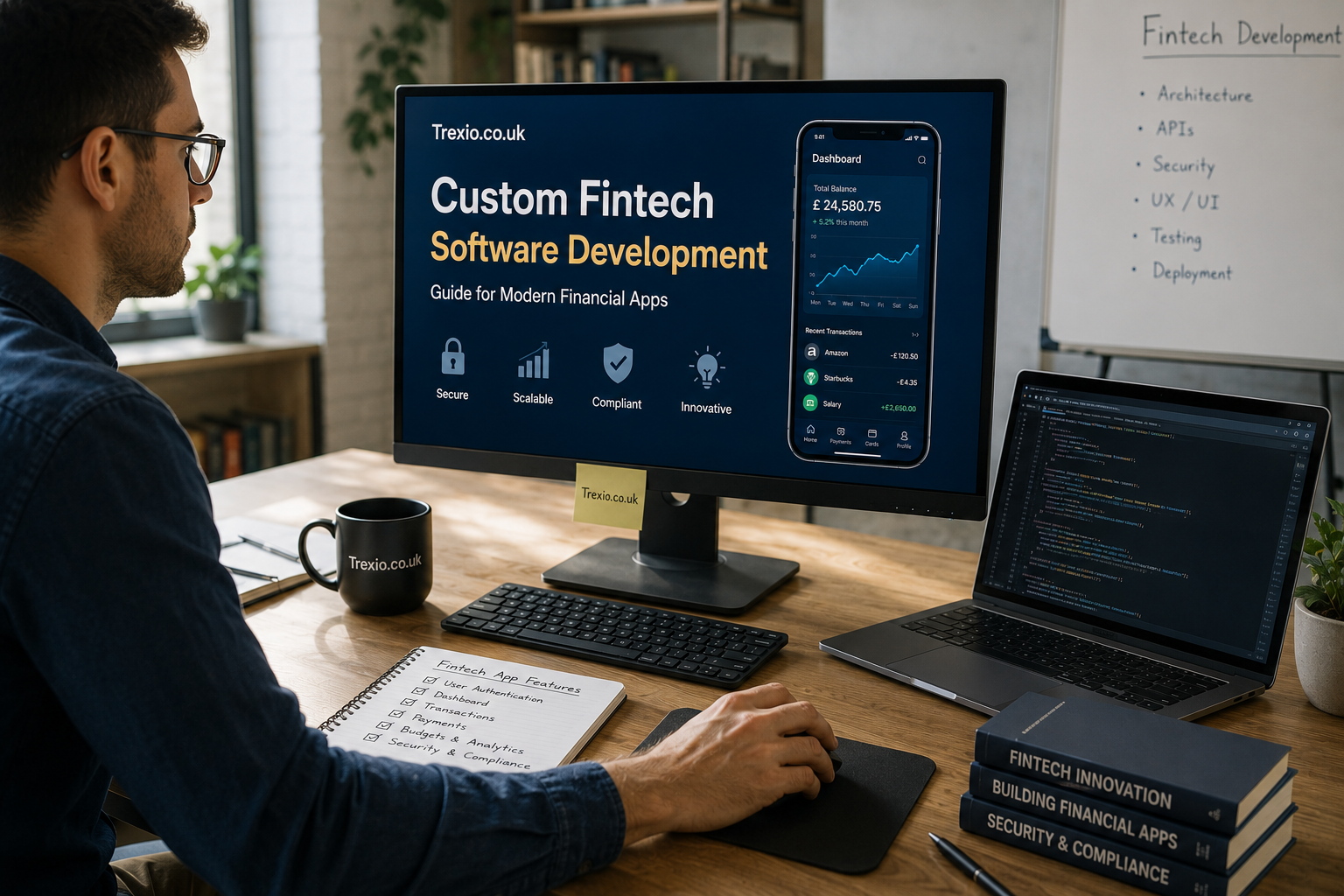
Financial services have changed dramatically over the past decade. Consumers now expect instant payments, digital banking, AI-powered recommendations, seamless lending experiences, and secure online transactions from every financial provider they use. Traditional software often struggles to meet these expectations because it was designed for generalized business operations rather than complex financial ecosystems. This is where custom fintech software development becomes a strategic investment rather than simply another technology project. Organizations can build solutions specifically designed around their workflows, regulatory requirements, security policies, customer expectations, and future growth plans. Whether a business is launching a digital bank, payment gateway, lending platform, investment portal, insurance application, or wealth management solution, tailored development creates a competitive advantage that off-the-shelf software rarely delivers. Companies investing in custom-built fintech platforms are also better prepared to adapt as regulations, customer behaviors, and emerging technologies continue to evolve. Understanding how this development approach works is the first step toward building a sustainable financial technology ecosystem.
Quick Answer
Custom fintech software development is the process of designing, developing, testing, deploying, and maintaining financial technology solutions tailored to the unique operational, security, compliance, and business requirements of an organization. Unlike ready-made software, custom fintech platforms are built specifically for banking, payments, lending, wealth management, insurance, accounting, cryptocurrency, compliance, fraud detection, and other financial services. These solutions offer greater flexibility, stronger security, easier scalability, and better integration with existing financial systems while helping businesses comply with industry regulations and deliver exceptional digital customer experiences.
Why Custom Fintech Software Development Is Growing Rapidly
The financial industry is experiencing one of the largest digital transformations in history. Customers expect mobile-first experiences, real-time notifications, personalized financial recommendations, and secure digital transactions regardless of where they are located. Businesses must also comply with increasingly complex regulations while protecting sensitive financial information from sophisticated cyber threats. These demands make generic software increasingly difficult to maintain and customize. Custom fintech software development gives organizations complete control over features, integrations, workflows, and security architecture while supporting continuous innovation. Financial institutions can respond faster to changing market demands because new capabilities are developed specifically for their operational goals rather than waiting for third-party vendors to release updates. As digital payments, embedded finance, open banking, and AI continue expanding, organizations investing in custom platforms position themselves for long-term growth. This combination of flexibility, security, and scalability explains why demand continues rising across nearly every segment of financial technology.
Major Market Drivers
Digital Financial Transformation
Digital transformation remains one of the strongest reasons businesses invest in custom fintech software development. Banks, insurers, investment firms, and payment providers are replacing legacy systems with cloud-native platforms capable of supporting millions of users simultaneously. Modern software architecture enables faster deployments, continuous updates, stronger disaster recovery, and better customer experiences. Businesses also gain access to advanced analytics, automation, and artificial intelligence that improve operational efficiency. Custom-built systems eliminate unnecessary features while focusing development resources on capabilities that directly benefit customers and employees. Organizations become more agile because every enhancement aligns with business objectives instead of vendor roadmaps. This flexibility significantly improves long-term return on investment. As digital transformation accelerates, custom software continues becoming a preferred technology strategy.
Rising Customer Expectations
Today’s financial customers compare banking experiences with leading technology companies rather than traditional financial institutions. They expect intuitive interfaces, instant approvals, biometric authentication, personalized dashboards, and real-time transaction tracking. Custom fintech software development enables organizations to build these experiences from the ground up while maintaining strict compliance and security standards. Businesses can optimize customer journeys based on actual user behavior instead of adapting workflows to fit commercial software limitations. Personalized experiences improve customer retention, increase engagement, and strengthen brand loyalty. Organizations can continuously improve digital products through analytics and customer feedback. This customer-centric approach creates lasting competitive advantages in highly competitive financial markets.
Core Benefits of Custom Fintech Software Development
Every financial organization has unique workflows, customer segments, operational requirements, and compliance obligations. Generic software rarely accommodates these differences without expensive modifications or compromises. Investing in custom fintech software development allows businesses to create solutions specifically aligned with organizational goals. Development teams can optimize every workflow, automate manual processes, strengthen security controls, and integrate multiple financial systems into one unified platform. Long-term flexibility also improves because future enhancements can be added without replacing the entire software ecosystem. Businesses gain ownership of their technology roadmap instead of depending entirely on external vendors. These benefits continue delivering value long after deployment. For organizations seeking sustainable innovation, customized solutions often provide significantly greater returns than standardized software.
Enhanced Security
Financial data represents one of the most valuable targets for cybercriminals. Protecting customer information, payment credentials, and transaction records requires multiple layers of security throughout the software architecture. Custom fintech software development enables developers to implement encryption, multi-factor authentication, secure APIs, fraud detection systems, access controls, monitoring tools, and security auditing specifically designed for organizational requirements. Rather than relying on default security settings found in commercial software, organizations establish customized protection strategies. Continuous security testing identifies vulnerabilities before attackers exploit them. Secure coding practices reduce common software weaknesses while regular updates maintain protection against emerging threats. This proactive security approach significantly reduces organizational risk.
Better Regulatory Compliance
Financial organizations operate under strict regulatory frameworks that differ across countries and industries. Compliance requirements affect data handling, reporting, customer identification, anti-money laundering procedures, and payment processing. Custom fintech software development allows organizations to design compliance directly into every business process rather than adding regulatory features later. Automated reporting reduces manual errors while audit trails improve transparency during inspections. Compliance monitoring becomes more efficient because systems generate required documentation automatically. Organizations also adapt more quickly when regulations change since developers control the platform architecture. This flexibility minimizes disruption while reducing compliance costs over time.
Improved Scalability
Successful fintech businesses rarely remain the same size for long. Customer numbers, transaction volumes, payment methods, and geographic markets often expand rapidly. Custom fintech software development supports scalable architectures capable of handling increasing workloads without sacrificing performance. Cloud infrastructure, containerized deployments, microservices, and API-driven systems allow organizations to expand gradually as demand increases. New products, payment channels, currencies, or customer segments can be introduced without rebuilding the entire platform. Scalability ensures technology supports business growth rather than becoming a limitation. Long-term planning also becomes easier because future expansion is considered during initial development.
Types of Custom Fintech Software Solutions
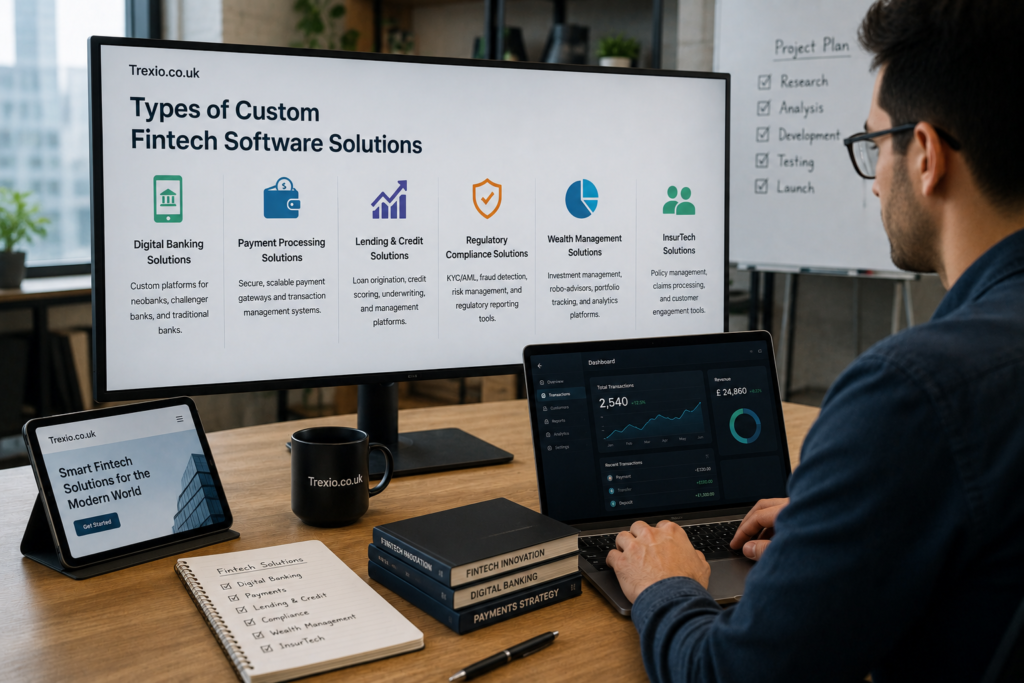
The financial technology industry encompasses many specialized software categories designed to solve different business challenges. Each solution requires unique security measures, regulatory compliance, user experiences, and technology integrations. Custom fintech software development allows organizations to select only the capabilities they need while ensuring seamless interoperability between different financial services. Tailored platforms improve operational efficiency, simplify customer interactions, and strengthen overall business performance. Organizations may build a single financial application or develop an integrated ecosystem supporting multiple financial products. Careful planning ensures every component aligns with long-term business strategies. The following categories represent some of the most common custom fintech solutions available today.
Digital Banking Platforms
Digital banking software enables customers to manage accounts, transfer funds, pay bills, monitor spending, apply for financial products, and receive personalized financial insights from virtually any device. Through custom fintech software development, banks can create unique customer experiences while integrating core banking systems, payment networks, fraud detection tools, customer relationship management platforms, and compliance systems. Personalized dashboards, budgeting features, AI chatbots, biometric authentication, and real-time notifications improve customer satisfaction. Banks also gain operational efficiencies through automation and intelligent workflow management. As digital banking adoption continues increasing worldwide, customized platforms provide greater flexibility than standardized banking software.
Payment Processing Systems
Modern payment ecosystems require secure, fast, and reliable transaction processing across multiple channels. Businesses investing in custom fintech software development can build payment gateways, merchant platforms, mobile wallets, subscription billing systems, cross-border payment solutions, and embedded payment infrastructures. These platforms integrate with banks, card networks, digital wallets, accounting software, fraud detection services, and identity verification providers. Intelligent routing improves payment success rates while advanced monitoring identifies suspicious activities. Customized payment systems also support multiple currencies, regional regulations, and customer preferences. Flexibility becomes increasingly valuable as payment technologies continue evolving.
Lending and Loan Management Software
Financial institutions increasingly rely on intelligent lending platforms to streamline application processing, automate underwriting, evaluate credit risk, and improve borrower experiences. Custom fintech software development enables organizations to integrate artificial intelligence, machine learning, credit scoring models, document verification, digital signatures, customer onboarding, and repayment management into one comprehensive platform. Automation significantly reduces approval times while improving consistency across lending decisions. Customers benefit from faster processing and greater transparency throughout the borrowing journey. Financial organizations simultaneously improve operational efficiency and reduce administrative costs through digital workflows.
Essential Technologies Used in Custom Fintech Software Development
Building modern financial applications requires combining multiple advanced technologies into a secure, scalable, and reliable ecosystem. Technology selection depends on business objectives, regulatory requirements, projected growth, integration needs, and customer expectations. Custom fintech software development often combines cloud computing, artificial intelligence, blockchain, API architecture, cybersecurity frameworks, data analytics, and automation to deliver exceptional digital financial services. Selecting the right technology stack early helps organizations avoid expensive migrations later. Experienced development teams also prioritize maintainability, performance, and future scalability throughout the software lifecycle. Strong technology foundations support continuous innovation as business needs evolve. Choosing wisely at the planning stage dramatically improves long-term project success.
Cloud Computing
Cloud infrastructure has transformed financial software by improving scalability, resilience, deployment speed, and disaster recovery. Through custom fintech software development, organizations leverage cloud services to support high transaction volumes while maintaining strong security controls. Cloud-native architectures simplify software updates, improve collaboration among development teams, and reduce infrastructure costs. Businesses also gain geographic redundancy and automated backup capabilities that strengthen operational continuity. Flexible resource allocation allows platforms to handle sudden traffic spikes efficiently. Cloud adoption continues accelerating because it supports innovation while improving overall system reliability.
Artificial Intelligence and Machine Learning
Artificial intelligence is becoming a central component of custom fintech software development. AI enhances fraud detection, customer service, risk assessment, predictive analytics, investment recommendations, document processing, compliance monitoring, and personalized financial experiences. Machine learning models continuously improve by analyzing transaction patterns and customer behaviors. Intelligent automation reduces manual workloads while improving decision accuracy across financial operations. Organizations also gain valuable business insights through advanced analytics and predictive forecasting. As AI technologies mature, their role within financial software continues expanding across virtually every business function.
Blockchain and Distributed Ledger Technology
Blockchain has become an important technology within custom fintech software development because it enables transparent, secure, and tamper-resistant financial transactions. Financial organizations use distributed ledger technology to simplify payment processing, improve cross-border transfers, automate settlement procedures, and strengthen transaction verification. Smart contracts eliminate many manual tasks by executing predefined business rules automatically once agreed conditions are met. This reduces processing time, lowers operational costs, and minimizes human error. Blockchain also improves traceability because every authorized transaction is permanently recorded. Businesses developing digital asset platforms, decentralized finance (DeFi) solutions, or tokenized payment systems often incorporate blockchain into their technology stack. Although blockchain is not necessary for every fintech project, it provides measurable advantages for organizations that require enhanced transparency, auditability, and transaction integrity.
API-First Architecture
An API-first strategy allows custom fintech software development projects to integrate seamlessly with banking systems, payment gateways, accounting software, identity verification platforms, customer relationship management solutions, and third-party financial services. APIs create flexible communication channels that enable multiple applications to exchange information securely and efficiently. This architecture also makes future expansion easier because new services can be connected without redesigning the entire platform. Businesses benefit from faster innovation since development teams can reuse APIs across different products and services. Well-designed APIs also improve developer productivity while reducing maintenance complexity. As embedded finance and open banking continue expanding globally, API-driven ecosystems have become essential for long-term fintech growth. Organizations that prioritize API architecture typically achieve greater scalability and stronger partner integration capabilities.
The Custom Fintech Software Development Process
Successful custom fintech software development follows a structured lifecycle that minimizes risks while ensuring the final solution aligns with business objectives. Every phase contributes to software quality, regulatory compliance, security, and long-term maintainability. Skipping important planning or testing activities often leads to expensive revisions after launch. Experienced development teams emphasize collaboration between stakeholders, designers, engineers, compliance specialists, and quality assurance professionals throughout the project. Continuous feedback ensures the product evolves according to changing business priorities. Organizations also benefit from incremental delivery models that reduce project risks while accelerating time-to-market. Understanding each development phase helps decision-makers prepare realistic budgets, timelines, and expectations.
Discovery and Business Analysis
The discovery phase establishes the foundation for successful custom fintech software development by identifying business goals, target audiences, regulatory obligations, competitive challenges, and technical requirements. Analysts work closely with stakeholders to understand workflows, customer pain points, operational bottlenecks, and desired outcomes. Functional requirements are documented alongside security expectations and integration needs. Risk assessments help identify potential technical and compliance issues before development begins. Early planning also defines project priorities, milestones, success metrics, and resource allocation. Thorough discovery minimizes misunderstandings during later development stages. Organizations that invest sufficient time in planning generally experience fewer costly changes during implementation.
UI/UX Design
Financial applications require intuitive interfaces that balance simplicity with powerful functionality. During custom fintech software development, designers create user journeys, wireframes, interactive prototypes, and accessibility-focused interfaces that simplify complex financial operations. Clear navigation, responsive layouts, and consistent branding improve customer satisfaction across web and mobile platforms. User-centered design also reduces support requests because customers can complete transactions with minimal confusion. Accessibility considerations ensure applications remain usable for diverse audiences. Regular usability testing validates design decisions before coding begins. A polished user experience significantly increases customer engagement and long-term retention.
Development and Integration
Once planning and design are complete, engineers begin building the application using secure coding practices and modern development frameworks. Custom fintech software development often involves front-end interfaces, back-end services, databases, cloud infrastructure, API integrations, payment processors, fraud detection systems, and compliance modules working together as one ecosystem. Agile methodologies allow incremental delivery while incorporating stakeholder feedback throughout development. Code reviews maintain quality standards and reduce security vulnerabilities. Automated testing improves software stability as new features are introduced. Continuous integration and deployment pipelines accelerate development while maintaining reliability. This collaborative process supports efficient delivery without sacrificing quality.
Testing, Deployment, and Maintenance
Testing remains one of the most critical stages of custom fintech software development because financial software cannot tolerate security weaknesses or transaction errors. Teams perform functional testing, integration testing, performance testing, security assessments, penetration testing, and user acceptance testing before deployment. After launch, ongoing maintenance includes software updates, performance optimization, security patching, compliance adjustments, and feature enhancements. Monitoring tools continuously evaluate system health and identify potential issues before they affect customers. Regular maintenance also extends software lifespan while supporting changing business requirements. Organizations that prioritize long-term maintenance maximize the value of their technology investments. Continuous improvement ensures fintech platforms remain competitive and secure.
Choosing the Right Technology Stack
Selecting the appropriate technology stack influences performance, security, scalability, and future flexibility throughout custom fintech software development. Every project should evaluate programming languages, cloud providers, databases, security frameworks, integration platforms, and development tools based on long-term business objectives rather than temporary trends. High-performance architectures improve transaction speed while reducing infrastructure costs. Development teams also consider community support, ecosystem maturity, and future maintenance requirements. Technology decisions should support regulatory compliance and evolving customer expectations. Scalable solutions enable organizations to expand without major architectural changes. Strategic technology planning reduces long-term operational complexity.
Popular Technologies
| Technology Area | Common Choices | Primary Purpose |
|---|---|---|
| Front-End | React, Angular, Vue | Interactive user interfaces |
| Back-End | Java, .NET, Node.js, Python | Business logic and APIs |
| Mobile | Flutter, Swift, Kotlin | Native and cross-platform apps |
| Database | PostgreSQL, MySQL, MongoDB | Secure data storage |
| Cloud | AWS, Microsoft Azure, Google Cloud | Infrastructure and scalability |
| AI & Analytics | TensorFlow, PyTorch | Machine learning capabilities |
| DevOps | Docker, Kubernetes, Jenkins | Deployment automation |
| Security | OAuth 2.0, JWT, MFA | Identity and access management |
How to Choose a Custom Fintech Software Development Partner
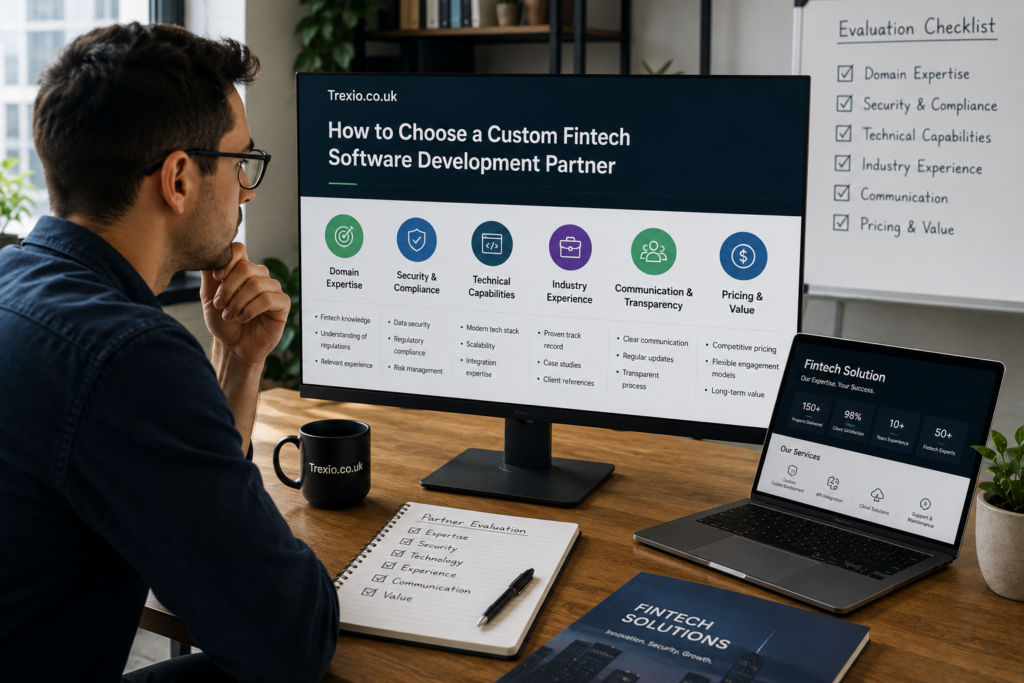
Selecting the right partner is one of the most important decisions in custom fintech software development. A qualified development company should possess technical expertise, financial industry knowledge, security experience, and regulatory awareness. Businesses should review previous fintech projects, client testimonials, technology capabilities, development methodologies, and communication practices before signing contracts. Strong documentation processes and transparent project management improve collaboration throughout development. Companies should also evaluate post-launch support services, maintenance offerings, and scalability expertise. Cost should never be the only deciding factor because poor-quality software often creates higher long-term expenses. An experienced partner contributes strategic guidance in addition to software engineering skills.
Evaluation Checklist
| Evaluation Factor | Why It Matters |
|---|---|
| Fintech Experience | Industry-specific expertise |
| Security Knowledge | Protects sensitive financial data |
| Compliance Understanding | Meets legal requirements |
| Portfolio | Demonstrates technical capability |
| Agile Methodology | Supports flexible development |
| Communication | Improves project transparency |
| Maintenance Services | Ensures long-term reliability |
| Scalability Expertise | Supports future business growth |
Best Practices for Custom Fintech Software Development
- Define clear business objectives before writing any code.
- Prioritize cybersecurity from the earliest planning stages.
- Build compliance requirements directly into the system architecture.
- Design scalable infrastructure capable of supporting business growth.
- Use API-first architecture for future integrations.
- Perform automated and manual security testing regularly.
- Implement continuous monitoring after deployment.
- Optimize user experience for both desktop and mobile users.
- Maintain detailed technical documentation throughout development.
- Continuously gather customer feedback to improve future releases.
Common Mistakes to Avoid
| Mistake | Potential Impact |
|---|---|
| Ignoring compliance early | Regulatory penalties |
| Choosing technology based only on trends | Higher maintenance costs |
| Weak security planning | Increased cyber risks |
| Poor scalability design | Performance bottlenecks |
| Limited testing | Software failures after launch |
| Inadequate documentation | Difficult maintenance |
| Skipping user research | Low customer adoption |
| No post-launch strategy | Faster software obsolescence |
Pro Tips
Invest in Security by Design
Build security into every layer of custom fintech software development instead of treating it as a final checklist. Encryption, authentication, monitoring, and secure coding practices should be integrated from the beginning.
Plan for Future Growth
Design your software architecture with scalability in mind. Microservices, cloud-native infrastructure, and modular APIs make it easier to introduce new products, payment methods, and customer services as your business expands.
Use Data to Drive Decisions
Analytics should not be limited to reporting. Collect meaningful operational and customer insights that guide feature improvements, fraud prevention strategies, and personalized financial experiences.
Never Stop Improving
Successful custom fintech software development is an ongoing journey rather than a one-time project. Continuous optimization, customer feedback, performance monitoring, and regular updates help maintain competitive advantages in an evolving financial landscape.
Conclusion
Custom fintech software development empowers financial organizations to create secure, scalable, and highly personalized digital solutions that align precisely with their operational goals and customer expectations. Unlike generic software, custom platforms provide complete control over functionality, integrations, compliance requirements, and long-term technology strategy. As digital banking, embedded finance, AI-powered services, and real-time payments continue transforming the financial industry, organizations with flexible software architectures will be better positioned for sustainable growth. Investing in tailored fintech solutions also improves operational efficiency, strengthens cybersecurity, enhances customer satisfaction, and simplifies regulatory compliance. While successful implementation requires careful planning, experienced development teams, and ongoing maintenance, the long-term benefits often outweigh the initial investment. Businesses that embrace innovation through custom-built financial technology can respond more quickly to market changes while delivering exceptional user experiences. A well-executed fintech platform becomes more than software—it becomes a strategic asset that supports innovation, competitiveness, and long-term business success.
Frequently Asked Questions
1. What is custom fintech software development?
Custom fintech software development is the process of creating tailored financial technology solutions designed specifically for an organization’s business model, operational workflows, security requirements, and compliance obligations.
2. Who needs custom fintech software?
Banks, credit unions, payment providers, insurance companies, investment firms, lending platforms, accounting businesses, and fintech startups commonly benefit from custom-built financial software.
3. Is custom software more secure than off-the-shelf software?
It can be, because security controls are designed specifically for the organization’s needs and can include customized authentication, encryption, monitoring, and compliance measures.
4. How long does fintech software development usually take?
Project timelines vary depending on complexity, integrations, regulatory requirements, and feature scope. Small projects may take several months, while enterprise platforms often require significantly longer.
5. Can custom fintech software integrate with existing banking systems?
Yes. Modern solutions are typically built using APIs that enable secure integration with banking platforms, payment gateways, accounting systems, customer databases, and third-party financial services.
6. Why is compliance important in fintech software?
Compliance helps organizations meet legal requirements, protect customer information, reduce financial risks, and avoid regulatory penalties.
7. Does custom fintech software support cloud deployment?
Yes. Many organizations choose cloud-native architectures because they improve scalability, availability, disaster recovery, and operational efficiency.
8. How does AI improve fintech software?
Artificial intelligence enhances fraud detection, customer support, predictive analytics, credit assessment, document processing, and personalized financial recommendations.
9. What is the biggest advantage of custom fintech software development?
The biggest advantage is complete flexibility to build software that precisely matches business objectives while supporting security, compliance, scalability, and future innovation.
10. How do businesses choose the right fintech development company?
They should evaluate industry experience, technical expertise, security practices, regulatory knowledge, portfolio quality, communication processes, and long-term maintenance capabilities.
Author Bio
About the Author
The author is an experienced technology and fintech content writer specializing in financial software, digital transformation, cloud computing, cybersecurity, artificial intelligence, and enterprise technology. With a strong focus on SEO, EEAT principles, and user-focused content, the author creates in-depth resources that help business leaders, developers, and decision-makers understand emerging technologies and make informed software investment decisions.