
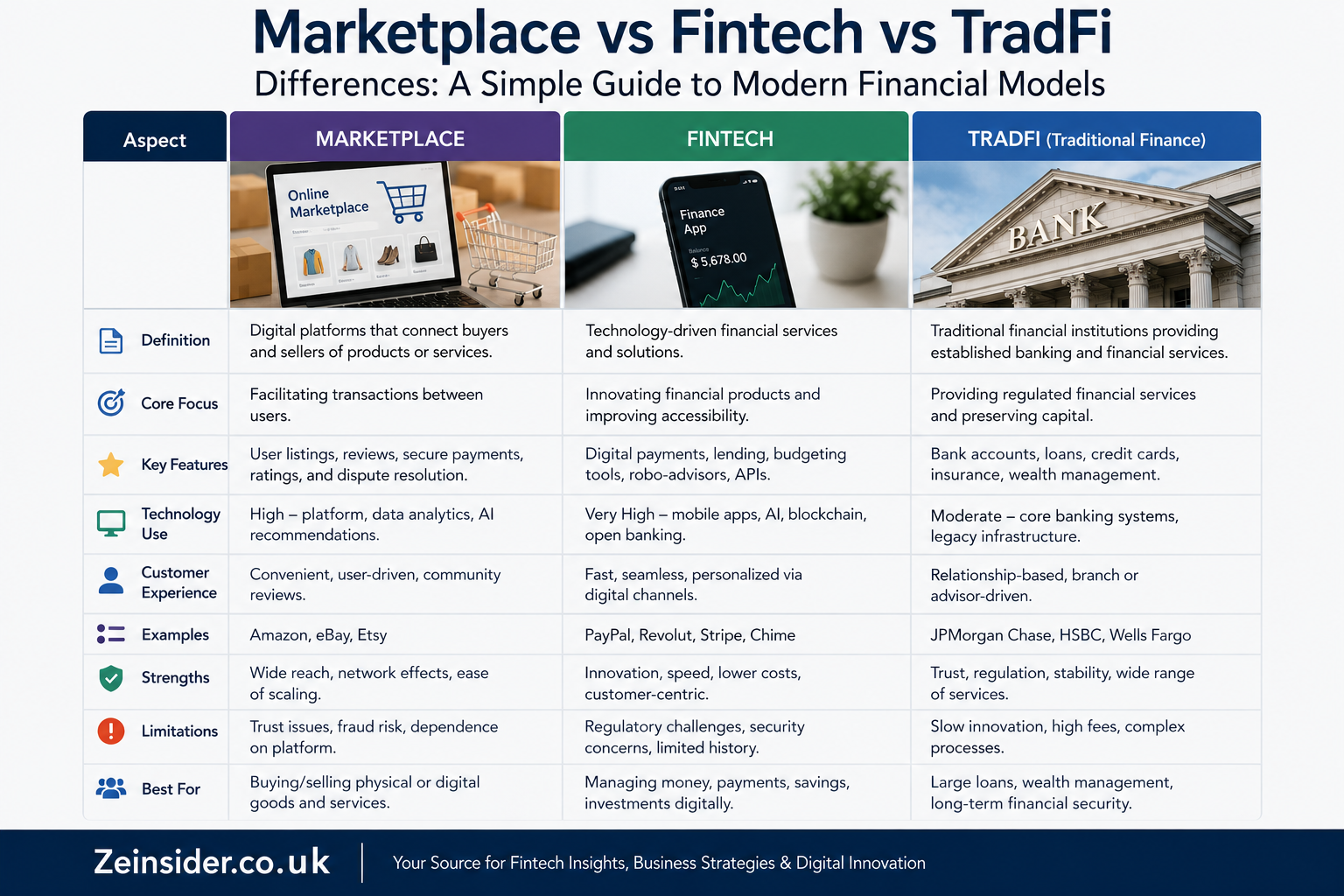
The financial world has changed dramatically over the last decade. Digital transformation, mobile technology, artificial intelligence, cloud computing, and changing customer expectations have reshaped how people borrow money, invest, save, make payments, and conduct business online. As a result, three major ecosystems now dominate financial discussions: marketplaces, fintech companies, and traditional financial institutions (TradFi). Understanding the marketplace vs fintech vs tradfi differences has become increasingly important for entrepreneurs, investors, startups, financial professionals, and everyday consumers who want to make informed decisions. Although these three models often overlap, they operate with different objectives, technologies, regulations, and customer experiences. Many businesses even combine multiple approaches to remain competitive in today’s digital economy. Knowing where each model excels can help individuals choose better financial products while enabling companies to build stronger strategies. This guide explains the marketplace vs fintech vs tradfi differences using practical examples and easy-to-understand explanations while following current industry trends.
Quick Answer
The marketplace vs fintech vs tradfi differences mainly revolve around business structure, technology adoption, customer interaction, and financial responsibility. A marketplace primarily connects buyers and sellers without necessarily owning financial products. Fintech companies use technology to improve or replace traditional financial services through digital innovation. Traditional finance (TradFi) refers to established banks, insurance firms, investment companies, and financial institutions that operate under long-standing regulatory frameworks. While marketplaces focus on facilitating transactions, fintech firms prioritize digital financial solutions, and TradFi institutions concentrate on providing regulated banking and financial services. Each model serves different purposes, offers unique advantages, and faces distinct challenges within the modern financial ecosystem.
Understanding Marketplace vs Fintech vs TradFi Differences
What Is a Marketplace?
A marketplace is an online or digital platform that connects multiple buyers with multiple sellers while simplifying transactions between them. Unlike traditional retailers, marketplaces usually do not own the products or services they facilitate. Instead, they generate revenue through commissions, subscription fees, advertising, listing charges, or transaction fees. Modern marketplaces can serve industries including eCommerce, real estate, transportation, healthcare, freelancing, education, and financial services. Some marketplaces specialize in lending, investment opportunities, insurance products, or payment services, creating financial ecosystems that connect consumers with providers. The rise of cloud infrastructure and digital payments has accelerated marketplace growth worldwide. As businesses evaluate the marketplace vs fintech vs tradfi differences, marketplaces stand out because they primarily enable interactions rather than directly manufacturing financial products. Their success depends heavily on network effects, user trust, liquidity, and efficient matching algorithms.
Key Characteristics of Marketplaces
Platform-Based Business Model
Marketplace businesses focus on creating value by bringing together multiple participants within one ecosystem. Instead of manufacturing products or lending money themselves, they simplify discovery, comparison, communication, and transactions. Their platforms often include user reviews, recommendation systems, payment gateways, and dispute resolution tools that improve customer confidence. As more participants join, the platform becomes increasingly valuable through network effects. This scalability explains why many successful marketplaces experience rapid growth after reaching critical mass. Revenue often increases alongside transaction volume rather than inventory expansion. These characteristics make marketplaces fundamentally different when examining the marketplace vs fintech vs tradfi differences.
Multiple Revenue Sources
Marketplace operators rarely rely on one income stream. They often combine commissions, premium memberships, featured listings, advertising services, payment processing fees, logistics partnerships, financing referrals, and software subscriptions. Diversifying revenue improves long-term sustainability while reducing dependence on individual sellers. Modern financial marketplaces increasingly integrate fintech capabilities like embedded payments, Buy Now Pay Later (BNPL), digital wallets, and lending options to create seamless customer experiences. This blending of services highlights how the marketplace vs fintech vs tradfi differences continue evolving as digital ecosystems mature.
What Is Fintech?
Financial technology, commonly known as fintech, refers to companies that use advanced technology to improve, automate, or replace traditional financial services. Fintech businesses leverage artificial intelligence, blockchain, machine learning, cloud computing, big data analytics, open banking, APIs, cybersecurity innovations, and mobile applications to deliver faster and more accessible financial products. Instead of requiring customers to visit physical branches, fintech platforms provide digital-first experiences through smartphones, websites, and integrated software solutions. Fintech has transformed payments, lending, investing, wealth management, insurance, budgeting, remittances, cryptocurrency services, and personal finance management. The rapid expansion of fintech has significantly influenced discussions surrounding the marketplace vs fintech vs tradfi differences, as consumers increasingly prefer digital convenience over traditional banking processes. Innovation remains the defining characteristic of fintech organizations.
Core Features of Fintech Companies
Technology-First Operations
Unlike traditional institutions, fintech companies build their services around modern technology from the beginning. Their systems are designed for automation, scalability, rapid deployment, and continuous improvement. Artificial intelligence assists with fraud detection, customer support, loan underwriting, and personalized financial recommendations. Cloud infrastructure enables flexible expansion without expensive physical branches. APIs allow fintech companies to integrate with banks, payment processors, marketplaces, and third-party applications. This technology-first mindset significantly differentiates fintech within the broader discussion of marketplace vs fintech vs tradfi differences.
Customer-Centric Innovation
Fintech organizations prioritize user experience by reducing paperwork, simplifying onboarding, improving mobile interfaces, and offering real-time financial insights. Digital identity verification speeds account creation while automated compliance systems reduce operational friction. Many fintech platforms also personalize recommendations using behavioral analytics and spending patterns. Subscription pricing, transparent fees, and intuitive dashboards appeal to younger consumers who expect seamless digital interactions. Continuous product updates enable fintech companies to respond quickly to changing customer needs. These advantages continue driving global fintech adoption while reshaping expectations across the financial industry.
What Is TradFi?
Traditional finance, often shortened to TradFi, represents the established financial system consisting of commercial banks, investment banks, insurance companies, stock exchanges, brokerage firms, credit unions, mortgage providers, pension funds, and asset management institutions. These organizations have operated for decades, often centuries, under comprehensive regulatory frameworks designed to ensure financial stability and consumer protection. TradFi institutions provide checking accounts, savings accounts, loans, mortgages, investment services, retirement planning, wealth management, insurance policies, and payment processing. Although many traditional institutions now offer digital services, their operational foundations remain rooted in conventional banking infrastructure. Understanding TradFi forms an essential part of learning the marketplace vs fintech vs tradfi differences, especially for businesses evaluating financial partnerships or digital transformation strategies.
Characteristics of Traditional Finance
Strong Regulatory Oversight
Traditional financial institutions operate under strict national and international regulations governing capital requirements, consumer protection, anti-money laundering procedures, cybersecurity, and financial reporting. These regulations help maintain trust within the financial system while reducing systemic risks. Compliance departments monitor legal obligations continuously, making regulatory adherence one of TradFi’s largest operational expenses. Customers often perceive regulated institutions as safer because deposits and investments may receive government protections depending on jurisdiction. This emphasis on regulation distinguishes TradFi when comparing the marketplace vs fintech vs tradfi differences.
Established Customer Trust
Many consumers continue relying on traditional financial institutions because of their long histories, recognizable brands, extensive branch networks, and government oversight. Businesses frequently choose established banks for treasury management, commercial lending, and corporate financial services due to proven reliability. While digital innovation has accelerated, institutional reputation remains one of TradFi’s greatest competitive strengths. Multi-generational customer relationships also contribute to strong retention rates. These trust factors explain why traditional finance remains highly influential despite increasing fintech competition.
Marketplace vs Fintech vs TradFi Differences at a Glance
| Feature | Marketplace | Fintech | TradFi |
|---|---|---|---|
| Primary Role | Connects buyers and sellers | Provides technology-driven financial services | Offers regulated financial services |
| Main Focus | Platform ecosystem | Digital innovation | Financial stability |
| Technology | High | Very High | Moderate to High |
| Physical Branches | Rare | Rare | Common |
| Revenue Model | Commission, subscriptions | Service fees, subscriptions, interest | Interest income, service fees |
| Customer Experience | Platform-based | Mobile-first | Branch plus digital |
| Speed of Innovation | Fast | Very Fast | Moderate |
| Regulatory Burden | Medium | Medium to High | Very High |
Business Models Behind Marketplace, Fintech, and TradFi
How Marketplace Business Models Work
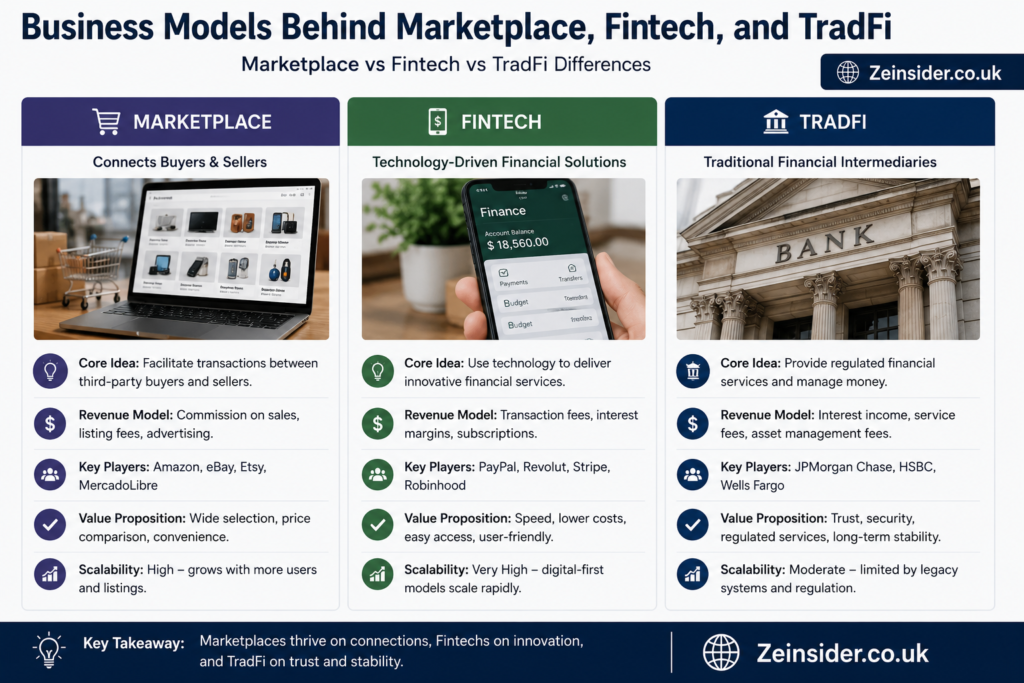
Marketplace businesses generate value by efficiently matching demand with supply while minimizing transaction friction. Rather than investing heavily in inventory, they invest in technology, trust systems, search algorithms, recommendation engines, payment infrastructure, and customer acquisition. Success depends on attracting enough buyers and sellers to create sustainable network effects. Platform operators continuously optimize pricing strategies, seller onboarding, dispute resolution, fraud prevention, and customer support to improve marketplace efficiency. Financial marketplaces often expand into embedded finance by integrating lending, insurance, digital wallets, or payment processing directly into customer journeys. This evolution further influences discussions surrounding the marketplace vs fintech vs tradfi differences because marketplaces increasingly offer financial features without becoming full financial institutions. Their flexible business models allow rapid adaptation to changing customer needs.
Marketplace Revenue Streams
Commission-Based Income
Transaction commissions remain the most common marketplace revenue model. Every successful transaction generates a percentage-based fee, creating scalable recurring income. As transaction volume increases, overall profitability generally improves without proportional operational costs. This asset-light approach makes marketplaces attractive for investors seeking scalable digital businesses. Many platforms also introduce premium features that increase seller visibility while generating additional revenue. Commission-based models remain a defining characteristic in the broader marketplace vs fintech vs tradfi differences discussion.
Subscription and Premium Services
Many marketplaces supplement commission revenue with monthly subscriptions offering advanced analytics, advertising tools, priority support, enhanced visibility, inventory management, customer relationship software, and financial insights. Premium memberships encourage seller loyalty while creating predictable recurring income. Enterprise users may receive dedicated account management and custom integrations that strengthen long-term partnerships. These diversified monetization strategies enhance financial sustainability while supporting continued platform innovation.
How Fintech Business Models Work
Fintech companies create value by solving financial problems with software, automation, and digital infrastructure rather than relying on extensive branch networks. Their products are designed to reduce friction, lower operating costs, and improve customer convenience through mobile applications and cloud-based platforms. Many fintech businesses begin by addressing one specific pain point, such as digital payments, peer-to-peer lending, expense management, online investing, or cross-border money transfers, before expanding into broader financial ecosystems. Revenue may come from transaction fees, subscription plans, interchange fees, lending interest, premium features, licensing technology, or software-as-a-service (SaaS) offerings. Open banking has enabled many fintech firms to connect securely with traditional banks while maintaining a seamless customer experience. As competition increases, fintech providers continue investing in artificial intelligence, automation, cybersecurity, and predictive analytics to improve efficiency and personalization. These innovations further emphasize the marketplace vs fintech vs tradfi differences, especially regarding speed of innovation and digital accessibility. Understanding these operating models helps businesses identify which financial ecosystem best aligns with their strategic goals.
Revenue Models Used by Fintech Companies
Subscription-Based Services
Many fintech businesses generate recurring income by offering premium subscription plans with additional financial insights, budgeting tools, investment analytics, automated tax reporting, or enhanced security features. Customers often appreciate predictable pricing rather than hidden service charges. Subscription models also create stable revenue streams that support continuous product improvements. Companies can introduce tiered pricing to serve both individual users and enterprise clients. This approach encourages customer retention while reducing dependence on transaction volume. Within the discussion of marketplace vs fintech vs tradfi differences, subscription-driven fintech firms highlight the industry’s focus on software innovation instead of conventional banking income.
Transaction and Interchange Fees
Payment-focused fintech companies commonly earn revenue whenever customers use debit cards, digital wallets, payment gateways, or money transfer services. Although individual fees may be relatively small, high transaction volumes can generate substantial income. Many businesses also partner with merchants to provide embedded payment solutions that simplify online purchasing. As digital commerce expands globally, transaction-based revenue continues growing rapidly. These scalable models demonstrate how fintech companies monetize technology while improving user convenience. This business structure remains a major differentiator within the marketplace vs fintech vs tradfi differences landscape.
How Traditional Financial Institutions Generate Revenue
Traditional financial institutions have long relied on diversified revenue sources that combine lending activities, investment services, advisory solutions, and account management. Interest earned from mortgages, personal loans, business financing, and credit products remains one of their largest income streams. Banks also generate fees from wire transfers, account maintenance, foreign exchange, wealth management, brokerage services, and payment processing. Insurance companies earn premiums while investment firms generate management fees from client portfolios. Unlike many startups, established financial institutions often maintain diversified revenue across multiple business units, reducing reliance on a single service. Their financial strength enables them to withstand economic fluctuations more effectively than smaller competitors. These characteristics continue to shape the marketplace vs fintech vs tradfi differences, particularly regarding financial resilience and long-term stability. While innovation may progress more gradually, diversified income remains one of TradFi’s greatest strengths.
Technology Comparison: Marketplace vs Fintech vs TradFi Differences
Technology adoption represents one of the most visible marketplace vs fintech vs tradfi differences. Marketplaces focus on matching algorithms, recommendation engines, digital payments, customer reviews, and scalable cloud platforms that facilitate transactions efficiently. Fintech companies push technology even further by incorporating artificial intelligence, blockchain, biometric authentication, machine learning, open APIs, robotic process automation, and predictive analytics into everyday financial services. Traditional financial institutions increasingly modernize their systems but often balance innovation with strict compliance requirements and legacy infrastructure. As a result, technology upgrades may require longer implementation timelines. However, many established banks now collaborate with fintech startups to accelerate digital transformation while preserving regulatory compliance. This convergence has blurred some industry boundaries without eliminating the unique characteristics of each model. Businesses evaluating digital strategies should consider technological flexibility alongside security, scalability, and customer expectations. Understanding these differences enables smarter investment and partnership decisions.
Technology Comparison Table
| Technology Area | Marketplace | Fintech | TradFi |
|---|---|---|---|
| AI Integration | Moderate | Extensive | Growing |
| Mobile Experience | High | Very High | High |
| Legacy Systems | Minimal | Minimal | Significant |
| Cloud Infrastructure | Extensive | Extensive | Increasing |
| API Integration | Common | Core Technology | Expanding |
| Blockchain Usage | Limited | Growing | Selective |
| Automation | High | Very High | Moderate |
Customer Experience Across the Three Models
User Journey and Accessibility
Customer experience significantly influences the marketplace vs fintech vs tradfi differences because each ecosystem serves users differently. Digital marketplaces prioritize convenience by allowing users to compare products, reviews, prices, and providers in one location. Fintech companies simplify financial activities with intuitive interfaces, instant onboarding, personalized recommendations, and mobile-first experiences that reduce paperwork. Traditional financial institutions continue emphasizing trust, advisory services, and long-term customer relationships while gradually enhancing digital channels. Many customers still appreciate face-to-face consultations for mortgages, investments, and complex financial planning. At the same time, younger generations increasingly expect instant digital access and self-service functionality. Organizations that successfully combine convenience with security often achieve the highest customer satisfaction. This balance remains an important consideration when comparing the marketplace vs fintech vs tradfi differences.
Regulatory and Compliance Differences
Why Regulations Matter
Regulatory compliance is another major factor defining the marketplace vs fintech vs tradfi differences. Traditional financial institutions operate under comprehensive regulatory frameworks covering capital adequacy, consumer protection, anti-money laundering requirements, cybersecurity standards, and operational resilience. Fintech companies also face increasing regulatory oversight, especially when providing lending, payment processing, digital banking, or investment services. However, regulatory obligations may vary depending on licensing requirements and jurisdictions. Marketplaces often face lighter financial regulation unless they directly facilitate financial transactions or hold customer funds. As embedded finance expands, regulators continue updating legal frameworks to ensure consumer protection while encouraging innovation. Businesses entering financial markets should understand licensing obligations before launching new products. Regulatory compliance ultimately strengthens consumer trust and supports sustainable industry growth.
Advantages and Disadvantages of Each Model
Marketplace
Advantages
- Highly scalable platform business
- Lower inventory requirements
- Multiple revenue opportunities
- Strong network effects
- Flexible partnerships
- Faster expansion into new markets
Disadvantages
- Heavy dependence on user acquisition
- Platform trust must be maintained
- Competitive pricing pressures
- Marketplace liquidity challenges
- Seller quality management
Fintech
Advantages
- Rapid innovation
- Excellent digital experience
- Lower operational costs
- Highly scalable software
- Faster product development
- Personalized customer services
Disadvantages
- Regulatory uncertainty
- Cybersecurity risks
- Customer acquisition expenses
- Dependence on technology infrastructure
- Competitive startup environment
Traditional Finance (TradFi)
Advantages
- Strong customer trust
- Comprehensive regulations
- Large capital reserves
- Diverse financial products
- Established global presence
- Long-term institutional stability
Disadvantages
- Slower innovation
- Legacy technology systems
- Higher operational expenses
- More complex internal processes
- Longer product development cycles
Marketplace vs Fintech vs TradFi Differences Comparison
| Category | Marketplace | Fintech | TradFi |
|---|---|---|---|
| Core Objective | Connect participants | Deliver digital financial services | Provide regulated financial products |
| Innovation Speed | Fast | Very Fast | Moderate |
| Customer Onboarding | Digital | Digital First | Digital + Branch |
| Revenue Sources | Commission, Ads, Subscription | Fees, SaaS, Lending, Subscription | Interest, Advisory, Fees |
| Trust Driver | Reviews & Platform | Technology & Experience | Reputation & Regulation |
| Main Asset | Network | Technology | Financial Capital |
| Growth Strategy | Network Expansion | Product Innovation | Customer Retention |
Which Model Is Best for Different Users?
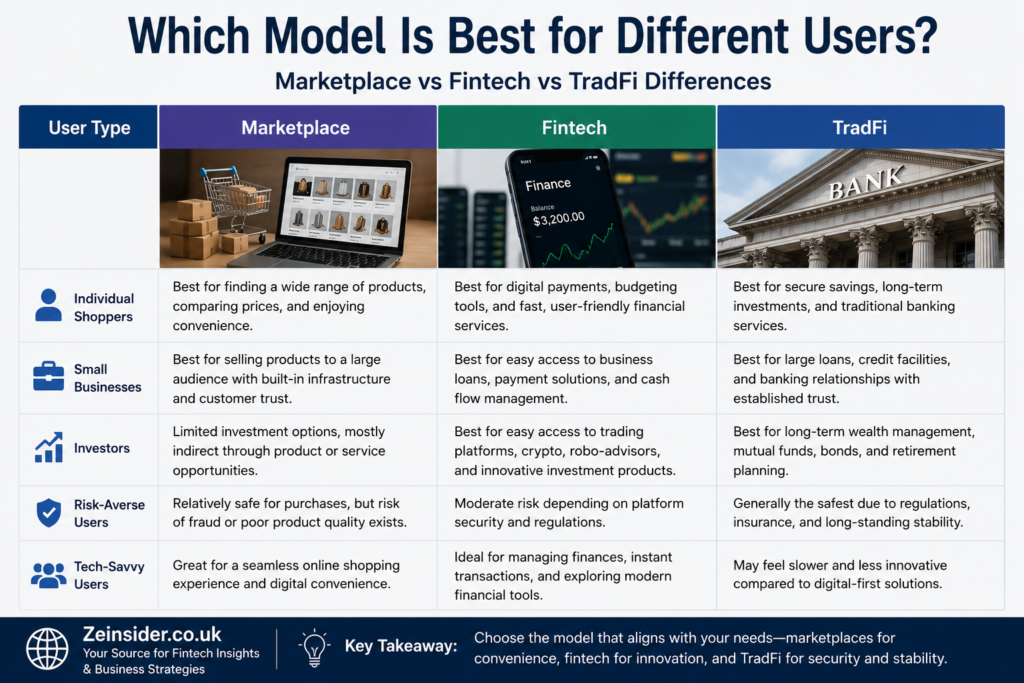
The answer depends entirely on individual objectives rather than a universal winner. Entrepreneurs seeking scalable digital ecosystems may prefer marketplace business models because they can connect buyers and sellers without owning inventory. Technology startups often choose fintech because software-driven innovation enables rapid growth and global expansion with relatively lower infrastructure costs. Established corporations and conservative investors frequently continue relying on traditional financial institutions due to their regulatory strength, financial stability, and trusted reputations. Many successful organizations no longer choose only one approach. Instead, they combine marketplace capabilities, fintech innovation, and traditional banking partnerships to create hybrid financial ecosystems. Embedded finance, Banking-as-a-Service, and API-driven collaboration continue reducing barriers between these industries. These developments illustrate how the marketplace vs fintech vs tradfi differences are evolving while each model retains unique strengths. Selecting the right model ultimately depends on business goals, customer expectations, compliance requirements, and long-term strategy.
Best Practices
- Clearly understand the marketplace vs fintech vs tradfi differences before selecting a business model.
- Prioritize customer trust alongside technological innovation.
- Invest in cybersecurity and data privacy from the beginning.
- Stay updated with financial regulations in every operating market.
- Build scalable infrastructure that supports long-term growth.
- Focus on user experience without compromising compliance.
- Diversify revenue streams whenever possible.
- Continuously monitor industry trends and customer expectations.
- Use analytics to improve financial decision-making.
- Form strategic partnerships that strengthen competitive advantages.
Common Mistakes
- Assuming fintech completely replaces traditional finance.
- Ignoring regulatory requirements during expansion.
- Choosing technology without considering customer needs.
- Underestimating cybersecurity risks.
- Overlooking long-term operational costs.
- Confusing marketplaces with financial institutions.
- Depending on only one revenue stream.
- Failing to build customer trust early.
- Expanding before achieving product-market fit.
- Neglecting compliance documentation.
Pro Tips
- Evaluate customer needs before choosing a financial model.
- Blend marketplace efficiency with fintech innovation whenever practical.
- Maintain transparent pricing structures to improve trust.
- Automate repetitive processes to reduce operational expenses.
- Use cloud-native infrastructure for scalability.
- Monitor competitor strategies regularly.
- Invest in AI responsibly while maintaining regulatory compliance.
- Develop strong risk management frameworks from day one.
- Continuously improve user experience through customer feedback.
- Remember that understanding the marketplace vs fintech vs tradfi differences provides a strategic advantage in today’s rapidly evolving financial landscape.
Conclusion
The marketplace vs fintech vs tradfi differences extend far beyond technology alone. Each model serves distinct purposes, operates under different business structures, and delivers unique value to consumers and businesses. Marketplaces specialize in connecting participants through scalable digital platforms, fintech companies transform financial services with innovation and automation, while traditional financial institutions continue providing stability, regulatory protection, and comprehensive financial products. As digital transformation accelerates, these ecosystems increasingly collaborate rather than compete directly, creating hybrid financial experiences that combine convenience with trust. Businesses should evaluate their objectives, regulatory obligations, customer expectations, and available resources before selecting the most suitable model. Consumers also benefit from understanding these differences because informed choices lead to better financial outcomes. As technology continues evolving, the relationship between marketplaces, fintech providers, and traditional finance will likely become even more interconnected while maintaining their individual strengths.
Frequently Asked Questions (FAQs)
1. What are the primary marketplace vs fintech vs tradfi differences?
Marketplaces connect buyers and sellers, fintech companies provide technology-driven financial services, and TradFi institutions offer regulated financial products through established banking systems.
2. Can a marketplace also become a fintech company?
Yes. Many digital marketplaces integrate payment processing, lending, insurance, or digital wallets, allowing them to offer fintech services within their platforms.
3. Is fintech replacing traditional finance?
No. Fintech is complementing and transforming traditional finance rather than completely replacing it. Many banks actively partner with fintech companies.
4. Why is TradFi considered more secure?
Traditional financial institutions operate under strict regulatory oversight, maintain significant capital reserves, and follow established compliance standards designed to protect consumers.
5. Which model is better for startups?
Technology-focused startups often prefer fintech or marketplace models because they generally offer greater scalability and faster innovation.
6. What technologies drive fintech growth?
Artificial intelligence, blockchain, cloud computing, machine learning, APIs, automation, cybersecurity, and big data analytics are among the leading technologies powering fintech.
7. How do marketplaces make money?
Marketplaces typically generate revenue through commissions, subscriptions, advertising, listing fees, premium services, and transaction processing.
8. Why are APIs important in fintech?
APIs allow secure integration between banks, fintech platforms, marketplaces, and third-party applications, improving efficiency and customer experience.
9. Can traditional banks adopt fintech technology?
Yes. Many banks now integrate AI, cloud computing, digital onboarding, automation, and open banking capabilities to modernize their services.
10. Why should businesses understand marketplace vs fintech vs tradfi differences?
Understanding these differences helps organizations choose the right business model, improve strategic planning, meet compliance requirements, and deliver better customer experiences.
Author Bio
About the Author
The author is an experienced SEO content writer and financial technology researcher specializing in digital finance, fintech innovation, online marketplaces, business strategy, and emerging financial trends. With a focus on EEAT principles and user-first content, the author creates in-depth, well-researched articles that simplify complex financial concepts into practical insights for entrepreneurs, investors, businesses, and everyday readers.