

Think Fintech Consulting Limited Leadership
Leadership is often the defining factor that separates an average fintech consultancy from an organization capable of creating lasting business value. Companies operating in the financial technology sector face constant regulatory changes, evolving customer expectations, cybersecurity challenges, and rapid digital innovation. Because of this dynamic environment, strong leadership becomes more than simply managing employees—it becomes the foundation for innovation, strategic decision-making, and sustainable growth. Anyone researching Think Fintech Consulting Limited leadership is typically looking to understand how leadership influences the company’s direction, consulting approach, and long-term business objectives. Understanding these elements helps clients, partners, and professionals evaluate the organization’s ability to deliver trusted fintech consulting services. This article explores the leadership philosophy, strategic priorities, management practices, and organizational framework that contribute to effective fintech consulting operations. It also explains why leadership remains one of the most valuable competitive advantages in today’s digital financial ecosystem.
Quick Answer
Think Fintech Consulting Limited leadership represents the strategic direction, executive decision-making, innovation culture, and management philosophy guiding the company’s fintech consulting services. Effective leadership in fintech consulting focuses on digital transformation, regulatory compliance, customer-centric innovation, technology adoption, risk management, operational excellence, and long-term business partnerships. Successful leaders align technical expertise with business strategy while building agile teams capable of adapting to the rapidly changing financial technology landscape.
Understanding Think Fintech Consulting Limited Leadership
Leadership within a fintech consulting organization extends well beyond supervising projects or approving budgets. It involves creating a long-term vision that aligns technology innovation with measurable business outcomes for clients operating in banking, payments, insurance, lending, wealth management, and digital finance. Think Fintech Consulting Limited leadership is generally associated with strategic planning, organizational growth, operational governance, talent development, and customer success. Effective leaders understand how emerging technologies such as artificial intelligence, cloud computing, blockchain, open banking, embedded finance, and automation influence financial institutions worldwide. Rather than reacting to industry changes, experienced leadership teams anticipate market trends and position their organizations to capitalize on new opportunities. This forward-thinking approach enables consulting firms to provide valuable recommendations that help clients remain competitive while meeting regulatory expectations. Leadership also establishes the company’s culture by encouraging collaboration, accountability, continuous learning, and innovation. These qualities strengthen client relationships and improve project outcomes across multiple financial sectors.
A modern fintech consulting leader must balance innovation with practical execution. Introducing cutting-edge technology without understanding business objectives often results in unnecessary complexity and increased costs. Successful leadership therefore focuses on solving real business challenges through carefully planned digital transformation strategies. Leaders coordinate multidisciplinary teams that include software engineers, cybersecurity specialists, financial analysts, compliance professionals, project managers, and business consultants. By combining these diverse perspectives, organizations can deliver comprehensive solutions that address operational efficiency, customer experience, and regulatory requirements simultaneously. Leadership also plays an essential role in building trust among clients by demonstrating transparency, ethical decision-making, and measurable performance. As fintech continues evolving, organizations increasingly depend on leaders who combine financial expertise with technological insight, making leadership one of the strongest drivers of organizational success.
Why Leadership Matters in Fintech Consulting
The financial technology industry operates within one of the most rapidly evolving business environments. Regulatory frameworks change frequently, customer preferences shift quickly, cybersecurity threats become increasingly sophisticated, and technological innovation accelerates every year. Within this environment, Think Fintech Consulting Limited leadership must make informed decisions that balance innovation, compliance, operational stability, and commercial growth. Strong leadership reduces uncertainty by establishing clear strategic priorities while maintaining organizational flexibility. This allows consulting firms to respond effectively when market conditions change unexpectedly. Leaders also ensure that investment decisions support sustainable growth rather than short-term gains. Their ability to manage uncertainty creates confidence among employees, investors, business partners, and clients alike.
Leadership also influences how consulting firms approach client relationships. Rather than delivering standardized recommendations, experienced executives encourage customized consulting strategies tailored to each client’s business objectives. This client-focused mindset improves long-term partnerships because organizations receive solutions aligned with their operational realities instead of generic technology implementations. Leadership further supports knowledge sharing by promoting continuous professional development, certification programs, cross-functional collaboration, and innovation workshops. These initiatives help consultants remain current with evolving fintech trends while strengthening internal expertise. Strong leadership therefore contributes not only to organizational performance but also to higher-quality consulting services capable of generating lasting business value across multiple financial industries.
Core Leadership Principles Behind Successful Fintech Consulting
Strategic Vision
Every successful fintech consulting company begins with a clearly defined strategic vision. Think Fintech Consulting Limited leadership is expected to establish measurable objectives that align technology investments with business outcomes while anticipating future market developments. Strategic vision includes identifying growth opportunities, evaluating competitive trends, understanding customer expectations, and investing in emerging digital capabilities before they become mainstream. Effective leaders continuously monitor industry developments to ensure their organizations remain relevant within an increasingly competitive marketplace. Long-term planning also enables consulting firms to allocate resources efficiently while maintaining financial sustainability. A clear strategic vision provides employees with direction, helping teams understand how individual contributions support broader organizational goals. This alignment improves collaboration, accountability, and overall project execution.
Long-Term Growth Planning
Long-term growth planning involves balancing immediate business opportunities with sustainable expansion. Leadership evaluates market demand, emerging technologies, operational capacity, and client expectations before making strategic investment decisions. Rather than pursuing every opportunity available, experienced executives prioritize initiatives that strengthen organizational capabilities and deliver measurable value over time.
Innovation Leadership
Innovation remains central to every successful fintech consulting organization. Leaders encourage experimentation while ensuring innovation aligns with customer needs and regulatory obligations. Think Fintech Consulting Limited leadership benefits from fostering a culture where employees are encouraged to explore new technologies, test creative solutions, and continuously improve consulting methodologies. Innovation leadership also requires investment in research, professional development, technology infrastructure, and knowledge management. Organizations that support innovation remain better positioned to address complex financial challenges through modern digital solutions. This proactive mindset enhances competitive advantage while improving client satisfaction and operational performance.
Innovation leadership also involves managing calculated risks. Not every emerging technology becomes commercially successful, making leadership responsible for evaluating technical feasibility, market readiness, security implications, and return on investment. Balanced innovation enables organizations to remain competitive without exposing clients to unnecessary operational or financial risks. Leaders who successfully manage this balance contribute significantly to long-term organizational resilience and industry credibility.
Organizational Structure Supporting Leadership Success
An effective organizational structure allows leadership to translate strategic objectives into operational execution. Rather than relying solely on executive decision-making, successful fintech consulting firms establish collaborative leadership models where responsibilities are distributed across specialized departments. Think Fintech Consulting Limited leadership likely depends on cooperation among technology specialists, consulting professionals, compliance experts, cybersecurity teams, operations managers, finance departments, and customer success leaders. This collaborative framework improves communication while reducing decision-making delays. Cross-functional teamwork enables organizations to solve complex client challenges more efficiently because expertise from multiple disciplines is incorporated throughout each consulting engagement.
Organizational structure also supports accountability through clearly defined reporting relationships, performance metrics, governance policies, and project management frameworks. Employees understand their responsibilities while leadership maintains visibility into operational performance across the organization. This transparency helps identify improvement opportunities before small operational issues develop into larger business risks. Modern fintech consulting firms increasingly adopt agile organizational models that promote flexibility, faster decision-making, and continuous improvement. Such structures enable leadership teams to respond rapidly to market changes while maintaining consistent service quality and regulatory compliance.
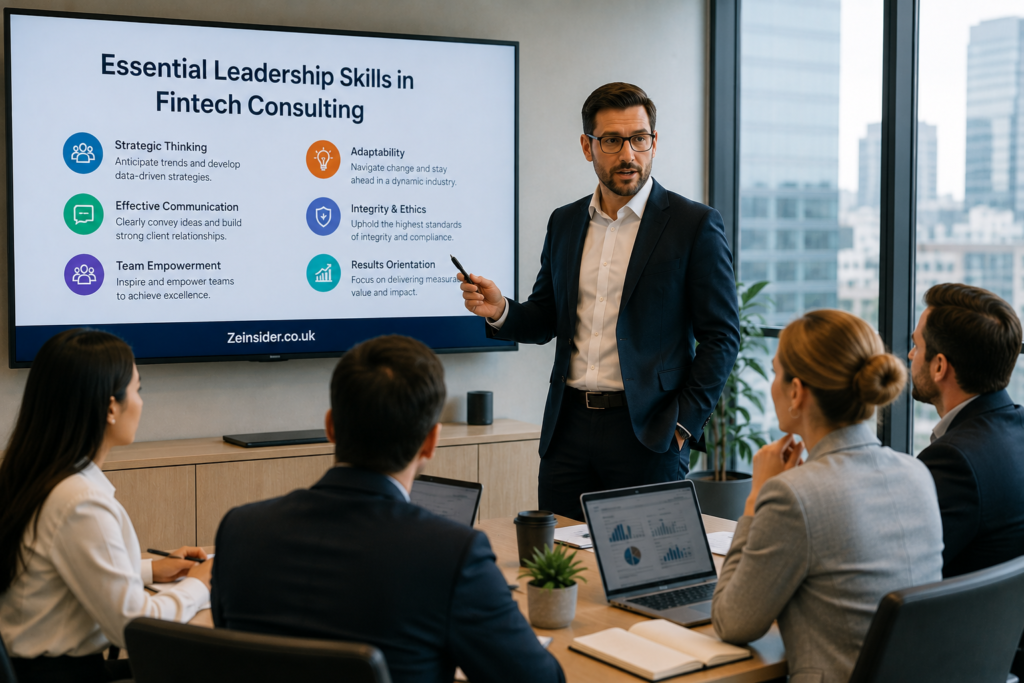
Essential Leadership Skills in Fintech Consulting
Financial Industry Expertise
One of the defining characteristics of successful fintech leaders is a deep understanding of financial services. Banking operations, payment systems, digital lending, insurance technology, wealth management, capital markets, and financial regulations all require specialized knowledge. Think Fintech Consulting Limited leadership benefits from executives capable of combining financial expertise with technological innovation to create practical consulting strategies. Industry knowledge enables leaders to identify business opportunities while recognizing regulatory constraints that may affect implementation. This balanced perspective improves strategic planning and client advisory services.
Financial expertise also strengthens communication with executive stakeholders. Business leaders expect consulting partners to understand industry terminology, compliance requirements, operational challenges, and competitive pressures. Leadership possessing this knowledge establishes greater credibility while improving client confidence throughout consulting engagements. Strong financial knowledge therefore becomes a valuable competitive advantage within fintech consulting.
Technology Leadership
Technology leadership involves understanding how digital tools create measurable business value rather than simply adopting new technologies because they are popular. Leaders evaluate cloud computing, artificial intelligence, blockchain, machine learning, cybersecurity, API integration, automation, and data analytics based on business objectives and customer outcomes. This practical perspective ensures technology investments generate operational improvements while supporting long-term strategic goals.
Technology leaders also encourage continuous learning because digital innovation evolves rapidly. Employees receive opportunities to expand technical knowledge through certifications, workshops, collaborative projects, and industry research. These initiatives strengthen consulting capabilities while enabling organizations to remain competitive within the rapidly changing fintech ecosystem.
Leadership’s Role in Building Client Trust
Trust represents one of the most valuable assets within fintech consulting. Organizations handling financial technology projects often gain access to sensitive business information, operational processes, customer data, and strategic initiatives. Consequently, Think Fintech Consulting Limited leadership must establish governance practices that prioritize confidentiality, transparency, ethical decision-making, and regulatory compliance. Strong leadership creates consistent service standards while ensuring consultants maintain professional integrity throughout every client engagement. Open communication further strengthens trust by keeping stakeholders informed about project progress, potential risks, implementation timelines, and measurable outcomes. These practices help organizations build long-term partnerships rather than focusing solely on individual consulting engagements.
Leadership also reinforces trust through accountability. When challenges arise during digital transformation projects, experienced leaders address issues proactively instead of avoiding difficult conversations. This willingness to accept responsibility strengthens client confidence while demonstrating organizational maturity. Trust becomes increasingly valuable as fintech consulting relationships evolve into long-term strategic partnerships involving continuous innovation, technology modernization, cybersecurity improvements, and business transformation initiatives.
How Leadership Drives Digital Transformation
Digital transformation is one of the primary responsibilities of modern fintech leadership because financial institutions must continually improve customer experiences while maintaining operational efficiency. Think Fintech Consulting Limited leadership plays a central role in identifying technologies that solve real business problems instead of implementing digital solutions simply because they are trending. Effective leaders evaluate business objectives, customer expectations, compliance requirements, cybersecurity risks, and available resources before recommending transformation strategies. They ensure every technology investment aligns with measurable business outcomes, including increased productivity, improved customer satisfaction, reduced operational costs, and stronger regulatory compliance. Leadership also encourages collaboration between technical teams and business stakeholders so that digital initiatives meet organizational goals. Continuous monitoring allows leaders to adjust transformation roadmaps as market conditions evolve. This agile decision-making process reduces project risks while maximizing long-term return on investment. Organizations guided by strategic leadership generally achieve more sustainable digital transformation than those relying solely on technology implementation.
Successful digital transformation also depends on leadership’s ability to manage organizational change. Employees often require new skills, revised workflows, and updated performance expectations as technology evolves. Leaders support these transitions through transparent communication, professional development programs, structured change management, and continuous feedback. By involving employees throughout transformation initiatives, leadership minimizes resistance while increasing engagement and productivity. Clients also benefit because consulting teams remain focused on delivering practical solutions rather than creating unnecessary disruption. This people-first approach reinforces why Think Fintech Consulting Limited leadership is an essential component of successful fintech consulting engagements.
Leadership and Regulatory Compliance
Compliance remains one of the most challenging aspects of financial technology consulting. Regulatory expectations continue evolving across banking, payments, insurance, anti-money laundering, data privacy, consumer protection, and cybersecurity. Think Fintech Consulting Limited leadership must ensure consulting recommendations remain aligned with current legal and regulatory standards while supporting innovation. Effective leaders establish governance frameworks that encourage responsible decision-making throughout every project. Compliance becomes integrated into organizational culture instead of being treated as a final project checklist. Leadership also encourages collaboration between legal professionals, compliance specialists, cybersecurity experts, and technology consultants. This multidisciplinary approach reduces regulatory risks while improving solution quality. Organizations with strong compliance leadership generally experience greater client confidence and fewer operational disruptions.
Leadership also recognizes that compliance requirements differ across industries and geographic markets. Consulting teams therefore tailor recommendations according to each client’s regulatory environment rather than applying standardized solutions. Regular internal audits, policy reviews, employee training, and risk assessments strengthen organizational resilience while supporting continuous improvement. Clients appreciate consulting firms that prioritize compliance because regulatory failures can result in significant financial penalties and reputational damage. By integrating compliance into strategic planning, Think Fintech Consulting Limited leadership demonstrates its commitment to responsible innovation and sustainable business growth.
Building High-Performance Teams
Talent Development
Exceptional leadership recognizes that people remain the organization’s greatest competitive advantage. Think Fintech Consulting Limited leadership supports professional growth by investing in technical education, leadership development, mentoring, certifications, and continuous learning opportunities. Employees who regularly expand their knowledge contribute more effectively to client engagements while adapting quickly to technological change. Leaders identify individual strengths and create career development plans aligned with both organizational objectives and employee aspirations. This investment improves retention while strengthening consulting expertise across multiple financial sectors. Learning also encourages innovation because knowledgeable professionals introduce new perspectives and creative solutions. Organizations that prioritize talent development often outperform competitors in service quality and client satisfaction. Continuous improvement therefore becomes an integral part of leadership strategy.
Creating Collaborative Teams
Strong collaboration begins with leadership establishing clear communication channels, shared objectives, and mutual accountability. Cross-functional teams composed of consultants, software developers, compliance experts, analysts, cybersecurity professionals, and project managers deliver better outcomes because they combine diverse expertise. Leadership encourages knowledge sharing while reducing organizational silos that can delay decision-making. Collaborative environments improve innovation because employees feel comfortable contributing ideas regardless of seniority. This inclusive culture increases engagement while strengthening organizational resilience. Effective collaboration also improves project delivery by ensuring every stakeholder remains aligned throughout implementation.
Leadership Communication
Communication remains one of the defining characteristics of successful executives. Think Fintech Consulting Limited leadership communicates organizational vision, project priorities, business expectations, and strategic objectives clearly across every department. Transparent communication reduces uncertainty while strengthening trust among employees and clients. Leaders actively listen to feedback before making major decisions, ensuring multiple viewpoints contribute to organizational success. Regular meetings, performance reviews, project updates, and strategic planning sessions create opportunities for continuous dialogue. Effective communication also helps resolve conflicts before they escalate into larger operational challenges. Employees who understand organizational priorities generally perform more confidently and consistently. Strong communication therefore supports both operational excellence and long-term business relationships.
Leadership Challenges in the Fintech Industry
The fintech industry presents unique leadership challenges due to rapid technological advancement, increasing customer expectations, evolving regulations, and intense market competition. Think Fintech Consulting Limited leadership must balance innovation with operational stability while managing limited resources efficiently. Leaders frequently make complex decisions involving cybersecurity investments, digital transformation initiatives, talent acquisition, regulatory compliance, and strategic partnerships. Every decision influences organizational performance, client satisfaction, and long-term competitiveness. External economic conditions also affect technology investment priorities, requiring leadership to remain flexible and adaptable. Effective executives prepare contingency plans that minimize disruption while supporting sustainable growth. Their ability to respond quickly to unexpected challenges often determines organizational resilience. This adaptability distinguishes successful fintech consulting firms from competitors.
Another challenge involves attracting and retaining highly skilled professionals within an increasingly competitive labor market. Leadership must create an organizational culture where employees feel valued, supported, and motivated to build long-term careers. Competitive compensation alone is no longer sufficient because professionals increasingly prioritize career development, flexibility, innovation, and meaningful work. By investing in employee wellbeing and continuous learning, Think Fintech Consulting Limited leadership strengthens organizational capabilities while improving client service quality.
Leadership Comparison in Fintech Consulting
| Leadership Area | Strong Leadership Approach | Weak Leadership Approach |
|---|---|---|
| Strategic Planning | Long-term vision with measurable goals | Short-term reactive decisions |
| Innovation | Customer-focused technology adoption | Technology without business value |
| Compliance | Integrated into every project | Considered only during final review |
| Team Development | Continuous learning and mentoring | Minimal employee development |
| Client Relationships | Long-term partnerships | Transaction-focused engagement |
| Risk Management | Proactive planning and governance | Reactive problem solving |
| Communication | Transparent and collaborative | Limited organizational communication |
| Decision Making | Data-driven and strategic | Assumption-based decisions |
Leadership Qualities That Create Long-Term Success

Modern fintech consulting requires leaders who combine technical knowledge with emotional intelligence and strategic thinking. Think Fintech Consulting Limited leadership benefits from executives who remain adaptable while maintaining consistent organizational values. Integrity strengthens client relationships because ethical decision-making creates trust even during challenging situations. Vision enables leadership to identify future market opportunities before competitors recognize them. Accountability ensures commitments are fulfilled while encouraging continuous organizational improvement. Innovation keeps consulting services relevant within an evolving financial ecosystem. Collaboration improves decision quality by incorporating expertise from multiple disciplines. Together, these qualities support sustainable business growth and stronger client outcomes.
Successful leadership also encourages resilience. Economic uncertainty, regulatory changes, cybersecurity threats, and technological disruption are inevitable within fintech. Leaders who remain calm under pressure inspire confidence throughout their organizations while maintaining operational stability. Continuous learning allows executives to adapt strategies as industry conditions evolve. This commitment to improvement reinforces why leadership remains one of the most valuable assets within any fintech consulting organization.
Best Practices for Effective Fintech Leadership
- Develop a long-term strategic vision supported by measurable objectives.
- Encourage continuous learning and professional development.
- Prioritize cybersecurity and regulatory compliance from the beginning of every project.
- Build cross-functional teams with complementary expertise.
- Use data-driven decision-making instead of assumptions.
- Maintain transparent communication with employees and clients.
- Promote innovation while carefully managing operational risks.
- Measure business outcomes rather than focusing only on technology implementation.
- Foster an ethical organizational culture built on accountability and trust.
- Continuously review market trends to identify new opportunities.
Common Mistakes to Avoid
- Prioritizing technology over business objectives.
- Ignoring regulatory requirements until late project stages.
- Failing to communicate organizational vision clearly.
- Underinvesting in employee development.
- Making strategic decisions without sufficient data.
- Overlooking cybersecurity planning.
- Resisting organizational change.
- Using standardized consulting approaches for every client.
- Neglecting customer feedback during transformation projects.
- Focusing only on short-term financial performance.
Pro Tips
- Align every digital initiative with measurable business value.
- Invest equally in leadership development and technical capabilities.
- Encourage collaboration between consultants, developers, and compliance specialists.
- Establish regular performance reviews using meaningful KPIs.
- Build long-term client partnerships rather than transactional relationships.
- Monitor fintech trends continuously to remain competitive.
- Create an innovation culture where employees can safely test new ideas.
- Balance growth ambitions with responsible governance and risk management.
- Document lessons learned after every consulting engagement.
- Continuously refine leadership strategies based on industry developments.
Conclusion
Think Fintech Consulting Limited leadership represents far more than executive oversight—it serves as the strategic force guiding innovation, client success, regulatory responsibility, and sustainable business growth. Strong leadership enables fintech consulting organizations to navigate rapidly changing markets while maintaining operational excellence and customer trust. Through strategic planning, technology expertise, talent development, compliance management, and transparent communication, effective leaders build organizations capable of delivering lasting value. As financial technology continues evolving, leadership will remain one of the most important factors influencing consulting quality and competitive advantage. Organizations that prioritize ethical governance, continuous learning, innovation, and collaboration position themselves for long-term success within the digital financial ecosystem. Whether evaluating consulting capabilities, exploring fintech partnerships, or researching industry best practices, understanding Think Fintech Consulting Limited leadership provides valuable insight into the qualities that distinguish high-performing fintech consulting firms.
H2: Frequently Asked Questions (FAQs)
1. What is Think Fintech Consulting Limited leadership?
It refers to the strategic management, executive vision, governance, and organizational direction that guide the company’s fintech consulting services and business growth.
2. Why is leadership important in fintech consulting?
Leadership helps organizations balance innovation, regulatory compliance, cybersecurity, operational efficiency, and customer satisfaction while supporting sustainable growth.
3. What qualities define effective fintech leaders?
Strategic thinking, financial expertise, technology knowledge, communication skills, adaptability, ethical decision-making, collaboration, and accountability are among the most important qualities.
4. How does leadership influence digital transformation?
Leadership aligns technology investments with business goals, manages organizational change, supports employee development, and ensures projects deliver measurable value.
5. Why is regulatory compliance a leadership responsibility?
Leadership establishes governance frameworks, promotes compliance-focused culture, and ensures consulting recommendations meet applicable financial regulations.
6. How do leaders build strong fintech consulting teams?
They invest in continuous learning, encourage collaboration, provide mentoring, recognize employee achievements, and create clear career development opportunities.
7. What challenges do fintech leaders commonly face?
Rapid technological change, regulatory updates, cybersecurity threats, talent shortages, economic uncertainty, and increasing customer expectations are among the biggest challenges.
8. How does leadership improve client relationships?
Transparent communication, accountability, customized consulting strategies, and ethical decision-making help build long-term client trust and satisfaction.
9. What role does innovation play in fintech leadership?
Innovation enables organizations to adopt emerging technologies responsibly while solving real business challenges and improving customer experiences.
10. Why is strategic planning essential for fintech consulting leadership?
Strategic planning aligns organizational resources with long-term objectives, helping consulting firms remain competitive, adaptable, and financially sustainable.
Author Bio
About the Author
The author is an experienced SEO content writer and fintech industry researcher specializing in financial technology, digital transformation, business consulting, enterprise software, and emerging technology trends. With extensive experience creating EEAT-focused, search-optimized content, the author produces in-depth articles that combine practical insights, industry knowledge, and clear explanations to help professionals, businesses, and readers make informed decisions in the rapidly evolving fintech landscape.