
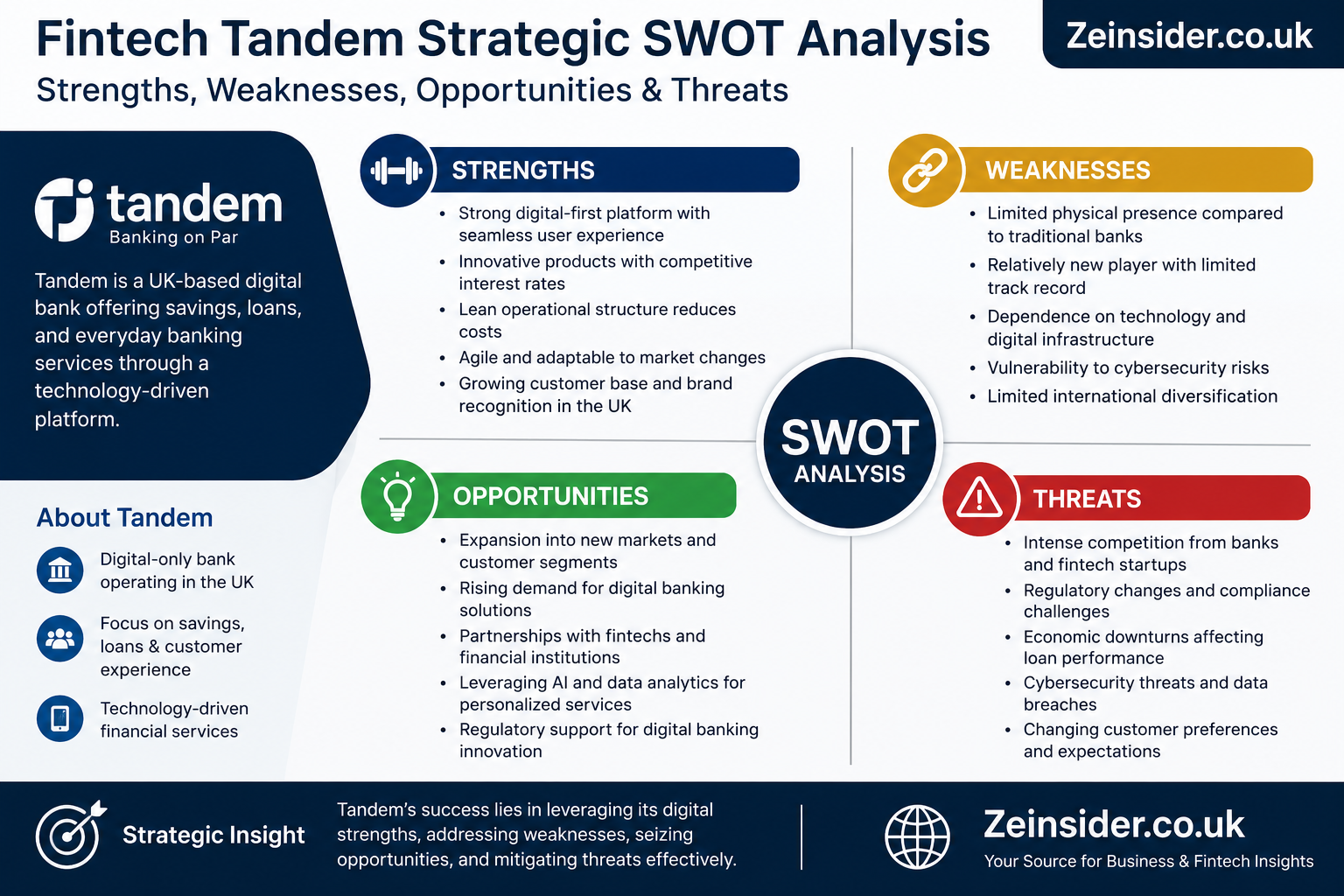
The fintech tandem strengths weaknesses opportunities threats analysis has become increasingly important as digital banking continues reshaping the global financial industry. Investors, entrepreneurs, fintech professionals, and banking executives often rely on SWOT analysis to understand how innovative financial companies compete against traditional banks and emerging fintech startups. Tandem represents one of the companies that has embraced technology to improve customer experiences while expanding financial inclusion through digital services. Understanding the fintech tandem strengths weaknesses opportunities threats helps explain how innovation, customer trust, regulatory compliance, and technology influence long-term business success. As competition intensifies across digital lending, personal finance management, AI-driven banking, and mobile banking solutions, evaluating Tandem’s internal capabilities and external environment provides valuable strategic insights. This analysis also highlights how evolving consumer expectations create both opportunities and risks. Whether you are researching fintech strategy or studying digital banking trends, this guide provides a comprehensive overview of Tandem’s competitive landscape.
Quick Answer
The fintech tandem strengths weaknesses opportunities threats analysis reveals that Tandem benefits from digital innovation, customer-focused banking, sustainability initiatives, and technology-driven financial services. However, challenges such as increasing competition, regulatory complexity, limited global presence, and customer acquisition costs can impact growth. Opportunities include AI-powered banking, embedded finance, open banking, green finance, and international expansion, while threats involve cybersecurity risks, economic uncertainty, changing regulations, and competition from established financial institutions and fintech startups.
Introduction to SWOT Analysis in Fintech
SWOT analysis has become one of the most widely used strategic planning frameworks across financial technology companies because it provides a structured method for evaluating both internal and external business factors. When examining the fintech tandem strengths weaknesses opportunities threats, decision-makers gain valuable insights into competitive positioning, operational efficiency, innovation capabilities, customer satisfaction, and long-term sustainability. Unlike traditional financial institutions that often depend on legacy infrastructure, fintech organizations compete primarily through technological innovation, customer convenience, automation, and personalized financial experiences. Understanding strengths and weaknesses allows management teams to improve internal operations while identifying opportunities and mitigating external risks. Investors also use SWOT analysis when evaluating business potential, profitability, scalability, and investment risks. In today’s highly competitive digital banking market, continuous assessment helps organizations remain agile amid rapid technological changes. Regulatory developments, cybersecurity concerns, and evolving customer preferences make regular SWOT analysis even more valuable. As financial technology continues transforming banking worldwide, the fintech tandem strengths weaknesses opportunities threats framework serves as an essential strategic planning tool.
Understanding Tandem as a Digital Financial Company
Tandem has positioned itself as a technology-driven financial company focused on delivering digital banking solutions that simplify money management while promoting responsible financial behavior. Rather than relying on traditional branch-based banking models, Tandem emphasizes mobile accessibility, digital customer engagement, and data-driven financial services. This customer-centric strategy allows the company to respond quickly to changing consumer expectations while reducing operational inefficiencies commonly associated with legacy banks. Evaluating the fintech tandem strengths weaknesses opportunities threats requires understanding how digital transformation influences every aspect of its business model. Technology enables faster loan approvals, improved customer support, automated financial insights, and enhanced security features that modern consumers increasingly expect. At the same time, operating within the financial sector requires balancing innovation with strict regulatory compliance and risk management. As consumer demand for digital financial services continues rising, Tandem’s technology-focused approach offers significant competitive advantages. These characteristics make the fintech tandem strengths weaknesses opportunities threats particularly relevant for analyzing future growth potential.
The Rise of Digital Banking
Digital banking has fundamentally changed consumer expectations regarding financial services over the past decade. Customers now expect instant transactions, intuitive mobile applications, personalized recommendations, and around-the-clock account access without visiting physical branches. These changing expectations create favorable conditions for fintech organizations capable of delivering innovative digital experiences. The fintech tandem strengths weaknesses opportunities threats analysis becomes increasingly relevant because companies must continuously innovate while maintaining customer trust. Cloud computing, artificial intelligence, machine learning, and open banking technologies have accelerated digital transformation throughout the financial industry. Consumers also prioritize convenience, transparency, and lower service fees, encouraging fintech firms to differentiate themselves through superior customer experiences. Traditional banks continue investing heavily in digital modernization, increasing competitive pressure across the sector. Consequently, understanding Tandem’s strategic position within this evolving market provides valuable insights for stakeholders.
Why Fintech SWOT Analysis Matters
Strategic planning has become increasingly complex within financial technology because companies operate in rapidly changing regulatory, technological, and competitive environments. Conducting a detailed fintech tandem strengths weaknesses opportunities threats assessment enables organizations to identify competitive advantages while preparing for industry disruptions. SWOT analysis provides executives with a structured framework for making informed investment, operational, and innovation decisions. Internal strengths highlight areas where the company outperforms competitors, while weaknesses reveal operational improvements that require management attention. External opportunities identify emerging markets, technological innovations, and customer trends that can support expansion. Threats emphasize potential challenges such as cybersecurity attacks, economic instability, regulatory changes, and increased competition from global financial institutions. Investors frequently examine SWOT analysis when evaluating business sustainability and long-term profitability. For fintech organizations navigating continuous digital transformation, the fintech tandem strengths weaknesses opportunities threats remains an essential decision-making framework.
Benefits of Strategic SWOT Evaluation
A comprehensive SWOT assessment provides numerous advantages beyond identifying strengths and weaknesses. It improves strategic planning by aligning organizational resources with market opportunities while minimizing exposure to potential risks. Leadership teams gain greater clarity regarding investment priorities, technology development, product innovation, and competitive positioning. The fintech tandem strengths weaknesses opportunities threats also supports more effective communication among executives, investors, and stakeholders by creating a common understanding of organizational capabilities. Businesses can allocate resources more efficiently when they understand where competitive advantages exist and where improvements are necessary. SWOT analysis further assists in identifying emerging industry trends before competitors fully capitalize on them. These strategic insights contribute to stronger operational performance and more sustainable long-term growth.
Overview of the Fintech Industry
The global fintech industry has evolved into one of the fastest-growing sectors within financial services, driven by technological innovation, increasing smartphone adoption, and changing consumer preferences. Financial technology companies now provide digital payments, online lending, wealth management, insurance technology, personal finance management, blockchain solutions, and embedded finance services. The fintech tandem strengths weaknesses opportunities threats cannot be fully understood without considering this broader industry transformation. Consumers increasingly prefer digital financial services because they offer convenience, lower costs, faster transactions, and personalized recommendations powered by artificial intelligence. Businesses also benefit from automated financial processes that improve operational efficiency while reducing administrative costs. Government initiatives supporting financial inclusion and open banking continue creating additional growth opportunities. However, increased innovation has also intensified competition among fintech startups, traditional banks, and global technology companies. These industry dynamics directly influence the fintech tandem strengths weaknesses opportunities threats by shaping both opportunities and competitive pressures.
Major Trends Shaping Financial Technology
Several emerging trends continue transforming the global fintech ecosystem and influencing strategic business decisions. Artificial intelligence enhances fraud detection, customer service, and financial personalization through advanced data analytics. Open banking encourages secure data sharing that enables innovative financial products and stronger customer experiences. Embedded finance allows non-financial businesses to integrate banking services directly into their digital platforms, expanding market opportunities. Sustainable finance has also gained momentum as consumers increasingly prioritize environmentally responsible financial products. Blockchain technology continues improving transparency, security, and payment efficiency across financial ecosystems. Regulatory technology simplifies compliance while reducing operational complexity for financial institutions. These innovations significantly influence the fintech tandem strengths weaknesses opportunities threats by creating new possibilities alongside evolving competitive challenges.
Core Business Model of Tandem
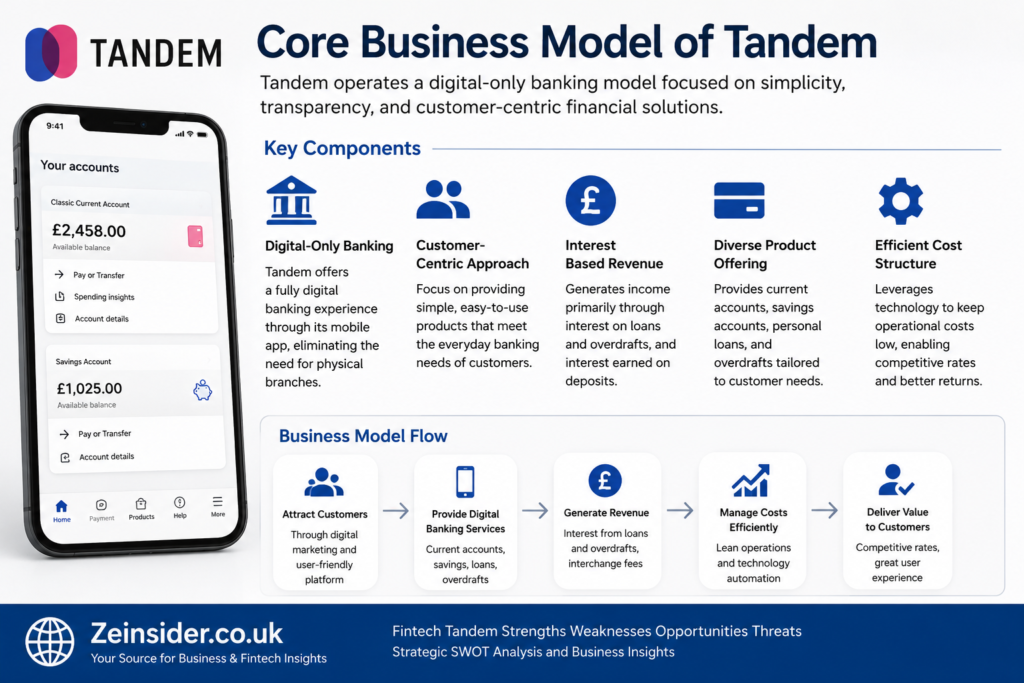
Understanding Tandem’s operational framework is essential when evaluating the fintech tandem strengths weaknesses opportunities threats because its business model emphasizes digital accessibility, financial wellness, and technology-enabled customer experiences. Unlike conventional banks with extensive physical branch networks, Tandem primarily serves customers through digital platforms that deliver banking services efficiently and cost-effectively. This operating model allows faster product development, continuous software improvements, and data-driven decision-making. Customer engagement focuses on personalized financial insights that encourage responsible spending, saving, and borrowing behaviors. Automation reduces operational expenses while improving transaction speed and service availability. Technology also enables more efficient customer onboarding and account management compared to traditional banking processes. Strategic partnerships further expand service offerings while increasing market reach. These characteristics collectively strengthen the fintech tandem strengths weaknesses opportunities threats by supporting scalable growth.
Revenue Generation Strategy
Tandem generates revenue through multiple financial products and digital services designed to create diversified income streams while maintaining customer value. Interest income from lending products, service fees, strategic partnerships, and value-added financial services contribute to overall financial performance. Diversification reduces dependence on any single revenue source, improving business resilience during economic fluctuations. Data-driven customer insights help identify additional cross-selling opportunities that strengthen long-term customer relationships. Subscription-based financial tools and premium digital services may also enhance recurring revenue potential. Efficient digital operations support profitability by reducing infrastructure costs associated with traditional banking. This diversified approach contributes positively to the fintech tandem strengths weaknesses opportunities threats by improving financial stability while supporting sustainable expansion.
Key Products and Services
Tandem offers a range of digital financial products designed to simplify everyday banking while supporting long-term financial wellness. These services often include digital savings solutions, lending products, money management tools, financial insights, and environmentally conscious financial initiatives. Technology integrates these services into a seamless customer experience accessible through mobile applications and online platforms. Automation enables faster account management while artificial intelligence improves financial recommendations based on customer behavior. Security remains a central priority through advanced authentication technologies and fraud prevention systems. Continuous innovation allows Tandem to introduce new features that respond to evolving customer needs. Product diversification also strengthens customer retention by addressing multiple financial requirements within a unified ecosystem. These offerings significantly influence the fintech tandem strengths weaknesses opportunities threats, positioning the company as a competitive participant in the expanding digital banking market.
Major Strengths of Tandem
The strengths identified within the fintech tandem strengths weaknesses opportunities threats analysis provide valuable insights into the company’s ability to compete effectively in an increasingly digital financial landscape. Tandem’s emphasis on technology, customer experience, operational efficiency, and sustainability creates several competitive advantages that distinguish it from many traditional banking institutions. These strengths support long-term scalability while enabling rapid adaptation to changing consumer preferences and technological advancements. Investment in innovation allows continuous enhancement of digital services, improving both customer satisfaction and operational performance. Efficient digital infrastructure reduces costs while supporting faster product deployment and service improvements. Strong customer engagement strategies encourage loyalty through personalized financial experiences. These combined strengths position Tandem favorably within the competitive fintech ecosystem while supporting future expansion opportunities.
Digital-First Banking Strategy
A digital-first approach represents one of the most significant strengths within the fintech tandem strengths weaknesses opportunities threats because it enables faster innovation, lower operational costs, and improved customer convenience. Customers increasingly expect seamless mobile banking experiences that provide immediate access to financial services anytime and anywhere. Tandem’s technology-driven infrastructure supports rapid feature development, secure transactions, and efficient customer service without dependence on extensive physical branch networks. Digital platforms also generate valuable customer data that supports personalized financial recommendations and more effective decision-making. Automated workflows improve efficiency while minimizing manual processing errors across banking operations. Cloud-based systems enhance scalability, allowing the organization to accommodate growing customer demand without significant infrastructure expansion. Continuous software updates further improve security, usability, and customer satisfaction. This digital foundation remains a critical competitive advantage within the fintech tandem strengths weaknesses opportunities threats analysis.
Customer-Centric Innovation
Customer-focused innovation strengthens Tandem’s competitive position by ensuring financial products evolve according to changing consumer expectations rather than traditional banking practices. User-friendly interfaces, simplified onboarding, personalized budgeting insights, and intelligent financial tools contribute to higher engagement and satisfaction levels. Customer feedback continuously influences product development, allowing rapid improvements that enhance usability and loyalty. Artificial intelligence further personalizes recommendations based on spending habits and financial goals. This commitment to innovation supports stronger customer retention while attracting digitally savvy consumers seeking modern banking experiences. As financial technology continues evolving, customer-centric innovation remains one of the most valuable strengths identified in the fintech tandem strengths weaknesses opportunities threats analysis.
Sustainable Finance as a Competitive Advantage
Sustainability has become an increasingly influential factor in financial services, and it represents another meaningful strength within the fintech tandem strengths weaknesses opportunities threats framework. Modern consumers are no longer evaluating financial institutions solely on pricing or convenience; many also consider environmental responsibility and ethical business practices. Tandem’s focus on sustainable finance helps differentiate its brand in a crowded digital banking market while appealing to environmentally conscious customers. Green lending initiatives, energy-efficient financing, and support for sustainable consumer choices contribute to stronger brand loyalty and improved public perception. Investors also favor businesses demonstrating environmental, social, and governance (ESG) commitments because these practices often indicate long-term resilience. Sustainability initiatives can strengthen partnerships with regulators, institutional investors, and environmentally focused organizations. As climate-related financial policies continue evolving, Tandem’s sustainability efforts may become an even greater strategic asset. This aspect significantly strengthens the fintech tandem strengths weaknesses opportunities threats analysis by demonstrating how responsible innovation can support both customer trust and business growth.
Technology Infrastructure and Digital Innovation
A strong technology infrastructure forms the backbone of every successful fintech company, making it one of the defining strengths in the fintech tandem strengths weaknesses opportunities threats assessment. Cloud computing, application programming interfaces (APIs), artificial intelligence, automation, and advanced analytics enable faster product development and more efficient banking operations. These technologies improve scalability without requiring extensive investments in physical infrastructure. Automated workflows reduce processing times while minimizing operational errors and administrative costs. Data analytics also helps identify customer behavior patterns, allowing more personalized financial products and proactive customer support. Continuous software improvements enable the company to respond rapidly to market trends and security challenges. Technology-driven operations increase efficiency while enhancing customer satisfaction through seamless digital experiences. Altogether, these capabilities reinforce the positive aspects identified within the fintech tandem strengths weaknesses opportunities threats evaluation.
Weaknesses of Tandem
While Tandem demonstrates numerous competitive strengths, every fintech company also faces internal challenges that can influence long-term growth. Understanding these weaknesses is essential for a balanced fintech tandem strengths weaknesses opportunities threats analysis because internal limitations may reduce competitiveness if not addressed proactively. Factors such as operational scale, customer acquisition costs, regulatory complexity, and market recognition can impact expansion strategies. Although digital banking reduces infrastructure expenses, maintaining cutting-edge technology requires continuous investment. Building consumer trust in financial services also takes time, especially when competing against established banking institutions. These weaknesses do not necessarily indicate poor business performance but instead highlight areas requiring strategic improvement. Recognizing these challenges allows management teams to prioritize investments and strengthen future competitiveness. Therefore, evaluating weaknesses remains an essential component of the fintech tandem strengths weaknesses opportunities threats framework.
Limited Brand Recognition Compared with Traditional Banks
One of the primary weaknesses within the fintech tandem strengths weaknesses opportunities threats assessment is comparatively lower brand recognition when measured against long-established financial institutions. Traditional banks often benefit from decades of customer relationships, extensive branch networks, and widespread public familiarity. Newer fintech companies must invest heavily in marketing, customer education, and digital engagement to build similar levels of trust. Customer hesitation may occur when individuals are considering where to keep savings or apply for loans because financial decisions often involve high levels of confidence. Strong digital experiences help overcome these concerns, but establishing brand credibility remains an ongoing process. Competition from internationally recognized fintech firms also increases customer acquisition challenges. Continued investment in customer service, transparency, and positive user experiences can gradually strengthen market reputation. This weakness remains an important consideration in the fintech tandem strengths weaknesses opportunities threats analysis.
High Customer Acquisition Costs
Acquiring new customers within digital banking has become increasingly expensive as competition continues intensifying across the fintech sector. Digital advertising, referral incentives, promotional offers, and brand awareness campaigns require significant financial investment. Rising customer acquisition costs can reduce profitability, particularly during periods of aggressive expansion. Retaining existing customers therefore becomes just as important as attracting new users. Personalized experiences, excellent customer support, and innovative financial products help improve customer retention while lowering long-term acquisition expenses. However, balancing growth with marketing efficiency remains a strategic challenge. Companies must continually optimize advertising performance while improving organic brand visibility. This operational challenge contributes to the weaknesses identified within the fintech tandem strengths weaknesses opportunities threats framework.
Dependence on Digital Infrastructure
A digital-first operating model creates efficiency but also introduces certain operational vulnerabilities. System outages, cloud service disruptions, software bugs, or technical failures can temporarily interrupt customer access to financial services. Unlike traditional banks that maintain physical branches, digital platforms rely heavily on technology availability. Customers increasingly expect uninterrupted access to mobile applications and online banking services. Even brief service interruptions can affect customer satisfaction and public confidence. Continuous investment in cybersecurity, disaster recovery planning, and infrastructure redundancy helps reduce these risks. Maintaining reliable technology infrastructure requires ongoing operational expenditures and specialized technical expertise. Consequently, digital dependence represents another weakness considered within the fintech tandem strengths weaknesses opportunities threats evaluation.
Opportunities for Future Growth
The external environment offers numerous growth possibilities that strengthen the optimistic outlook within the fintech tandem strengths weaknesses opportunities threats assessment. Rapid digital transformation, changing customer expectations, technological innovation, and government support for financial inclusion continue expanding opportunities across global fintech markets. Companies capable of adapting quickly can introduce new financial products while reaching previously underserved customer segments. Open banking initiatives encourage collaboration between financial institutions and technology providers, creating entirely new revenue opportunities. Artificial intelligence further enhances customer personalization, fraud prevention, and operational efficiency. Sustainable finance continues attracting environmentally conscious consumers and investors alike. These evolving market conditions create favorable circumstances for long-term expansion. Therefore, opportunities remain one of the most encouraging aspects of the fintech tandem strengths weaknesses opportunities threats analysis.
Expansion into New Markets
International expansion represents one of the largest opportunities identified within the fintech tandem strengths weaknesses opportunities threats framework. Many regions continue experiencing growing demand for affordable digital banking solutions as smartphone adoption and internet accessibility improve. Entering carefully selected international markets can diversify revenue streams while reducing dependence on domestic economic conditions. Strategic partnerships with local financial institutions may simplify regulatory compliance and accelerate market entry. Localization of products, languages, and payment systems further improves customer adoption. Expansion strategies also benefit from scalable cloud-based infrastructure capable of supporting growing customer volumes. Careful market research remains essential for identifying regions with favorable regulatory environments and strong digital banking demand. Successfully expanding internationally could significantly enhance Tandem’s long-term growth potential.
Artificial Intelligence and Automation
Artificial intelligence continues reshaping financial services, creating significant opportunities throughout the fintech tandem strengths weaknesses opportunities threats analysis. AI-powered customer support, predictive analytics, automated underwriting, fraud detection, and personalized financial recommendations improve both efficiency and customer satisfaction. Machine learning algorithms help identify financial risks while supporting more accurate lending decisions. Automation reduces operational costs by minimizing repetitive administrative tasks. Customers increasingly value intelligent financial insights that help improve budgeting, saving, and investment decisions. AI also strengthens cybersecurity by detecting unusual account activity in real time. As technology advances, organizations investing strategically in artificial intelligence are likely to achieve stronger competitive positions. This emerging opportunity plays a central role within the fintech tandem strengths weaknesses opportunities threats framework.
Open Banking and Embedded Finance
Open banking continues transforming financial services by enabling secure sharing of customer-authorized financial data through standardized APIs. This innovation allows fintech companies to develop personalized financial products while integrating banking services into non-financial digital platforms. Embedded finance expands revenue opportunities through partnerships with retailers, e-commerce platforms, software providers, and service marketplaces. Customers benefit from seamless payment processing, lending, insurance, and savings features integrated directly into their everyday digital experiences. These innovations encourage stronger customer engagement while creating diversified business models. Regulatory support for open banking in many markets further accelerates adoption. Organizations that embrace collaborative financial ecosystems are positioned to benefit from long-term industry transformation. Consequently, open banking represents an important opportunity in the fintech tandem strengths weaknesses opportunities threats analysis.
Threats Facing Tandem
External threats remain unavoidable for every financial institution regardless of size or technological sophistication. Identifying these risks provides a balanced fintech tandem strengths weaknesses opportunities threats assessment by highlighting challenges that may influence future performance. Economic uncertainty, changing regulations, cybersecurity threats, and aggressive market competition all require continuous strategic attention. Financial technology evolves rapidly, making innovation both an opportunity and a necessity. Organizations unable to adapt quickly risk losing market share to more agile competitors. External threats cannot always be eliminated but can often be reduced through effective planning, investment, and risk management. Monitoring industry developments allows companies to respond proactively instead of reactively. These considerations complete the threat component of the fintech tandem strengths weaknesses opportunities threats framework.
Increasing Market Competition
Competition within digital banking has intensified dramatically as traditional banks, fintech startups, technology companies, and global financial institutions all invest heavily in innovation. Customers now enjoy numerous choices when selecting digital financial services, making differentiation increasingly important. Competitors frequently introduce new features, pricing strategies, loyalty programs, and personalized services. Continuous innovation therefore becomes essential for maintaining market relevance. Companies must balance product development with operational efficiency and customer satisfaction. Strategic partnerships and niche specialization may help strengthen competitive positioning. Maintaining innovation momentum remains critical in this rapidly evolving environment. Competitive pressure is therefore a major external threat identified within the fintech tandem strengths weaknesses opportunities threats analysis.
Cybersecurity Risks
Cybersecurity remains one of the most significant challenges facing every financial technology organization. Financial institutions manage sensitive personal information, payment credentials, and financial transactions, making them attractive targets for cybercriminals. Data breaches, ransomware attacks, phishing campaigns, and identity theft can damage customer trust while creating regulatory and financial consequences. Continuous investment in encryption, multi-factor authentication, threat monitoring, and employee training helps strengthen security defenses. Regulatory compliance also requires maintaining high cybersecurity standards. Customer confidence depends heavily on reliable data protection practices. As cyber threats continue evolving, proactive security investments remain essential. Cybersecurity therefore represents a major threat within the fintech tandem strengths weaknesses opportunities threats framework.
Regulatory Changes
Financial regulations evolve continuously as governments seek to protect consumers while encouraging responsible innovation. Compliance requirements relating to privacy, anti-money laundering, lending practices, and operational resilience may increase administrative complexity and operational costs. Expanding internationally introduces additional regulatory obligations across multiple jurisdictions. Companies must invest in compliance professionals, legal expertise, and regulatory technology to maintain adherence to evolving standards. Failure to comply can result in financial penalties and reputational damage. At the same time, proactive compliance strengthens customer confidence and investor trust. Effective governance therefore becomes a competitive advantage despite increased complexity. Regulatory uncertainty remains a significant external threat identified within the fintech tandem strengths weaknesses opportunities threats analysis.
SWOT Comparison Table
| SWOT Element | Key Factors | Strategic Impact |
|---|---|---|
| Strengths | Digital banking, technology infrastructure, customer experience, sustainability, innovation | Supports long-term growth and competitiveness |
| Weaknesses | Limited brand recognition, acquisition costs, digital dependence | Requires continuous operational improvement |
| Opportunities | AI, open banking, international expansion, embedded finance, ESG | Creates new revenue streams and market expansion |
| Threats | Competition, cybersecurity, regulations, economic uncertainty | Requires proactive risk management |
Best Practices
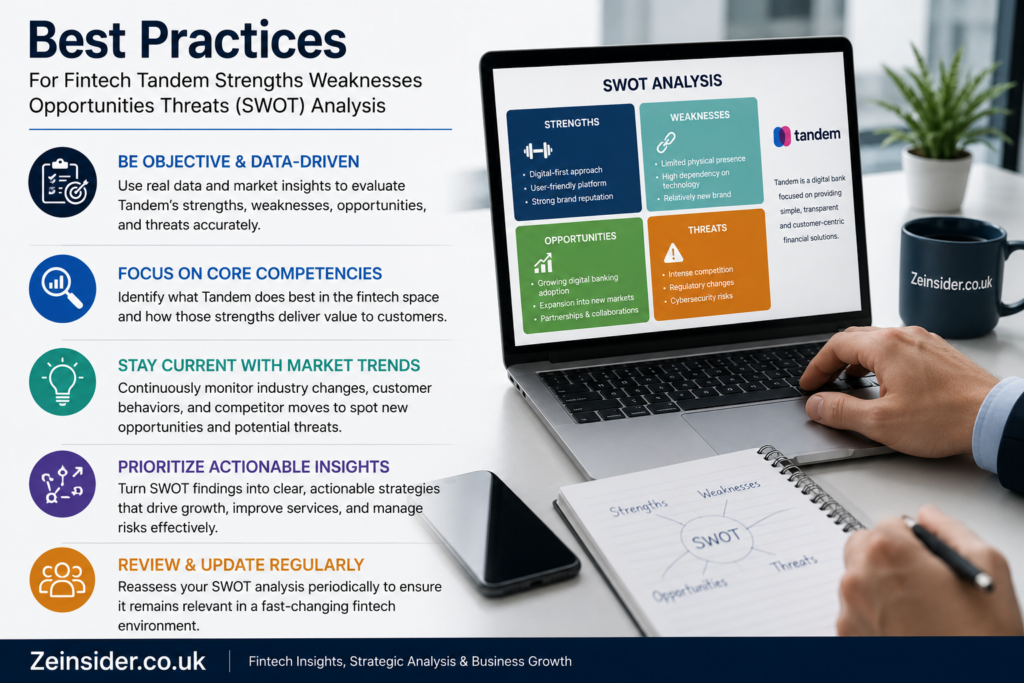
- Perform regular fintech tandem strengths weaknesses opportunities threats reviews as market conditions evolve.
- Invest consistently in cybersecurity infrastructure and employee awareness.
- Use customer feedback to improve digital products and banking experiences.
- Expand through carefully selected strategic partnerships.
- Diversify revenue streams to reduce dependence on individual products.
- Strengthen regulatory compliance using automation and RegTech solutions.
- Continue investing in AI-driven personalization and fraud prevention.
- Build customer trust through transparency, security, and responsible lending.
- Monitor competitors and emerging fintech innovations regularly.
- Align sustainability initiatives with long-term business objectives.
Common Mistakes
- Treating SWOT analysis as a one-time business exercise.
- Ignoring customer feedback when developing financial products.
- Underestimating cybersecurity investment requirements.
- Expanding into new markets without sufficient regulatory preparation.
- Focusing only on technology while overlooking customer trust.
- Neglecting employee training regarding compliance and security.
- Depending too heavily on one source of revenue.
- Failing to monitor changing consumer expectations.
- Overlooking long-term sustainability initiatives.
- Delaying infrastructure modernization.
Pro Tips
- Update the fintech tandem strengths weaknesses opportunities threats analysis every quarter.
- Benchmark competitors using measurable financial and technology indicators.
- Use predictive analytics to identify customer trends before competitors.
- Strengthen API ecosystems to support embedded finance partnerships.
- Maintain flexible technology architecture for faster product innovation.
- Invest in scalable cloud infrastructure that supports future expansion.
- Combine AI with human expertise for improved customer service.
- Develop crisis response plans for cybersecurity and operational disruptions.
- Continuously monitor regulatory developments across target markets.
- Prioritize customer retention alongside customer acquisition.
Conclusion
The fintech tandem strengths weaknesses opportunities threats analysis demonstrates that Tandem operates within one of the world’s fastest-changing financial sectors, where innovation, customer trust, technology, and regulatory compliance determine long-term success. Its digital-first business model, commitment to customer experience, sustainable finance initiatives, and modern technology infrastructure provide meaningful competitive advantages. At the same time, challenges such as intense competition, increasing customer acquisition costs, evolving regulations, and cybersecurity risks require continuous strategic attention. Emerging technologies including artificial intelligence, open banking, automation, and embedded finance present substantial opportunities for sustainable growth if implemented effectively. Organizations that continuously evaluate both internal capabilities and external market conditions are better positioned to adapt to industry changes while maintaining resilience. A comprehensive SWOT framework enables investors, business leaders, and financial professionals to better understand Tandem’s strategic position within the evolving fintech ecosystem. By balancing innovation with responsible governance and customer-focused development, Tandem can continue strengthening its competitive position in the digital banking industry. Ultimately, the fintech tandem strengths weaknesses opportunities threats assessment serves as a valuable strategic tool for understanding both current performance and future business potential.
Frequently Asked Questions (FAQs)
1. What is the fintech tandem strengths weaknesses opportunities threats analysis?
It is a SWOT analysis that evaluates Tandem’s internal strengths and weaknesses along with external opportunities and threats affecting its business strategy.
2. Why is SWOT analysis important for fintech companies?
It helps businesses understand competitive advantages, identify operational improvements, recognize market opportunities, and prepare for external risks.
3. What are Tandem’s biggest strengths?
Its major strengths include digital-first banking, customer-focused innovation, modern technology infrastructure, sustainability initiatives, and operational efficiency.
4. What weaknesses affect Tandem?
Limited brand recognition, higher customer acquisition costs, and dependence on digital infrastructure are among its key internal challenges.
5. What opportunities exist for Tandem?
Artificial intelligence, international expansion, embedded finance, open banking, sustainable finance, and strategic partnerships offer significant growth opportunities.
6. What threats does Tandem face?
Major threats include cybersecurity risks, regulatory changes, increasing competition, and economic uncertainty.
7. How does AI support Tandem’s future growth?
AI improves fraud detection, customer support, lending decisions, personalization, operational efficiency, and financial insights.
8. Why is cybersecurity critical in fintech?
Strong cybersecurity protects customer data, maintains regulatory compliance, prevents fraud, and preserves customer trust.
9. How often should a fintech SWOT analysis be updated?
Most experts recommend reviewing it quarterly or whenever major market, regulatory, or technological changes occur.
10. Who benefits from this SWOT analysis?
Business executives, investors, researchers, fintech professionals, entrepreneurs, consultants, and students can all benefit from understanding the fintech tandem strengths weaknesses opportunities threats analysis.
Author Bio
About the Author
The author is an experienced SEO content writer and fintech researcher specializing in digital banking, financial technology, SaaS platforms, business strategy, and emerging technology trends. With a strong focus on Google’s EEAT principles and helpful content guidelines, the author creates in-depth, well-researched articles that simplify complex financial concepts while delivering practical insights for business leaders, investors, professionals, and general readers.