
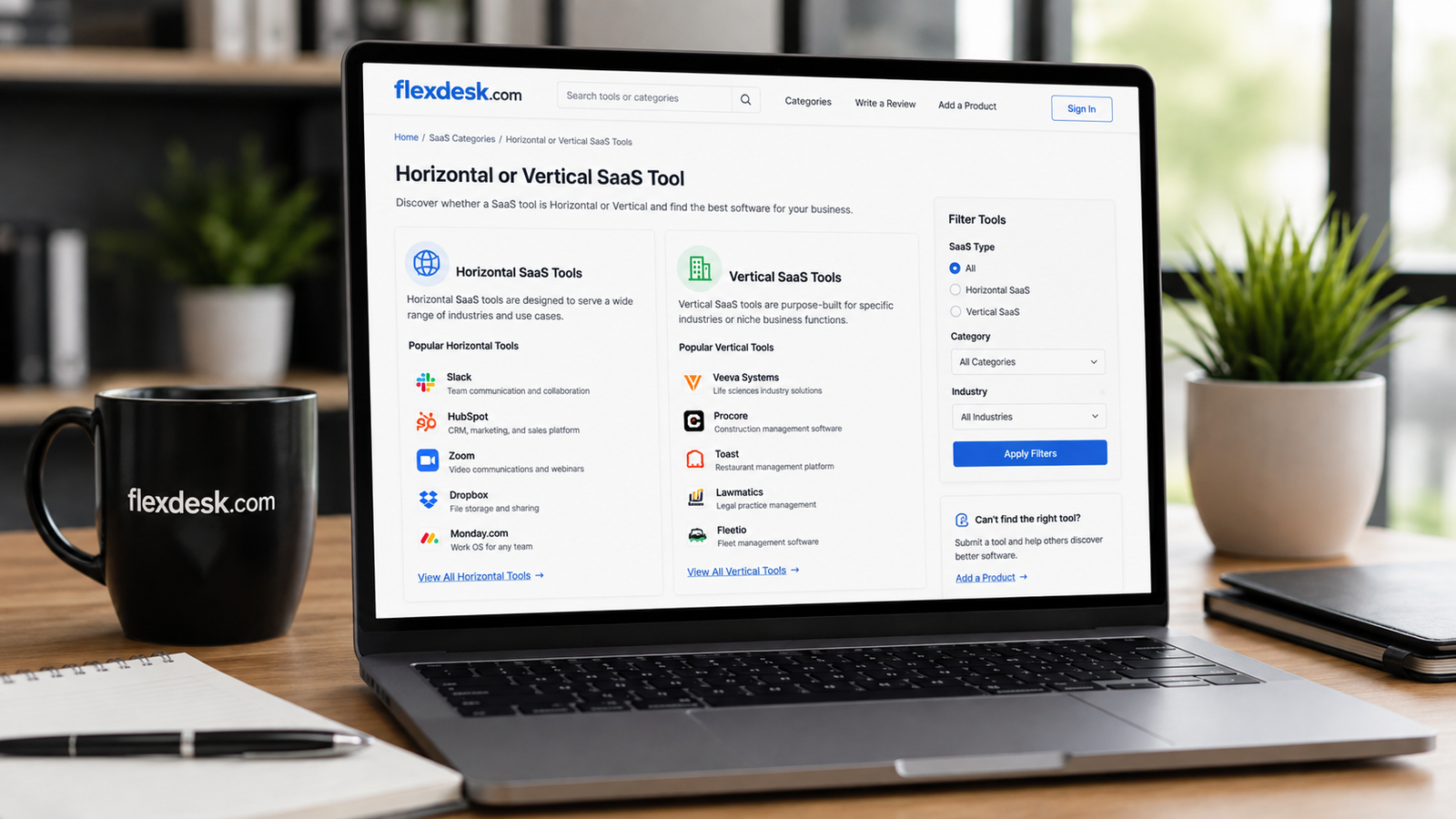
FlexDesk sits at an interesting intersection of workplace technology, corporate real estate and SaaS. At first glance, its integrations with HR systems, badge access, Wi-Fi, sensors, booking platforms and lease data could make it look like a broad horizontal software product. But the more important question is not how many systems FlexDesk connects to. It is who the platform serves and which business problems it is designed to solve.
The evidence points to a clear answer: FlexDesk is best classified as a vertical B2B SaaS platform focused on corporate real estate and workplace management. The company describes its platform as being built exclusively for corporate occupiers, with products covering portfolio management, utilization intelligence and coworking management.
What Does Horizontal or Vertical SaaS Mean?
Horizontal SaaS products address common business needs across many industries. Customer relationship management, accounting, email marketing, project management and general collaboration software are classic examples. A technology company, retailer, healthcare provider or manufacturing business can often use the same horizontal product with relatively minor configuration.
Vertical SaaS takes a more specialized route. Instead of attempting to serve almost every business, it concentrates on a particular industry, profession or operational function. The product typically incorporates specialized workflows, terminology, data models and integrations. That specialization can make the software harder to replace because it becomes deeply connected to how a particular business function operates.
The Short Answer: FlexDesk Is Vertical SaaS
The strongest classification for FlexDesk is vertical SaaS, specifically vertical B2B SaaS for corporate real estate and workplace operations. FlexDesk says its platform is designed exclusively for corporate occupiers and provides a centralized environment for lease management, utilization tracking and coworking programs.
That positioning separates it from a generic workplace or productivity platform. FlexDesk’s products are built around the problems faced by organizations managing physical office portfolios, commercial leases, employee attendance, coworking programs and workplace utilization. Its focus is therefore specialized even though its technology connects to a wide range of external systems.
Why FlexDesk Fits the Vertical SaaS Model
The clearest evidence comes from FlexDesk’s product architecture. Its portfolio-management platform brings together corporate real estate information, lease data, utilization measurements, rent obligations and portfolio analysis. It supports functions such as scenario analysis, space-efficiency analysis, lease alerts and future space planning.
These are not generic business-management functions. They exist because companies have specialized requirements around physical workplaces and commercial real estate. A horizontal document-management system might store a lease, for example, but FlexDesk is designed to turn lease information into structured data that can be connected to utilization and portfolio decisions.
Corporate Real Estate Is the Core Vertical
Corporate real estate, commonly abbreviated as CRE, is central to FlexDesk’s identity. The company’s portfolio-management product is positioned as a single source of truth for CRE data and is designed to help corporate occupiers track leases, monitor obligations and make data-driven portfolio decisions.
This specialization becomes even clearer when considering the platform’s intended users. Corporate real estate teams can use portfolio information for renewal and transaction decisions, while workplace and facilities teams can analyze occupancy and space requirements. Human resources teams can also use workplace attendance information. The departments vary, but the underlying business domain remains the same: corporate workplaces and real estate.
Lease Management Is a Specialized Workflow
Lease administration is one of the strongest indicators that FlexDesk belongs in the vertical SaaS category. Its platform allows users to access lease information, configure alerts and track rent obligations while connecting those records to broader portfolio analysis.
FlexDesk also describes AI-powered lease abstraction, allowing users to upload lease documents and automatically parse them into a structured data schema. Its platform can then connect that information to other corporate real estate data. This type of workflow requires domain-specific understanding and is significantly more specialized than the document-storage capabilities found in conventional horizontal SaaS products.
Utilization Intelligence Makes the Specialization Even Clearer
FlexDesk’s Utilization Intelligence product is another major reason the company should be viewed as vertical SaaS. The platform connects attendance sources including badge systems, Wi-Fi and network analysis, room and desk bookings, and sensors. It transforms those inputs into workplace utilization insights.
The resulting use cases are highly specific to corporate workplace management. FlexDesk highlights applications such as reducing operating costs, evaluating space-type inventory, monitoring return-to-office compliance and predicting demand for food, staffing and occupancy-related resources. A generic horizontal SaaS product would rarely be built around these particular relationships between attendance, space and real estate economics.
Coworking Management Does Not Make FlexDesk Horizontal
FlexDesk also operates a coworking booking platform that provides access to thousands of locations. Its website currently states that the network covers 7,000 locations across 1,800 cities and 100 countries. Users can reserve desks, meeting rooms and office suites by the hour or day.
Booking software on its own could potentially be considered a horizontal capability. However, FlexDesk embeds coworking reservations inside a broader corporate workplace system. Its platform connects bookings with HRIS systems, spending controls, consolidated billing, utilization tracking and corporate policies. In other words, booking is one specialized component of a larger workplace-management workflow.
API Integrations Do Not Make FlexDesk Horizontal
One of the biggest classification mistakes is confusing integration breadth with market breadth. FlexDesk is highly integration-oriented. Its platform can work with lease data, market comparables, badge systems, Wi-Fi, HRIS information, sensors, coworking data and desk or room booking systems.
But APIs describe how software communicates, not who the software is designed to serve. A vertical SaaS company may actually need more integrations than a horizontal application because it is consolidating information from multiple specialized systems within one industry. FlexDesk’s broad integration stack strengthens its role as a CRE data hub rather than turning it into a horizontal SaaS company.
AI Strengthens FlexDesk’s Vertical Position
FlexDesk describes itself as an AI-native platform, but AI does not make the product horizontal. Instead, its AI capabilities are being applied to specialized corporate real estate workflows.
The portfolio platform includes AI-powered lease abstraction and an AI Copilot in beta. FlexDesk says the Copilot can support scenario planning, attendance and utilization analysis, interactive lease-language searches, guided recommendations and optimization opportunities. These applications demonstrate how AI can become more valuable when trained or configured around a specific professional domain.
Recent Product Development Supports the Classification
FlexDesk’s recent product releases show continued investment in specialized CRE functionality. Its Q1 2026 update introduced additional portfolio-analysis fields such as capacity and headcount, improved in-app access to lease documents and enhanced regional and country-level reporting.
The same update expanded Utilization Intelligence with individual attendance annotations, multiple department fields and enhanced reporting. Its coworking-management product also added third-party coworking data, billing chargebacks and additional usage reporting. Rather than broadening into unrelated business software, these developments deepen the platform’s existing vertical focus.
FlexDesk Compared With a Horizontal SaaS Platform
Imagine a horizontal software product designed to help businesses manage reservations. It could potentially be adapted for restaurants, clinics, salons, hotels, conference facilities or offices.
FlexDesk’s coworking workflow is different because the booking activity is connected to corporate employees, HRIS records, company policies, spending limits, workplace analytics and consolidated billing. The reservation is therefore part of a specialized enterprise workplace program rather than an isolated booking function.
The same distinction applies to lease management. A horizontal file-management application can store documents, but FlexDesk extracts lease information, structures it and connects it to portfolio performance and workplace utilization. That domain-specific context is a hallmark of vertical SaaS.
Is FlexDesk a PropTech Company?
Yes. At a broader industry level, FlexDesk can reasonably be classified as PropTech, or property technology. More specifically, it operates in the corporate real estate and workplace technology segment.
PropTech is a broad category encompassing property management, construction technology, real estate marketplaces, smart buildings, investment platforms and workplace systems. FlexDesk occupies a more focused area within that market because its core customer is the corporate occupier and its platform is designed around the management and optimization of workplace portfolios.
Who Is FlexDesk Built For?
FlexDesk is designed primarily for organizations that manage corporate workplaces. Its product positioning specifically refers to corporate occupiers, while its utilization platform identifies corporate real estate, HR and facilities or space-planning teams as important stakeholders.
That is significant because vertical SaaS does not always mean serving one narrow industry such as dentistry or restaurants. It can also mean specializing in a professional function. FlexDesk’s specialization is corporate workplace and real estate management, regardless of whether the end customer happens to be a technology company, financial institution, retailer or another type of organization.
FlexDesk’s Enterprise SaaS Characteristics
FlexDesk also has several characteristics associated with enterprise software. Its website lists single sign-on and SCIM, geographic and role-based access controls and SOC 2 compliance. It also highlights real-time integrations, AI-powered document abstraction, automated workflows and dedicated account support.
Those capabilities are particularly relevant to organizations managing sensitive workplace and real estate information. Lease terms, financial obligations, employee attendance and utilization data can have commercial and operational implications. Enterprise-grade access controls therefore support FlexDesk’s positioning as a specialized B2B platform rather than a lightweight consumer workplace application.
A Real-World Example of the Platform’s Use
FlexDesk’s case study with ezCater provides a useful example of how its vertical specialization works in practice. ezCater used the platform to give remote employees access to coworking locations while avoiding the administrative burden associated with expense reimbursements and fragmented coworking accounts.
According to FlexDesk’s published case study, ezCater began making reservations less than six weeks after starting with the platform. The company eventually recorded bookings across more than 40 coworking spaces, with more than half of employees returning after their first use. The example demonstrates how coworking management becomes part of a broader corporate workplace strategy rather than simply being a consumer booking tool.
FlexDesk and the Vertical SaaS Business Model
Vertical SaaS companies typically compete by developing deep expertise in a particular market or function. Their products often contain specialized workflows that generic platforms cannot easily reproduce without significant customization.
FlexDesk demonstrates this model through the combination of lease management, utilization analytics, workplace data ingestion and coworking management. The more of these workflows a corporate occupier manages in one environment, the more valuable a centralized data model can become.
This can create a potential competitive advantage. Instead of asking CRE teams to reconcile spreadsheets, lease systems, attendance reports, booking platforms and coworking invoices separately, the software attempts to connect those datasets into a unified workplace intelligence layer.
The Importance of Data in FlexDesk’s Strategy
Data may ultimately be one of FlexDesk’s most important strategic assets. The platform’s integration stack includes lease documents, market data, badge swipes, Wi-Fi, HRIS information, sensor data, coworking data and booking information.
Each dataset tells only part of the workplace story. Combined, however, they can provide a more detailed picture of how much space employees use, what it costs, how attendance changes over time and where a company may have excess or insufficient capacity. That makes FlexDesk’s value proposition fundamentally data-driven and domain-specific.
Why Vertical SaaS Matters for Corporate Real Estate
Corporate real estate decisions can involve significant long-term commitments. Renewing a lease, consolidating offices or changing space requirements can affect costs for years. As a result, CRE teams increasingly need accurate information rather than relying solely on static spreadsheets or isolated reports.
FlexDesk’s positioning reflects that challenge. Its portfolio-management product emphasizes scenario analysis, space efficiency and future space needs, while its utilization platform focuses on connecting attendance data to workplace decisions.
The value of vertical SaaS in this environment is therefore not simply automation. It is the ability to encode specialized knowledge into software so teams can make more informed decisions.
Recent Trends Point Toward More Specialized Workplace Intelligence
The evolution of FlexDesk also reflects a wider trend in enterprise software: vertical platforms are moving from systems of record toward systems of intelligence. Instead of merely storing information, modern SaaS products increasingly analyze it and recommend actions.
FlexDesk’s AI Copilot, utilization analytics and scenario-planning functionality fit that direction. Its 2026 product updates also show an emphasis on deeper reporting and more structured workplace data.
For corporate real estate teams, this could eventually mean moving from questions such as “How much space do we have?” to more strategic questions such as “How much space will we need under different attendance scenarios, and what would each option cost?”
How FlexDesk Differs From Horizontal Workplace Software
The distinction can be summarized simply. A horizontal workplace application might help employees reserve desks. FlexDesk attempts to connect that reservation with employee identity, coworking spend, utilization data and corporate workplace policy.
Similarly, a general document platform might store a lease. FlexDesk turns the lease into structured corporate real estate information and connects it to portfolio analytics, rent obligations and future space decisions.
That depth is the central reason the platform should be classified as vertical SaaS.
FlexDesk’s Future as a Vertical SaaS Platform
The next stage of vertical SaaS is likely to involve increasingly intelligent decision support. For FlexDesk, that could mean using workplace data to help corporate occupiers evaluate lease renewals, space consolidation, coworking demand and workplace investments.
Its existing product direction already points toward this model. The company is adding more structured portfolio metrics, utilization analytics and AI capabilities rather than moving toward unrelated horizontal business applications.
If this trajectory continues, FlexDesk could increasingly function as a specialized intelligence layer for corporate real estate, combining operational data with financial and workplace information.
Key Takeaways
The evidence supports a straightforward classification:
- FlexDesk is vertical SaaS, not horizontal SaaS.
- Its primary market is corporate real estate and workplace management.
- It can also be categorized broadly as PropTech.
- Its stated target customer is the corporate occupier.
- Its major products include portfolio management, utilization intelligence and coworking management.
- Its extensive API integrations do not make it horizontal.
- AI capabilities are being applied to specialized CRE workflows.
- Its recent product updates have deepened, rather than broadened, its vertical specialization.
- Its strongest differentiation comes from connecting specialized workplace and real estate data.
- The platform is best understood as vertical enterprise SaaS for corporate real estate intelligence.
Frequently Asked Questions
FlexDesk is best classified as vertical SaaS. Its platform is built specifically for corporate occupiers and focuses on specialized workflows such as lease management, workplace utilization, portfolio analysis and coworking programs.
FlexDesk primarily serves corporate real estate and workplace management. Its users can include corporate real estate, HR, facilities and space-planning teams.
Yes. FlexDesk can be categorized as a PropTech company, with a more specific focus on corporate occupier portfolio management and workplace technology.
Yes. FlexDesk describes itself as an AI-native platform. Its portfolio product includes AI-powered lease abstraction and an AI Copilot in beta for functions such as scenario planning, utilization analysis and lease-language search.
Because integrations describe the systems a product can connect to, while SaaS classification describes its target market and core problem. FlexDesk connects many data sources because corporate real estate teams need information from multiple workplace systems.
It connects existing attendance sources such as badge systems, Wi-Fi, bookings and sensors to create workplace utilization insights. Its stated use cases include cost reduction, space planning, return-to-office monitoring and demand prediction.
Organizations managing corporate office portfolios, leases, hybrid-work programs, utilization data or coworking programs are the clearest potential users. Companies looking only for generic task management or basic desk booking may not need the platform’s specialized CRE capabilities.
Conclusion
The answer to “flexdesk.com horizontal or vertical saas tool” is clear: FlexDesk is a vertical B2B SaaS platform.
Its vertical is corporate real estate and workplace management, while its broader industry category is PropTech. The platform’s specialized lease management, portfolio intelligence, utilization analytics and coworking workflows demonstrate that its competitive positioning comes from domain depth rather than broad horizontal applicability.
Its extensive integrations should not change that classification. In fact, they reinforce it: FlexDesk is bringing together many specialized workplace data sources to create a unified environment for corporate occupiers. As AI, workplace analytics and flexible-office strategies continue to evolve, that specialized approach could become even more valuable.